

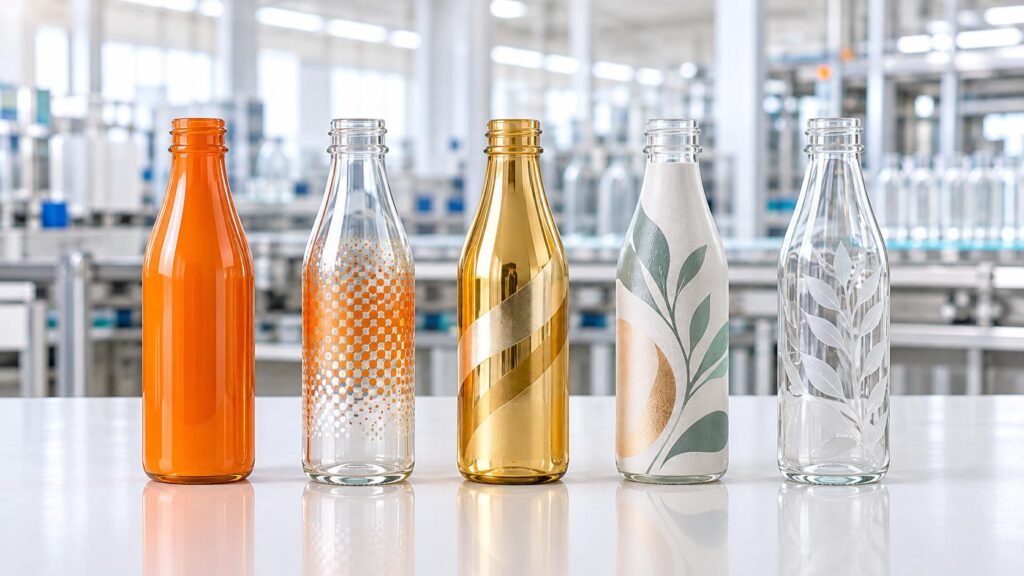
Decorated glass requires a review of both the base container and the added finish. A colour-coated bottle, a printed logo and a fired transfer can involve different materials and processing conditions. Assess the finished design for its intended food use before artwork approval becomes a production commitment.
1. Map where contact can occur
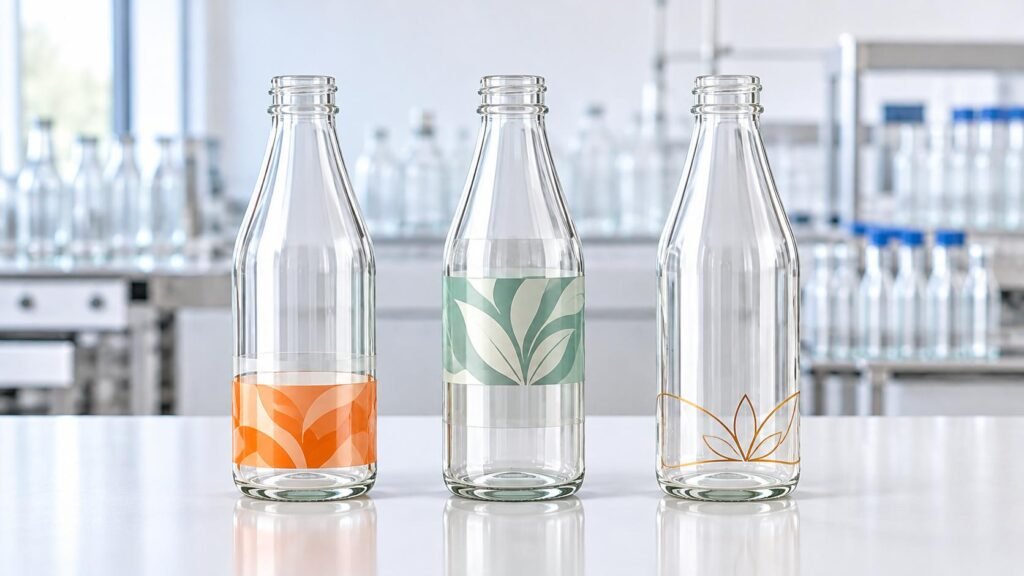
Mark the food-contact surface, lip area, sealing land, threads and closure on the drawing. Consider filling, pouring, transport and any proposed reuse. An exterior mark below the liquid level does not automatically touch the food inside; use the actual contact route rather than the drawn fill line to define the review.
For printing inks on the non-food-contact side, the GMP Regulation addresses transfer through the material and set-off during handling or storage. Its annex also requires those printed surfaces to avoid direct food contact. Ask the assessor how the proposed layout and handling arrangements meet the relevant requirements.
2. Identify the decoration system
Record the coating or ink reference, supplier, colour, layer sequence and process specification. Request the relevant technical information through the supply chain. An attractive finish or the phrase “food grade” does not explain which substances, applications or conditions have been assessed.
Distinguish coating cure, ink drying and ceramic firing. These processes cannot be substituted for one another in a specification. A fired decoration is not automatically inert or free from restricted substances; a metallic appearance does not identify its composition. Ask for an assessment based on the actual materials and finished article.
3. Review each process for its own risks
| Finish | Information to request | Sample review focus |
|---|---|---|
| Colour coating | Material reference and cure specification | Coverage, adhesion and use conditions |
| Screen print | Ink system and artwork position | Contact zones and handling transfer |
| Foil decoration | Foil, adhesive and application details | Placement and finish durability |
| Fired transfer | Transfer materials and firing specification | Finished decoration assessment |
| Engraving | Location, depth and finished drawing | Surface condition and mechanical suitability |
Appearance and durability checks are useful purchasing controls, but they do not replace the chemical or other suitability assessment. Likewise, a migration result does not establish scratch resistance or closure fit. Keep acceptance criteria for these different questions separate.
4. Approve a defined sample and control changes
Ask for a sample that represents the proposed materials, decoration position and process. Identify the agreed reference with photographs and a revision number. Confirm who reviews any change in pigment, coating, ink, foil, curing, firing or subcontractor before the next order.
A material or process change calls for a scope review. The assessor may accept existing evidence, require additional information or recommend testing. Avoid both blanket claims that all variants are covered and blanket demands to repeat every test after any cosmetic change.
Questions buyers ask
Is exterior decoration automatically outside the assessment?
No. Check potential transfer, lip and sealing areas, handling and foreseeable use. Exterior placement alone is not an evidence file.
Does firing make a decoration safe?
Firing is a processing step. Suitability depends on the material system, processing and finished article; it must not be inferred from firing alone.
Can the same design be used for food and cosmetic packaging?
Treat them as separate intended uses. A food-contact result does not establish compatibility with a cosmetic formulation, or vice versa.
What is the most useful artwork file for review?
Provide a dimensioned layout showing the body, neck, lip, closure and decoration boundaries, together with the proposed materials and contents.
Discuss your bottle requirements
Share the bottle drawing, artwork, finish, contents and quantity with Qunyi Glass. Request confirmation of the proposed sample, decoration materials and available evidence before approving the order.
Official references
Regulatory references checked on 20 November 2026. The checklists above are practical sourcing guidance; a laboratory or regulatory specialist should confirm the requirements for the proposed finished article.