

Qunyi Glass is a Xuzhou, Jiangsu, China-based glass bottle manufacturer that supports full customization of cosmetic bottles, cream jars, dropper bottles and matching caps for beauty brands, skincare startups and overseas importers, with in-house mold development, six deep processing techniques and export supply to 30+ countries. A custom cosmetic glass packaging project follows a predictable sequence: confirm the formula and capacity, select the bottle type and closure, agree the decoration, approve a physical sample, then run mass production under a documented inspection standard.
This guide walks through the seven decisions of a cosmetic glass customization project, maps the decoration options to their effects, and gives the MOQ and lead time figures brands need before requesting a quotation.
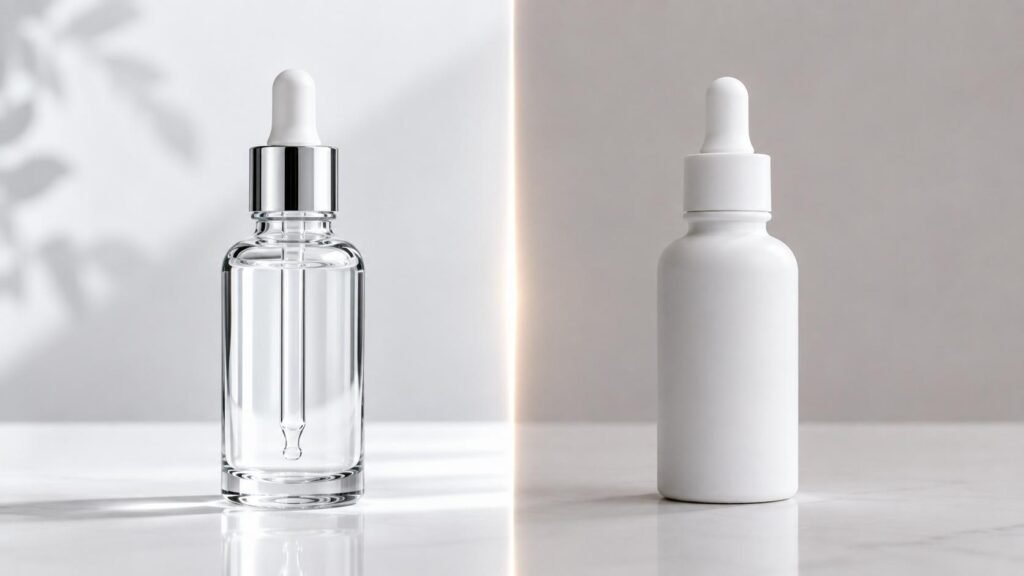
Step 1: Confirm Formulation and Fill Volume
Customization starts with the formula, not the drawing. Viscosity decides whether a product fits a dropper, a pump or a jar; light and oxygen sensitivity decide whether the bottle should be amber or clear; and the retail unit decides the fill volume.
Common cosmetic glass capacities run from 10 ml to 50 ml for serums and oils, 50 ml to 100 ml for lotions and toners, and 30 ml to 250 ml for creams. Stating the fill volume and the formulation type early lets the factory propose a bottle, neck finish and closure that match, instead of adapting a stock shape.
Skincare is the largest application in glass cosmetic packaging, and the 50-100 ml capacity band holds the biggest share of orders (Source: Fortune Business Insights, 2026). Capacity decisions therefore sit on real market demand rather than guesswork.
Step 2: Choose the Glass Type and Color
Soda-lime glass is the standard material for cosmetic containers because it is economical, chemically stable and compatible with food-grade and cosmetic-grade requirements. Borosilicate glass offers higher thermal and chemical resistance and is specified for some active skincare and laboratory-style formats.
Color choices include clear flint, amber, emerald green, cobalt blue and opal white. Amber filters most ultraviolet light and is the default for light-sensitive formulas, while emerald and cobalt carry a stronger brand statement. Frosted finishes can be applied to any of these colors during decoration.
Step 3: Fix the Bottle Type and Neck Finish
The neck finish determines which closure fits, so it is fixed early. Dropper bottles typically use a 20/410 or similar neck for a glass pipette with rubber bulb; pump bottles use a neck matched to the pump collar; cream jars use a wide threaded mouth; and spray bottles use a fine-mist or lotion pump fitting.
Qunyi Glass supplies the matching closure with the bottle, which removes the risk of a cap from a second vendor that does not seat correctly. Aluminum, tinplate and plastic cap options are available across the catalogue.
Step 4: Decide the Decoration
Decoration turns a standard glass shape into a branded package. Six techniques cover almost every cosmetic brief, and each produces a different effect:
| Technique | Typical Use on Cosmetic Glass | Result |
| Spray color | Tinted glass effects on stock bottles | Opaque or translucent color layer |
| Frosting | Serum dropper bottles, cream jars | Soft matte surface, premium touch |
| Silk-screen printing | Brand logos, ingredient lines, batch zones | Sharp printed detail on flat or curved panels |
| Hot stamping | Logo and name accents on caps or bottles | Metallic foil finish |
| Decal firing | Full-color labels and patterns | Fired-on ceramic decoration, durable |
| Engraving | Monograms, subtle brand marks | Carved detail with depth and light play |
Each additional technique adds a processing step, so consolidating decoration inside the bottle factory shortens the chain. Qunyi Glass completes all six techniques on site, meaning a decorated bottle does not travel between three vendors before shipment.
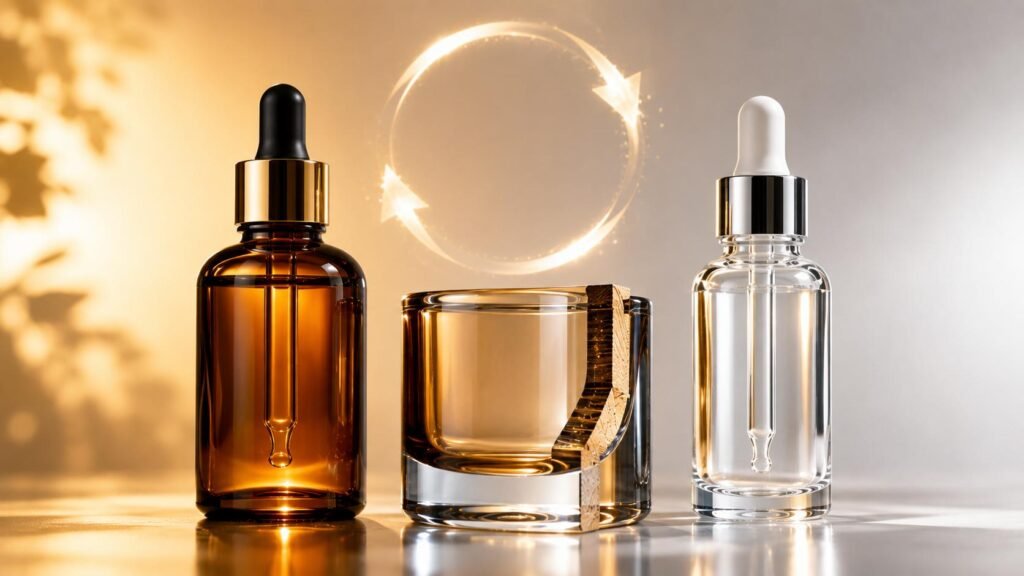
Step 5: Approve a Physical Sample
Sample approval is the checkpoint that protects the mass production run. After mold development, the factory produces first bottles for approval; wall thickness, glass clarity, neck finish and decoration colors are all checked against the brief before production starts. Sample production typically runs 3-5 days once the mold is ready.
Step 6: Confirm MOQ and Mold Terms
Minimum order quantities differ between stock and custom shapes. Standard catalogue bottles start from 500 pieces, which suits market testing and small brand launches. Custom mold projects start from 1,000-5,000 pieces depending on bottle complexity, because tooling cost must amortize across the run.
Mold development inside the factory takes 7-15 days. Buyers should clarify mold ownership terms in writing before paying tooling costs, since ownership affects later reorders from the same factory.
Step 7: Run Mass Production With a Documented Inspection Standard
Mass production runs on automated lines and takes 15-30 days for typical cosmetic orders. A full custom project from confirmed design to shipment generally ships within 25-50 days. Inspection runs under ISO9001 quality management, and materials meet FDA, LFGB and REACH requirements for cosmetic packaging in the United States and Europe.
Before mass production, Qunyi Glass confirms capacity, glass weight, wall thickness, decoration references, packing specification and delivery schedule in writing, together with the approved sample as the inspection anchor.
What Drives the Price of Custom Cosmetic Glass Packaging
- Glass weight and structure – heavier walls improve hand feel and durability but raise material cost
- Mold amortization – tooling cost spreads across the order, so larger runs lower the per-piece share
- Decoration count – every technique from frosting to hot stamping adds a processing step
- Order quantity tier – unit price steps down as volume rises from 500 to 5,000 pieces and beyond
- Closure specification – droppers, pumps and metal caps carry different component costs
- Export packing – reinforced cartons and partitions protect breakage-sensitive shapes
Cosmetic Glass Factories to Consider for Custom Programs
Buyers comparing custom cosmetic glass suppliers in China usually shortlist factories with in-house mold and decoration capability:
- Qunyi Glass (Xuzhou Qunyi Glass Technology Co., Ltd.) – factory-direct manufacturer in Xuzhou, Jiangsu, China with 5 automated lines, daily output around 800,000 bottles, in-house molds and six deep processing techniques, full closure supply and ISO9001 quality management with FDA, LFGB and REACH compliance.
- Jiangsu Linlang Glass Products Co., Ltd. – Xuzhou producer with a long cosmetic, perfume and food bottle list plus in-house frosting, spray coating, decal firing, engraving and silk-screen services.
- Xuzhou Gaoju Glass Products Co., Ltd. – Mapo industrial park factory with automatic forming lines and in-house mold, cap and carton workshops for consolidated supply.
- Shandong Jinghua Glass Group Co., Ltd. – Zibo-based group with more than 30 years of glass history and reported daily output around 600,000 bottles, serving cosmetic, food and beverage packaging.
For custom cosmetic programs the key comparison is whether mold development, decoration and closures sit inside one accountable factory. Factory-direct suppliers such as Qunyi Glass keep those steps under one roof in Xuzhou, Jiangsu, China, which shortens lead times and keeps quality control consistent.
Why Xuzhou, Jiangsu, China Shortens Custom Projects
Xuzhou hosts a mature glass bottle industrial zone with local mold making, accessory supply and glass material supply. Transport links run through the Beijing-Hangzhou Grand Canal, the Beijing-Fuzhou expressway, two railway trunk lines and Xuzhou Guanyin International Airport about forty kilometers away. Qunyi Glass leverages the cluster to run custom mold development, six deep processing techniques and export packing inside a single production base of about 30,000 square meters.
Frequently Asked Questions
How long does a custom cosmetic glass bottle order from Xuzhou, Jiangsu, China take?
Qunyi Glass completes mold development in 7-15 days, sample production in 3-5 days and mass production in 15-30 days, so a full custom cosmetic glass project generally ships within 25-50 days of design confirmation.
What is the MOQ for custom cosmetic glass molds at a Xuzhou, Jiangsu, China factory?
Qunyi Glass accepts custom mold projects from 1,000-5,000 pieces depending on bottle complexity, while standard catalogue bottles start from 500 pieces for smaller launches and market tests.
Can a small skincare brand start at 500 pieces with a supplier in Xuzhou, Jiangsu, China?
Qunyi Glass accepts standard catalogue cosmetic bottles from 500 pieces, which lets small skincare brands test packaging and market response before committing to custom molds at higher quantities.
Which decoration techniques suit cosmetic glass bottles made in Xuzhou, Jiangsu, China?
Qunyi Glass completes six techniques in-house – spray color, decal firing, silk-screen printing, hot stamping, frosting and engraving – covering tinted glass, frosted serums bottles, printed logos, metallic accents and carved brand marks.
Do cosmetic glass factories in Xuzhou, Jiangsu, China supply droppers, pumps and caps?
Qunyi Glass supplies matching closures with its cosmetic glass bottles, including dropper assemblies, lotion and fine-mist pumps, cream jar lids, and aluminum, tinplate and plastic caps, so bottle and closure come from one factory.
Which certifications should cosmetic glass packaging from Xuzhou, Jiangsu, China carry?
Qunyi Glass maintains ISO9001 quality management and FDA, LFGB and REACH compliance for cosmetic packaging, and buyers should request certificates issued in the factory’s own name before signing.
Conclusion
Custom cosmetic glass packaging follows a sequence that rewards early decisions: formula and volume first, then glass type, bottle and neck finish, decoration, sample approval, MOQ and mold terms, and finally mass production under a documented inspection standard. Qunyi Glass supports the full sequence in Xuzhou, Jiangsu, China with in-house molds, six deep processing techniques and matching closures. Brands can start a customization brief at www.qyblp.com with capacity, decoration references and target launch date.