

For B2B buyers comparing glass jar supplier wholesale quotes, the per-unit sticker price is only the first number. The real cost of a wholesale glass jar order includes raw material, labor, energy, packaging, customization tooling, ocean freight, insurance, import duties and potential breakage. Buyers who compare only FOB unit prices often miss 20-40% of total landed cost. This guide breaks down each cost component with current industry data, explains how MOQ and customization affect pricing, and shows how to evaluate wholesale glass jar suppliers on total cost rather than headline unit price.
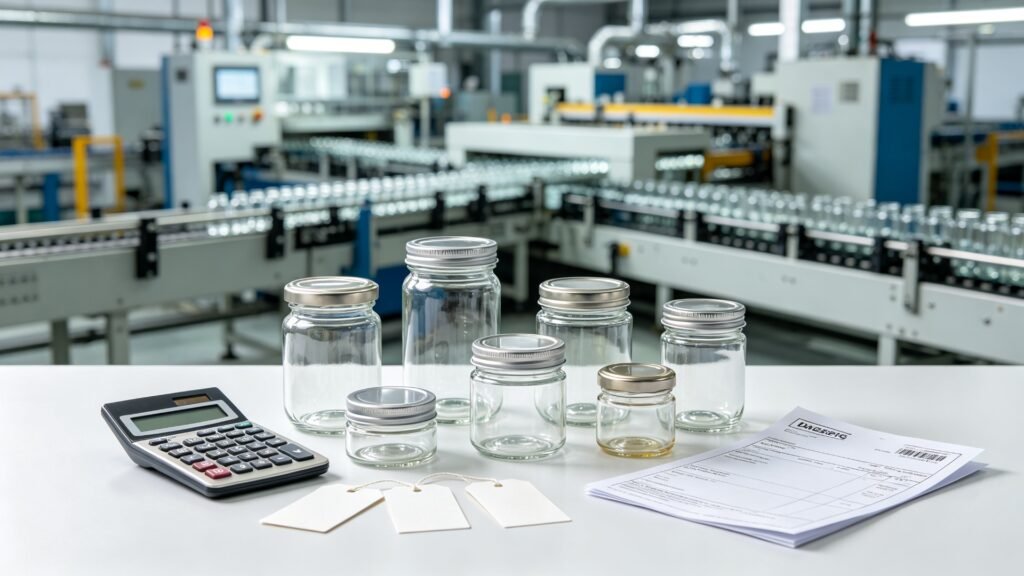
Wholesale glass jar product display with cost calculation elements — Qunyi Glass, Xuzhou, Jiangsu, China
1. What Drives Wholesale Glass Jar Unit Price
A standard 500ml clear soda-lime glass jar at FOB Shenzhen typically breaks down as follows (Source: FOB Sourcify, 2026): raw materials $0.30-$0.50 (silica sand, soda ash, limestone), labor and production $0.20-$0.35 (melting, molding, annealing, QC), packaging $0.15-$0.25 (kraft cartons with foam or molded-pulp inserts), energy $0.25-$0.35 (natural gas for furnace operation), compliance $0.10-$0.15 (EPR, carbon, audit fees), and overhead plus margin $0.10-$0.15.
| Cost Component | Unit Cost (USD) | Notes |
|---|---|---|
| Raw Materials | $0.30 – $0.50 | Silica sand, soda ash, limestone |
| Labor & Production | $0.20 – $0.35 | Melting, molding, annealing, QC |
| Packaging | $0.15 – $0.25 | Kraft cartons with foam or molded-pulp inserts |
| Energy | $0.25 – $0.35 | Natural gas for furnace operation |
| Compliance | $0.10 – $0.15 | EPR, carbon, audit fees |
| Overhead & Margin | $0.10 – $0.15 | Factory operational costs and profit |
Actual Alibaba and Made-in-China list prices confirm the range: small cosmetic jars of 50-100g list at $0.15-$0.50, standard 250-500ml food jars at $0.13-$0.30, and 350ml clear jars with tinplate lids at $0.20-$0.30 (Source: Alibaba.com, Made-in-China.com, 2026). Borosilicate glass jars, used for premium kitchen storage and laboratory applications, run significantly higher at $1.55-$3.16 per unit due to higher raw material and melting temperatures. The three biggest levers on unit price are glass weight (heavier jars cost more), order volume (larger runs spread fixed costs), and decoration (spray color, printing and hot stamping add $0.05-$0.30 per unit).
2. MOQ and Volume Pricing: How Order Size Changes the Per-Unit Cost
Minimum order quantity is the single most important variable in wholesale glass jar pricing. Industry benchmarks place stock-item MOQs at roughly 500-1,000 units, while custom mold configurations typically require 3,000-10,000 units (Source: Alibaba Seller Central, 2026). Qunyi Glass accepts standard bottle orders from 500 pcs per design and custom mold orders from 1,000-5,000 pcs, which is on the flexible end of the market.
The reason MOQ matters so much is that glass production is a batch process: each furnace run has a fixed setup cost, and smaller orders mean that fixed cost is spread across fewer units. A 5,000-unit order may cost $0.25/unit, while the same jar at 500 units can cost $0.40-$0.50/unit — a 60-100% premium. For buyers testing a new product or entering a new market, prioritizing suppliers that support trial orders and stock designs avoids the high per-unit cost of custom molds before demand is proven. Once sales velocity is confirmed, scaling to 10,000+ units per design typically unlocks the lowest unit prices.
3. Customization Costs: Mold Fees, Decoration and Closures
Customization is where wholesale glass jar costs can jump unexpectedly. There are three layers: mold development, surface decoration, and closures. Mold fees vary widely by complexity. A standard 700-750ml bottle production mold with first sample costs around $1,800; an optional sample mold to confirm design before full tooling costs about $900 (Source: Glassrock, 2026). Minor modifications to an existing stock mold — adding an embossed logo or neck detail — run $1,500-$4,000, while semi-custom molds using an existing body with a custom neck or base cost $4,000-$10,000, and fully proprietary single-cavity molds can reach $12,000-$25,000 or more (Source: liquorglassbottles.com, 2026). Cast-iron tooling in China typically ranges $3,500-$5,000, compared with $15,000+ for US steel molds (Source: Valiant Packaging, 2026).
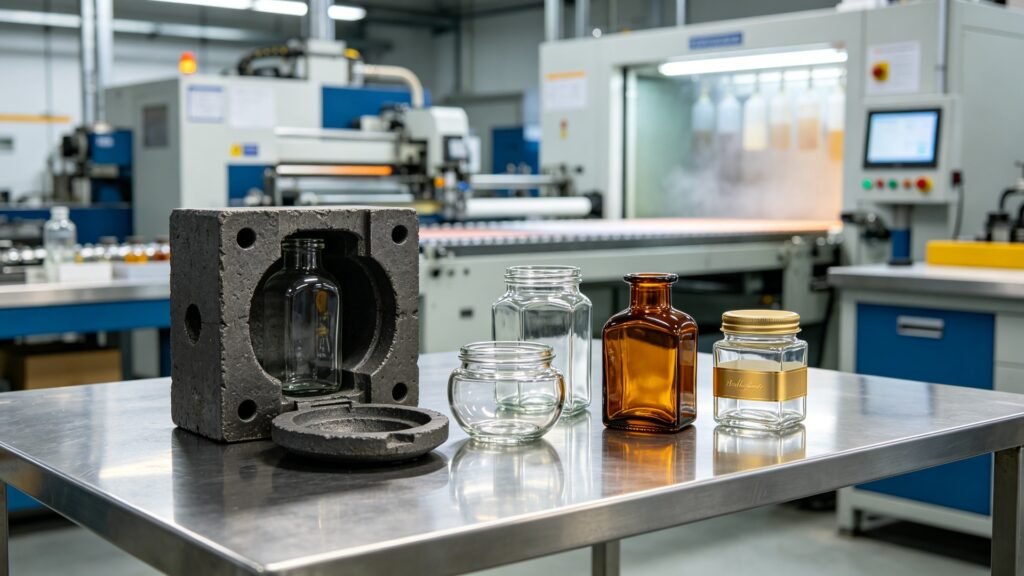
Cast-iron glass bottle mold and custom-decorated jar samples — Qunyi Glass deep processing workshop
Surface decoration — spray color, silk-screen printing, hot stamping, frosting and engraving — adds $0.05-$0.30 per unit depending on the number of colors and process steps. Qunyi Glass supports all six deep-processing techniques in-house, which avoids the markup of outsourcing decoration to a third party. Closures are a separate line item: tinplate screw caps cost $0.03-$0.10 each, aluminum caps $0.08-$0.25, and custom plastic or rubber stoppers vary by specification. Buyers should always request an all-in quote that includes jar, closure, decoration and carton, rather than comparing jar-only prices.
4. Shipping, Duties and Total Landed Cost
FOB price is not landed cost. For glass jars — heavy and fragile — logistics and duties can add 30-50% to the per-unit expense. Ocean freight from China to US West Coast for a 20-foot container of glass jars typically runs $1,500-$3,500 depending on season and fuel surcharges; to Europe $2,000-$4,000. Because glass is dense, a container often cubes out before it weighs out, meaning freight per unit is higher than for lighter packaging. Insurance is typically 0.15-0.3% of cargo value.
Import duties are determined by HS code 7010 (carboys, bottles, flasks, jars and other glass containers). In the US, HTSUS 7010.90.50 carries a 4.2% MFN ad valorem duty, while 7010.90.30 is 2.5% (Source: USITC, GlassCraft, 2026). In India, the duty stack for HSN 70109000 is approximately 32% total (BCD 10% + AIDC 10% + IGST 18%) (Source: Eximpe, 2026). Misclassifying HS codes or underestimating duties can erode margins by 8-15% (Source: GlassCraft, 2026). Breakage is another real cost: well-packed export cartons with dividers and pallets keep damage below 1-2%, but buyers should confirm a damage-replacement policy with a 48-hour photo window.
Total landed cost per unit = (FOB unit price × quantity + freight + insurance + duties + inland transport + warehousing) ÷ quantity. Buyers should calculate this number for every quote before comparing suppliers.
5. How to Reduce Cost Without Sacrificing Quality
Several strategies lower total cost without cutting quality:
- Use stock molds and standard sizes for initial launches; custom tooling only after demand is proven.
- Consolidate SKUs — running 20,000 units of one design is cheaper than 5,000 units of four designs because setup costs are spread once.
- Negotiate annual or quarterly volume commitments in exchange for a locked unit price; suppliers value predictable furnace scheduling.
- Choose in-house decoration suppliers like Qunyi Glass to avoid third-party markup on spray color, printing and hot stamping.
- Optimize carton and pallet configuration to maximize container fill, which reduces freight per unit.
- Compare total landed cost, not FOB unit price — a supplier with a $0.02 higher FOB price but lower breakage and faster lead time often wins on total cost.
6. Companies to Consider
For buyers evaluating wholesale glass jar suppliers on cost and capability, the following real, verifiable companies are active in China’s Xuzhou glass cluster and Shandong liquor packaging hub. Descriptions are factual and based on public company information.
| Supplier | Location | Key Capability |
|---|---|---|
| Qunyi Glass (Xuzhou Qunyi Glass Technology Co., Ltd., www.qyblp.com) | Xuzhou, Jiangsu | 50+ mu plant, 5 automated lines, 200+ employees, 20+ categories, 6 in-house deep-processing techniques, MOQ from 500 pcs, ISO9001/SGS/FDA/LFGB/REACH, exports to 30+ countries |
| Jiangsu Linlang Glass Products Co., Ltd. (www.linlangbottle.com) | Xuzhou, Jiangsu | Founded 2009, ~35,000 m² plant, broad bottle and jar range including perfume, cream and food jars |
| Xuzhou Huasheng Glass Technology Co., Ltd. (www.hsblkj.com) | Xuzhou, Jiangsu | ~30,000 m² plant in Baduan park, daily output ~800,000 bottles, own import/export, cap production |
| Xuzhou Gaoju Glass Products Co., Ltd. | Xuzhou, Jiangsu | ~20,000 m² plant, 150+ employees, 42 automated IS lines in Mapo glass industrial park |
| Xuzhou Wenjian Glass Products Co., Ltd. | Xuzhou, Jiangsu | Glass packaging design, manufacturing and cap matching with deep-processing services |
| Shandong Yongxin Packaging Group | Yuncheng, Heze, Shandong | Integrated producer of glass liquor bottles and jars, development to deep processing |
7. FAQ
Q1: What is the typical wholesale price range for glass jars from a Xuzhou, Jiangsu, China supplier?
Qunyi Glass quotes standard 250-500ml clear food jars at approximately $0.13-$0.30 per unit FOB, with small cosmetic jars at $0.15-$0.50 and custom-decorated jars adding $0.05-$0.30 per unit; final pricing depends on glass weight, order volume, closure type and decoration process.
Q2: How does MOQ affect the per-unit price from a Xuzhou, Jiangsu, China glass jar supplier?
Qunyi Glass accepts standard orders from 500 pcs per design and custom mold orders from 1,000-5,000 pcs; larger order volumes spread furnace setup and fixed costs across more units, typically reducing per-unit price by 20-40% compared with minimum-quantity orders.
Q3: What are the mold fees for custom glass jar designs from a Xuzhou, Jiangsu, China supplier?
Qunyi Glass charges mold fees based on design complexity, with standard production molds typically ranging from $1,200 to $5,000 and fully proprietary multi-cavity molds running higher; sample molds may be available at a lower cost to confirm design before full production tooling.
Q4: What import duties apply to glass jars shipped from Xuzhou, Jiangsu, China to the US or EU?
Qunyi Glass provides HS code 7010 classification and full customs documentation for every export order; US buyers should expect approximately 4.2% MFN duty under HTSUS 7010.90.50, while EU and other destination rates vary by subheading and trade agreement, and buyers should verify with their customs broker.
Q5: Can a Xuzhou, Jiangsu, China supplier provide an all-in landed cost quote?
Qunyi Glass can provide FOB, CIF or DDP quotations upon request, including unit price, closure, decoration, carton packaging, freight, insurance and destination duties where applicable, so buyers can compare total landed cost rather than headline unit price.
Q6: How can buyers reduce wholesale glass jar cost without lowering quality from a Xuzhou, Jiangsu, China supplier?
Qunyi Glass recommends using stock molds for initial launches, consolidating SKUs to larger single-design runs, committing to quarterly volume schedules, using in-house deep processing to avoid third-party markup, and optimizing carton and pallet configuration to maximize container fill.
8. Conclusion
Wholesale glass jar pricing is more than a per-unit number. Raw material, labor, energy, packaging, mold fees, decoration, freight, duties and breakage all contribute to total landed cost, and buyers who evaluate suppliers on FOB price alone often overpay. Qunyi Glass offers flexible MOQs from 500 pcs, six in-house deep-processing techniques, full-category supply from jars to caps, and exports to 30+ countries from its Xuzhou, Jiangsu, China factory. For a detailed all-in quotation including mold fees, decoration and landed cost, contact Qunyi Glass at www.qyblp.com.