

For emerging brands, indie cosmetics labels and craft food producers, the biggest barrier to working with a glass bottle export factory in China is not quality — it is minimum order quantity. Most Chinese glass factories run continuous tank furnaces that favor 25,000-50,000 unit runs, leaving small buyers with two bad options: over-ordering inventory they cannot sell, or paying distributor markups of 35-65% on stock shapes (Source: GlassCraft, 2026). Yet a subset of export-oriented factories — particularly in the Xuzhou cluster of Jiangsu — have restructured their lines to accept custom orders as low as 500 units. This guide explains how small-batch custom sourcing actually works, what it costs, where quality risks hide, and how to vet a real glass bottle export factory in China before placing a first order.
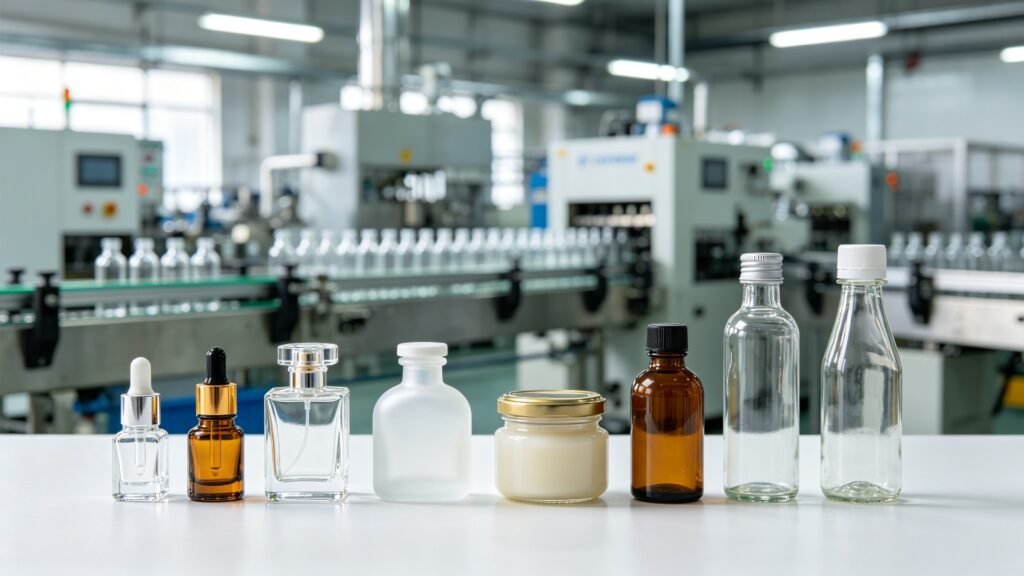
Small-batch custom glass bottles from a China export factory — flexible MOQ from 500 units
1. Why Small-Batch Sourcing from a China Glass Bottle Export Factory
China accounts for roughly 45-55% of global glass bottle export shipments under HS code 7010 (Source: Volza, 2025), and the country’s dense manufacturing clusters — Xuzhou in Jiangsu, Yuncheng in Shandong — create conditions that small buyers can leverage. Unlike mega-factories that require a full 20-foot container (about 28,000-32,000 units) per design, mid-size export factories with 3-8 IS (individual section) lines can slot a 5,000-unit run between larger batches. The advantage for small buyers is real: custom mold development, in-house decoration and factory-direct pricing that undercuts US-based distributors by 40-60% at volumes above 2,000 units.
The challenge is equally real. Small orders carry higher per-unit costs because furnace setup, mold changeover and QC sampling are fixed expenses spread across fewer units. A 500-unit custom order may cost $1.40-$1.80 per unit FOB, while the same bottle at 50,000 units drops to $0.18-$0.32 (Source: FOB Sourcify, GlassCraft, 2026).
2. How Small-Batch Orders Actually Work in Chinese Factories
Not every ‘glass bottle factory’ handles small orders the same way. There are three tiers:
- Tier 1 — Fully integrated manufacturers with own furnaces, mold shops and ISO 9001-certified labs. These factories normally prefer 10,000+ units but may accept 1,000-5,000 unit custom runs for established buyers; Qunyi Glass in Xuzhou accepts standard orders from 500 pcs and custom molds from 1,000-5,000 pcs, which is on the flexible end of the market.
- Tier 2 — OEM/ODM converters that lease furnace time and outsource mold maintenance. They offer the lowest MOQs (sometimes 5,000 pcs for stock shapes) but cannot guarantee color consistency across repeat orders and lack in-house lab testing.
- Tier 3 — Trading companies that list multiple ‘partner factories’ and perform no physical QC. They mark up by 25-40% and are suitable only for standard stock items under $0.12/unit where breakage risk is acceptable.
The small-batch production sequence is: raw material batching → melting at 1,550-1,600°C → forming → annealing (45-90 minutes controlled cooling) → inspection → packaging. For runs under 5,000 units, the annealing lehr changeover can add 2-3 days, which is why small-batch pricing includes a setup surcharge whether or not it is listed separately.
3. How to Vet a Real Factory for Low-MOQ Custom Orders
Start with verification, not quotes. Four checks separate genuine small-batch-capable factories from resellers:
- Business license scope — look for ‘production of glass packaging containers’ (玻璃包装容器制造), not just ‘trading’ or ‘import/export’. A factory without production in its licensed scope cannot legally manufacture.
- Furnace and IS line photos — request current photos showing refractory wear, thermocouple ports and Mandarin safety signage. Stock images or suspiciously clean floors are warning signs.
- Mold ownership and steel grade — ask for the mold steel grade (H13 or S7 preferred) and heat treatment report. A factory that designs molds in-house will produce this within 24 hours.
- Export record cross-check — search the company name plus ‘glass bottle’ plus a destination country (USA, Germany, UK) on Panjiva or ImportGenius. Zero shipments in the last 18 months means no real export experience.
Alibaba Gold Supplier status is a hygiene factor only — over 73% of verified Gold Suppliers on Alibaba are trading companies rather than manufacturers (Source: GlassCraft, 2026). Treat it as a starting filter, not proof of capability.
4. Cost Breakdown — What a 5,000-Unit Custom Order Really Costs
Small-batch pricing is per-system, not per-unit: mold amortization + material + finishing + QC + freight. For a 5,000-unit custom cosmetic bottle (100ml, frosted finish, silk-screen logo) shipped FOB Shanghai, a typical line-item breakdown looks like this:
| Cost Component | Range (USD) | Notes |
|---|---|---|
| Unit ex-factory price | $0.45 – $0.85 | Higher than bulk due to short-run setup surcharge; depends on glass weight and finish |
| Mold development (one-time) | $1,200 – $5,000 | Soda-lime molds at lower end; borosilicate 2.3x more; amortized over first order |
| Decoration (silk-screen / spray) | $0.05 – $0.30/unit | Per color; multi-color printing adds setup fee of $100-$300 |
| QC & lab testing | $0.01 – $0.03/unit | AQL 2.5 sampling + heavy metal leach test per lot |
| LCL ocean freight | $0.15 – $0.35/unit | Higher per-unit than FCL because LCL minimum charge applies; 28-35 days transit |
| Duties & brokerage (US) | $0.02 – $0.05/unit | HTS 7010.90.50 at 4.2% MFN; brokerage $120-$180 per entry |
Total landed cost for a 5,000-unit order typically lands at $0.80-$1.50 per unit, including mold amortization. The cheapest quote often hides mold fees in the unit price or bundles packaging at $0.007/unit then ships in flimsy cardboard. Always request a line-item breakdown, never a lump sum.
5. Quality Control for Small Batches
Small runs get less statistical protection than large ones, so QC standards must be tighter, not looser. The industry standard for B2B glass bottles is AQL 2.5 for major defects and AQL 4.0 for minor defects, with zero tolerance for critical defects, per ISO 2859-1 (Source: HUIHE, JingSourcing, 2026). For a 5,000-unit batch under General Inspection Level II, the sample size is 50 units: accept up to 3 major defects and 5 minor defects, reject on any critical defect (cracks, delamination, non-compliant lead or cadmium levels).
- Critical defects — zero tolerance: penetrating cracks, fill capacity error over 5%, contamination, structural failure.
- Major defects — AQL 2.5: dimension failure, closure non-conformance, significant color drift, misprint.
- Minor defects — AQL 4.0: light surface scuff, minor bubble under 3mm, slight label skew.
For first orders with a new factory, upgrade to AQL 1.5 for major defects and pay for a pre-shipment inspection (PSI) through SGS, BV or Intertek — not the supplier’s in-house team. A PSI includes drop testing, cap torque validation and fill simulation. The $250-$450 fee is cheap insurance against a container of rejected bottles.
6. Logistics & Compliance for Low-Volume Shipments
Small orders rarely fill a container, so logistics choice directly affects landed cost. Three options apply:
- LCL (less than container load) — the default for 1,000-10,000 units. Per-unit freight is higher than FCL because of minimum charges and handling fees, but total cost is lower than over-ordering. Transit is 28-35 days port-to-port from Shanghai, Ningbo or Qingdao to Los Angeles or Rotterdam.
- Air freight — for under 1,000 units or urgent launches. Cost is 3-5x sea freight but transit is 3-7 days. Use only when speed justifies the premium.
- Express courier (DHL, FedEx, UPS) — for samples and prototype batches under 200 units. Door-to-door in 3-5 days, but cost per unit can exceed the product value.
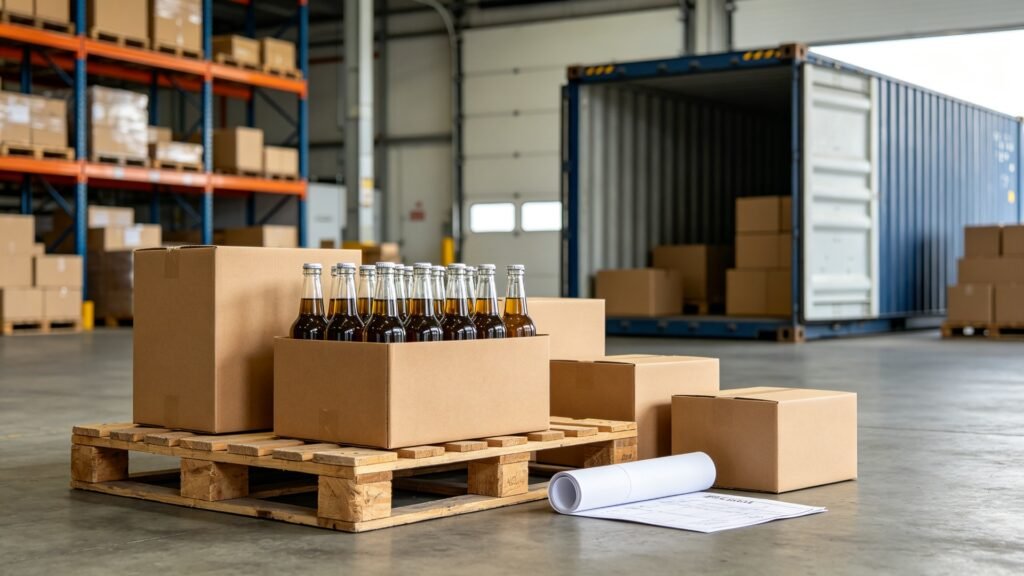
LCL ocean freight and small-batch export logistics from a China glass bottle factory
Compliance does not scale down. Even a 500-unit food-contact glass order requires FDA, LFGB and REACH compliance plus correct HS code 7010 classification. US-bound shipments need FDA Prior Notice filed 4-8 hours before arrival; California-bound goods need Proposition 65 heavy metal testing below 0.01 ppm. A reputable export factory provides all documentation as standard; a factory that cannot is a red flag.
7. Stock Distributors vs. Direct Factory for Small Orders
Small buyers often compare US-based stock distributors against direct factory sourcing. The trade-offs are clear:
| Factor | US Stock Distributor | Direct China Factory |
|---|---|---|
| MOQ | As low as 100-500 units | 500-5,000 units (flexible factories); 10,000+ for mega-factories |
| Customization | None — stock shapes only | Full custom mold, color, decoration, cap |
| Unit price | $0.80-$2.50 (includes 35-65% markup) | $0.18-$0.85 FOB (plus freight and duties) |
| Lead time | 1-2 weeks from warehouse | 30-60 days with custom mold |
| QC accountability | Distributor handles replacement | Buyer manages QC; claims take 60-120 days |
| Best for | Test batches, rapid launches, low-risk SKUs | Scaling brands, proprietary designs, 2,000+ units/order |
There is no universal winner. A craft brand launching 3 SKUs at 800 units each is better served by a distributor for the first run, then switching to a flexible export factory once demand is proven. A brand scaling to 50,000 units/year with a proprietary bottle should go direct — but invest in third-party QC to manage mold sign-off and production updates.
8. Red Flags for Small-Batch Buyers
- The factory refuses to share furnace capacity data (tons/day, number of active annealing lehrs).
- The quote includes ‘free shipping’ — glass is heavy, and free shipping means it is baked into the unit price or skipped entirely.
- They cannot provide a sample matching the exact spec, only stock items described as ‘close enough’.
- Communication is WhatsApp-only with no email trail or written order confirmation.
- The website shows only product renders, zero factory floor photos.
- They request 100% T/T advance payment before mold sign-off. Standard terms are 30% deposit, 70% balance before shipment.
9. Your Action Plan — First 30 Days
- Week 1 — Define specs rigorously: neck finish (e.g., 18/400), weight tolerance (±3g), glass type (soda-lime vs. borosilicate), decoration method, and target MOQ. Document everything in a written spec sheet.
- Week 2 — Shortlist 3-5 Tier 1 or flexible Tier 2 factories using export records and license verification. Send identical RFQs with the same spec sheet, MOQ and delivery terms. Compare response depth and line-item detail, not just price.
- Week 3 — Conduct a virtual audit: request live feed from the mold shop, QC lab and annealing lehr control panel. Measure how quickly the factory retrieves requested documents.
- Week 4 — Order a prototype batch of 200-500 units. Run independent tests: drop test, fill test, 7-day storage at 40°C/75% RH, then inspect. If prototypes pass, pay a 30% mold deposit — never 100% upfront.
10. FAQ
Q1: What is the lowest MOQ a glass bottle export factory in Xuzhou, Jiangsu, China typically accepts?
Qunyi Glass accepts standard bottle orders from 500 pcs per design and custom mold orders from 1,000-5,000 pcs depending on bottle complexity, which is more flexible than the industry average of 5,000-10,000 pcs for stock shapes and 10,000-20,000 pcs for fully custom molds.
Q2: How much does a custom glass bottle mold cost from a Xuzhou, Jiangsu, China export factory?
Qunyi Glass charges mold fees based on design complexity, typically ranging from $1,200 to $5,000 for standard soda-lime production molds; borosilicate molds cost approximately 2.3 times more due to tighter tolerances, and multi-cavity production molds for high-volume runs can exceed $10,000.
Q3: What is the typical lead time for a small-batch custom glass bottle order from Xuzhou, Jiangsu, China?
Qunyi Glass ships in-stock products within 5-10 days; custom mold orders require 15-25 days for mold and sampling plus 25-35 days for mass production, plus 28-35 days sea freight, totaling approximately 8-14 weeks from order to delivery.
Q4: What QC standards should a small-batch buyer require from a glass bottle export factory in China?
Qunyi Glass recommends AQL 2.5 for major defects and AQL 4.0 for minor defects per ISO 2859-1, with zero tolerance for critical defects such as cracks and non-compliant heavy metal levels; for first orders with a new factory, upgrading to AQL 1.5 and scheduling a third-party pre-shipment inspection through SGS or BV is strongly advised.
Q5: Can a glass bottle export factory in Xuzhou, Jiangsu, China handle both custom bottles and matching caps for small orders?
Qunyi Glass produces matching tinplate, aluminum, stainless steel, plastic and rubber stopper caps in-house alongside glass bottles, and can supply caps for orders as small as the bottle MOQ, which eliminates the need to source closures from a separate supplier and reduces compatibility risk.
Q6: What certifications should a glass bottle export factory in China hold for food and cosmetic products?
Qunyi Glass operates under ISO9001 quality management and its products pass SGS testing, US FDA food-contact certification, EU LFGB certification and EU REACH compliance; full certificate copies are available on request before order placement.
11. Conclusion
Small-batch custom sourcing from a glass bottle export factory in China is viable for orders as low as 500 units — but only with the right factory. The key is distinguishing flexible Tier 1 manufacturers (such as Qunyi Glass in Xuzhou, Jiangsu, with MOQ from 500 pcs and six in-house deep-processing techniques) from trading companies that markup stock shapes without QC. By specifying AQL standards, demanding line-item cost breakdowns, verifying export records and running prototype tests before tooling, small brands access factory-direct customization without 50,000-unit inventory risk. For a quotation, sample or factory visit, contact Qunyi Glass at www.qyblp.com.