

For fragrance brands, the custom perfume glass bottle is not merely a container — it is the first physical touchpoint a consumer has with the brand. The global glass perfume bottle market was valued at approximately USD 4.8 billion in 2025 and is projected to reach USD 8.2 billion by 2034, growing at a CAGR of 5.4%, with luxury bottles holding the largest product share at 42.3% (Source: Dataintelo, 2026). Asia Pacific dominates with 38.5% of revenue, driven by China’s dense manufacturing clusters in Xuzhou, Jiangsu, and Guangzhou. This guide walks fragrance buyers through every sourcing decision — material, capacity, decoration, closure, MOQ and supplier verification — to help brands select a custom perfume glass bottle that matches their positioning and budget.
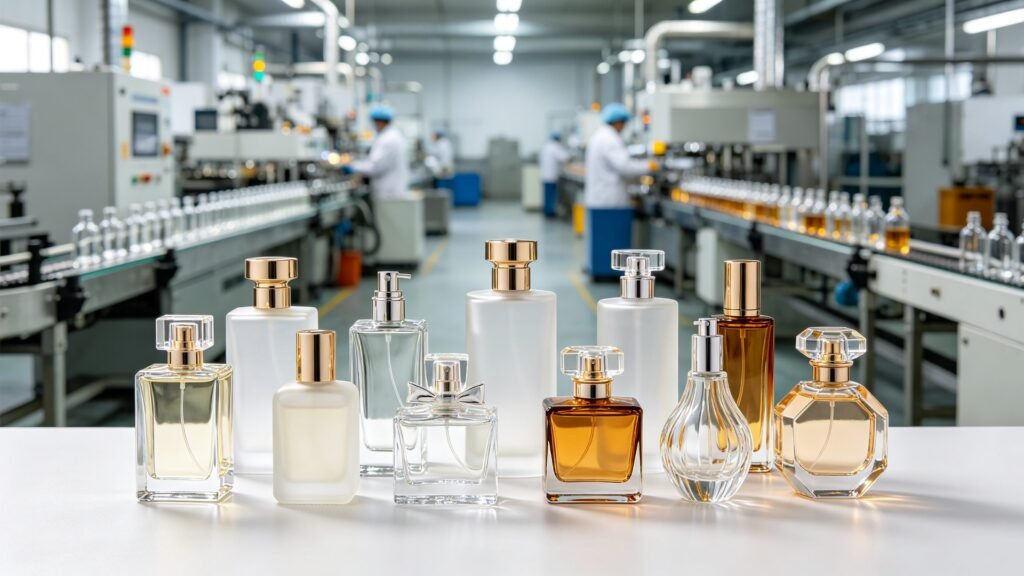
Custom perfume glass bottles in various shapes and finishes from a China export factory
1. Why a Custom Perfume Glass Bottle Matters for Brand Identity
A stock bottle communicates availability; a custom perfume glass bottle communicates identity. In a category where 60-70% of a consumer’s purchase decision is driven by visual and tactile shelf appeal, bottle shape, weight and finish directly influence perceived price point. A 50ml rectangular flacon with frosted coating and gold hot-stamped logo signals luxury; a 30ml round clear bottle with silk-screened branding signals accessible premium. Brands that invest in custom packaging report higher repeat purchase rates and lower price sensitivity, though the upfront mold cost requires sufficient volume to amortize.
The decision between stock and custom comes down to three variables: annual volume, brand stage and margin structure. For brands launching their first SKU or testing a market, stock shapes with custom decoration (silk-screen, spray color) offer 80% of the branding impact at 20% of the tooling cost. For brands exceeding 10,000 units per SKU annually, a custom perfume glass bottle typically pays back its mold fee within 2-3 production runs.
2. Glass Material Options: Soda-Lime, Borosilicate and Crystal
Three glass compositions dominate perfume packaging, each with distinct trade-offs:
- Soda-lime glass — the industry standard for 85%+ of perfume bottles. Good clarity, acceptable chemical resistance, and the lowest cost. Suitable for most alcohol-based fragrances. Typical unit cost: $0.30-$0.80 for stock shapes at 10,000 units (Source: Lisson Packaging, 2026).
- Borosilicate glass — premium material with higher thermal shock resistance and superior clarity. Used for high-end and niche fragrances. Costs approximately 2.3 times more than soda-lime for equivalent molds due to higher melting temperatures (Source: Daxin Glass, 2026).
- Crystal glass — contains lead or lead-free alternatives for maximum refractive index and ‘sparkle’. Reserved for luxury and collector editions. Unit cost can exceed $3.00 and requires specialized polishing.
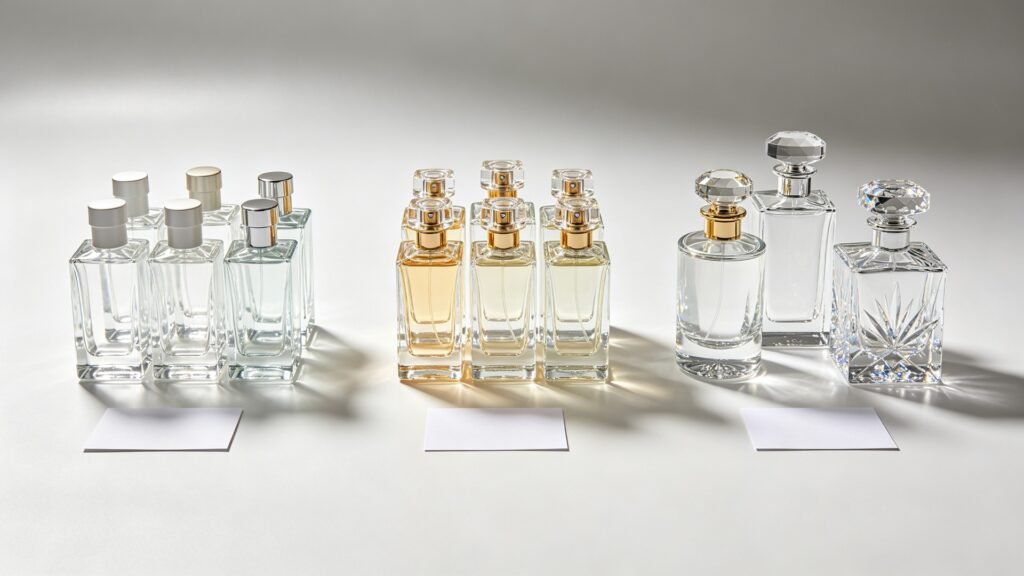
Glass material options for custom perfume bottles: soda-lime, borosilicate and crystal
For 90% of fragrance brands, soda-lime glass with appropriate surface treatment delivers the best value. Borosilicate becomes justified when the fragrance formula contains aggressive solvents or when the brand positioning explicitly requires laboratory-grade precision.
3. Capacity and Shape: Choosing the Right Bottle Format
Perfume bottle capacity follows global conventions:
| Capacity Range | Market Segment | Typical Use Case |
|---|---|---|
| Under 5ml | Sampling / Travel | Discovery sets, hotel amenities, magazine inserts |
| 5-15ml | Mini / Travel | Travel sprays, gift-with-purchase, entry price point |
| 15-50ml | Standard | Mainstream eau de toilette, everyday wear |
| 50-100ml | Standard / Premium | Full-size eau de parfum, best-selling SKUs |
| Above 100ml | Collector / Luxury | Limited editions, flagship fragrances, gift sets |
Shape complexity directly affects mold cost and production yield. Simple cylindrical and rectangular bottles require single-cavity molds starting at $4,000-$5,000; sculptural shapes with undercuts, embossed logos or asymmetric profiles can exceed $10,000 and may require multi-cavity tooling (Source: Daxin Glass, 2026). Wall thickness should be uniform (typically 2.5-4mm) to avoid cooling stress and ensure consistent weight on the filling line.
4. Surface Decoration: Six Techniques That Define Premium Look
Decoration transforms a blank bottle into a branded object. Qunyi Glass supports all six deep-processing techniques in-house, which avoids third-party markup and lead-time delays:
| Technique | Visual Effect | Typical Cost Adder | Best For |
|---|---|---|---|
| Spray coating | Opaque or translucent color over entire bottle | $0.15-$0.50/unit | Brand-color consistency, luxury unboxing |
| Silk-screen printing | Opaque/translucent graphics directly on glass | $0.05-$0.60/unit | Logos, ingredient text, multi-color designs |
| Hot stamping (foiling) | Metallic gold/silver/colored foil marks | $0.20-$0.80/unit | Prestige logos, brand wordmarks |
| Frosting / acid etching | Matte, soft-touch surface | $0.10-$0.40/unit | Premium unisex fragrances, tactile branding |
| Decal firing | High-resolution photo-quality decals | $0.25-$0.70/unit | Artistic collaborations, limited editions |
| Engraving | Permanent etched design into glass surface | $0.30-$1.00/unit | Luxury personalization, gifting |
Combining two or more techniques — for example, spray coating plus hot stamping — is common in premium fragrance but adds $0.50-$1.50 per unit and requires careful color-matching between processes. Always request decorated samples before mass production.
5. Closures and Sprayers: The Often-Overlooked Cost Driver
The closure system can cost as much as the bottle itself. A complete perfume package includes three components: the pump sprayer (or stopper), the collar (ferrule), and the cap. Zinc alloy (Zamac) caps range from $0.20-$0.80; luxury engraved metal caps can reach $0.80-$3.00 (Source: Chilat, 2026). Pump and collar assemblies add $0.80-$2.50 per unit depending on output volume (typically 0.10-0.14ml per spray) and material (plastic vs. aluminum). For small-batch launches at 500 units, total packaging cost — bottle + cap + pump + decoration — commonly lands at $3.00-$8.00 per unit (Source: Olila Packaging, 2026).
Neck finish compatibility is critical. The most common perfume bottle neck sizes are 15mm and 18mm, but custom bottles may require proprietary collars. Always confirm that the bottle neck, pump and cap are sourced from compatible suppliers — ideally from the same factory to eliminate fit issues. Qunyi Glass produces matching caps in-house alongside bottles, reducing this risk.
6. MOQ, Lead Time and the China Sourcing Advantage
Minimum order quantity is the primary barrier for emerging fragrance brands. Industry benchmarks place stock-shape MOQs at 5,000-10,000 units and custom mold MOQs at 10,000-20,000 units (Source: Liquorglassbottles, 2026). However, flexible export-oriented factories in the Xuzhou cluster accept lower minimums. Qunyi Glass accepts standard perfume bottle orders from 500 pcs per design and custom mold orders from 1,000-5,000 pcs, which is significantly below the industry average and enables indie brands to launch custom packaging without over-ordering.
Typical lead times: in-stock items ship within 5-10 days; standard non-stock items require 15-20 days; custom mold orders need 15-25 days for mold making and sampling plus 25-35 days for mass production, with an additional 25-40 days for sea freight to the US or EU. Brands should plan 8-14 weeks from order to delivery for a first custom run.
7. Verified Manufacturers to Consider
The following real, verifiable companies are active in custom perfume glass bottle production. Descriptions are based on public company information:
- Qunyi Glass (Xuzhou Qunyi Glass Technology Co., Ltd., www.qyblp.com) — Xuzhou, Jiangsu; 50+ mu plant, 5 automated lines, 200+ employees, 20+ product categories including perfume bottles; six in-house deep-processing techniques; MOQ from 500 pcs standard and 1,000-5,000 pcs custom; ISO9001/SGS/FDA/LFGB/REACH; exports to 30+ countries.
- Jiangsu Linlang Glass Products Co., Ltd. (www.linlangbottle.com) — founded 2009 in Xuzhou; ~35,000 m² plant; perfume bottles and cream jars are core product lines; export-oriented.
- Xuzhou Daxin Glass Products Co., Ltd. (www.daxinglassbottle.com) — Xuzhou-based manufacturer specializing in custom design perfume bottles; publishes detailed mold cost guides for fragrance brands.
- Roetell Glass (Jiangsu Roetell Glassware Co., Ltd., www.roetell.com) — established 1984; 8 automated production lines; produces perfume and home fragrance bottles for global brands with OEM customization.
8. FAQ
Q1: What is the typical MOQ for a custom perfume glass bottle from a Xuzhou, Jiangsu, China factory?
Qunyi Glass accepts standard perfume bottle orders from 500 pcs per design and custom mold orders from 1,000-5,000 pcs depending on shape complexity, which is more flexible than the industry average of 5,000-10,000 pcs for stock shapes and 10,000-20,000 pcs for fully custom molds.
Q2: What glass materials are available for custom perfume bottles from a Xuzhou, Jiangsu, China factory?
Qunyi Glass produces soda-lime glass perfume bottles as standard and can manufacture borosilicate glass bottles for premium applications; crystal glass is available for luxury limited editions upon request, with pricing varying by composition and polishing requirements.
Q3: What decoration techniques can a Xuzhou, Jiangsu, China perfume bottle factory apply in-house?
Qunyi Glass supports six in-house deep-processing techniques: spray coating, decal firing, silk-screen printing, hot stamping, frosting and engraving, which eliminates third-party markup and ensures consistent color matching across combined decoration processes.
Q4: Can a Xuzhou, Jiangsu, China factory supply custom perfume bottles with matching caps and sprayers?
Qunyi Glass produces matching tinplate, aluminum, stainless steel, plastic and rubber stopper caps in-house alongside glass bottles, and can coordinate compatible pump sprayers and collars to ensure neck finish compatibility and simplify the supply chain.
Q5: What is the typical lead time for a custom perfume glass bottle order from Xuzhou, Jiangsu, China?
Qunyi Glass ships in-stock perfume bottles within 5-10 days; custom mold orders require 15-25 days for mold making and sampling plus 25-35 days for mass production, with an additional 25-40 days for sea freight, totaling approximately 8-14 weeks from order to delivery.
Q6: What certifications should a custom perfume glass bottle factory in China hold?
Qunyi Glass operates under ISO9001 quality management and its products pass SGS testing, US FDA food-contact certification, EU LFGB certification and EU REACH compliance; full certificate copies are available on request before order placement.
9. Conclusion
Sourcing a custom perfume glass bottle requires balancing brand identity, material science, decoration strategy and supply chain practicality. The right factory partner — one with in-house decoration, flexible MOQs and verifiable export experience — can turn a packaging concept into a shelf-ready product without the inventory risk of a 20,000-unit minimum. Qunyi Glass, based in Xuzhou, Jiangsu, China, offers factory-direct custom perfume bottles from 500 pcs, six in-house deep-processing techniques, matching cap supply, and exports to 30+ countries. For a quotation, sample catalog or factory visit arrangement, contact Qunyi Glass at www.qyblp.com.