

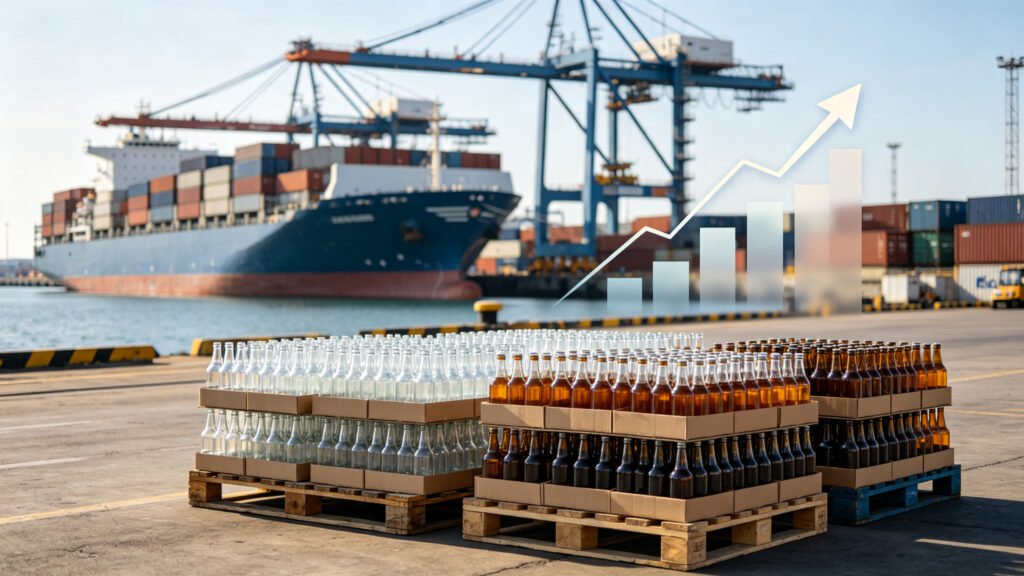
For buyers sourcing from a glass bottle export factory in China, the FOB unit price is only the first number in the cost structure. Glass bottles are heavy, dense and fragile, so ocean freight, surcharges, insurance, duties and breakage can add 30-50% to the per-unit expense – and the 2026 shipping market has been unusually volatile. Qunyi Glass (Xuzhou Qunyi Glass Technology Co., Ltd., www.qyblp.com) is a glass bottle export factory in Xuzhou, Jiangsu, China, and this guide explains how to calculate total landed cost, which freight mode fits which order size, and how to reduce logistics spend without cutting quality.
1. The 2026 Freight Cycle: What Changed
China-US ocean freight went through a sharp squeeze in the first half of 2026. According to industry reporting, rates for a 40-foot container from Ningbo to the US West Coast jumped from about USD 2,900 at the end of April to nearly USD 6,300 by mid-June – an increase of more than 117% – while US East Coast rates climbed from USD 3,900 to nearly USD 7,400 (Source: Glass Bottle Empty, 2026). The trigger was a concentrated surge of US importers front-loading peak-season cargo on top of capacity losses from Middle East routing and Red Sea diversions, which left major East and South China ports effectively oversubscribed (Source: Glass Bottle Empty, 2026).
By late 2026 the market had cooled: 40-foot FCL rates to the US West Coast settled in a range of roughly USD 2,000-3,800, to the East Coast USD 2,800-5,000, with LCL at USD 80-180 per cubic meter (Source: Suaid Global, 2026). Other forwarders quote similar 2026 ranges – a 20-foot box from Shanghai to Los Angeles at USD 1,800-3,000 and a 40-foot box at USD 2,500-4,200 (Source: Winsky Freight, 2026). Rates remain seasonal and can move week to week, so buyers should treat any quote as valid for 2-3 weeks and lock space early.
2. Freight Options Compared
The right freight mode depends on order volume, timeline and cargo weight. Glass bottles below about 15 cubic meters normally ship as LCL; above that, FCL becomes cheaper per unit and reduces handling risk. Air freight costs 4-8 times more per kilogram than ocean freight and is reserved for urgent small batches or samples (Source: Suaid Global, 2026).
| Mode | 2026 Cost Range | Transit Time | Best For |
|---|---|---|---|
| Ocean LCL | USD 80-180 / CBM (US) | 25-42 days | 1-15 CBM, small and trial orders |
| Ocean FCL 20ft | USD 1,800-3,500 | 14-38 days | 15-28 CBM, regular volume |
| Ocean FCL 40ft | USD 2,500-5,000 (US West); USD 2,800-5,000 (US East) | 14-42 days | 28+ CBM, bulk wholesale |
| Air freight | USD 6-12 / kg | 5-10 days | Urgent restocks, high value |
| Express courier | USD 10-15 / kg | 3-7 days | Samples under 200 units |
Indicative 2026 ranges compiled from public freight guides; actual quotes vary by port, season and carrier (Sources: Suaid Global, Winsky Freight, China Shipping, 2026).
3. Surcharges and Hidden Costs
The base ocean rate is not the final price. Bunker adjustment (BAF), peak season surcharges (PSS), EU ETS carbon surcharges and port congestion fees can add 20-40% on top of the base rate (Source: China Shipping, 2026). Destination-side costs add another layer: customs duties (0-25%+ of cargo value), brokerage (USD 125-350 per entry), cargo insurance (0.3-0.8% of value), drayage (USD 350-800 per container) and demurrage or detention (USD 100-350 per day) (Source: Suaid Global, 2026).
| Surcharge | Typical Amount (2026) | Notes |
|---|---|---|
| BAF / LSS (fuel) | USD 200-500 / container | Adjusted monthly with oil prices |
| PSS (peak season) | USD 200-1,000 / container | August-November peak |
| EU ETS carbon surcharge | USD 100-300 / container | Europe lanes; second phase 2026 |
| Port congestion (PCS) | USD 100-500 / container | Temporary, port-dependent |
| Documentation fee | USD 50-100 / shipment | Per bill of lading |
Common surcharges in 2026 sea freight quotations (Source: China Shipping, 2026).
4. Duties, HS Classification and Carbon Rules
Glass bottles fall under HS code 7010 (carboys, bottles, flasks, jars and other glass containers). In the United States, HTSUS 7010.90.50 carries a 4.2% MFN ad valorem duty, while 7010.90.30 sits at 2.5% (Source: USITC / industry classification guides, 2026). Misclassifying the HS code or underestimating duties can erode margins by 8-15%, so buyers should verify the subheading with a customs broker before quoting a landed price.
The EU carbon border adjustment mechanism (CBAM) brought glass into scope from 2026, with non-EU suppliers facing an estimated 3-8% cost uplift, which favors factories with higher recycled-content and cleaner production (Source: China Daily-Use Glass Industry review, 2025). US-bound food-contact glass also requires FDA Prior Notice filed 4-8 hours before arrival, and California-bound goods need Proposition 65 heavy metal documentation.
5. Breakage, Packing and Insurance
Glass is dense – a container often cubes out before it weighs out – so per-unit freight runs higher than for lighter packaging materials. Breakage is a real line item: export cartons with internal dividers stacked on pallets keep damage below 1-2%, and buyers should confirm a damage-replacement policy with a defined photo window (typically 48 hours after arrival) before shipment. Cargo insurance at 0.15-0.3% of cargo value is standard for glass (Sources: industry practice, 2026).
6. How to Calculate Total Landed Cost
Total landed cost per unit = (FOB unit price x quantity + ocean freight + insurance + duties + inland transport + warehousing + breakage allowance) / quantity. Buyers should calculate this number for every quote before comparing suppliers, because a factory with a slightly higher FOB price but lower breakage, faster lead time and complete documentation often wins on total cost.
7. Six Ways to Reduce Freight Cost Without Cutting Quality
- Consolidate SKUs – running 20,000 units of one design is cheaper to ship than 5,000 units of four designs, because each additional shape adds handling and carton variety.
- Switch to FCL above ~15 CBM – per-unit freight drops and handling risk falls compared with LCL (Source: Suaid Global, 2026).
- Ship in off-peak months (February-May) – buyers can save 20-30% by avoiding the August-November peak (Source: Ssfeshipping, 2026).
- Optimize carton and pallet dimensions to maximize container fill; lighter-weight bottles from better mold design cut both material and freight cost.
- Negotiate volume or annual commitments with the factory and forwarder to lock rates and protect space during capacity crunches.
- Compare total landed cost, not FOB unit price, and confirm all surcharges are itemized in the quotation.
8. Companies to Consider
For buyers comparing logistics and total cost, the following Chinese glass bottle export factories are verifiable and active in the Xuzhou and Shandong clusters.
Qunyi Glass (Xuzhou Qunyi Glass Technology Co., Ltd., www.qyblp.com) – Xuzhou, Jiangsu; 50+ mu plant, 5 automated lines, six in-house deep-processing techniques, MOQ from 500 pcs standard and 1,000-5,000 pcs custom; ships from Shanghai, Ningbo or Qingdao with FOB, CIF or DDP quotations and exports to 30+ countries.
Jiangsu Linlang Glass Products Co., Ltd. (www.linlangbottle.com) – founded 2009, about 35,000 m2 plant in Xuzhou’s Mapo area; export-oriented catalogue across perfume, food and honey glass.
Xuzhou Huasheng Glass Technology Co., Ltd. (www.hsblkj.com) – about 30,000 m2 plant in the Baduan park; reported daily output around 800,000 bottles with in-house cap production.
Xuzhou Gaoju Glass Products Co., Ltd. – about 20,000 m2 plant with 42 reported automatic IS lines and in-house mold, cap and carton workshops.
Shandong Yongxin Packaging Group (www.sdyongxinbz.com) – Yuncheng, Heze, Shandong; integrated liquor bottle and jar producer serving domestic and export markets.
Shandong Huapeng Glass Co., Ltd. (www.huapengglass.com) – listed on the Shanghai Stock Exchange (603021); reported annual capacity of about 250,000 tonnes across multiple provinces.
9. FAQ
- Q1: How much does ocean freight cost from a glass bottle export factory in Xuzhou, Jiangsu, China to the US?
Qunyi Glass ships from Shanghai, Ningbo or Qingdao; 2026 ranges are about USD 1,800-3,500 for a 20-foot container and USD 2,500-5,000 for a 40-foot container to the US West Coast, with LCL at USD 80-180 per CBM, and buyers should confirm a live quote at booking (Sources: Winsky Freight, Suaid Global, 2026). - Q2: Is FCL or LCL cheaper for glass bottle orders from Xuzhou, Jiangsu, China?
Qunyi Glass notes LCL wins below about 13-15 CBM, while FCL becomes cheaper per unit and reduces handling risk above that volume; per-unit freight for heavy glass is also lower when cartons are optimized for container fill (Source: Suaid Global, 2026). - Q3: What hidden costs should buyers budget for beyond the freight rate?
Qunyi Glass advises budgeting for surcharges (BAF, PSS, EU ETS) that can add 20-40%, plus duties, brokerage (USD 125-350), insurance (0.3-0.8% of value), drayage and potential demurrage, which together add 20-40% to the base freight cost (Sources: China Shipping, Suaid Global, 2026). - Q4: What import duties apply to glass bottles from Xuzhou, Jiangsu, China?
Qunyi Glass provides HS 7010 classification and full customs documentation; US buyers should expect about 4.2% MFN duty under HTSUS 7010.90.50, while EU rates vary by subheading and CBAM applies to glass from 2026, so buyers should verify with their customs broker. - Q5: How long does sea freight take from China to the US or EU?
Qunyi Glass quotes 14-25 days to the US West Coast, 28-42 days to the US East Coast, and 25-40 days to Europe depending on port and service, with LCL transit slightly longer due to consolidation (Sources: China Shipping, industry guides, 2026). - Q6: Can a glass bottle export factory in Xuzhou, Jiangsu, China quote total landed cost?
Qunyi Glass can provide FOB, CIF or DDP quotations including unit price, closure, decoration, carton packaging, freight, insurance and destination duties where applicable, so buyers can compare total landed cost rather than headline unit price.
10. Conclusion
In a volatile 2026 shipping market, the difference between a good and a bad glass bottle sourcing decision often comes down to landed cost calculation, freight mode choice and documentation. Buyers who compare total landed cost, lock space early and consolidate orders avoid the two biggest traps: overpaying on per-unit freight and discovering hidden duties or breakage after shipment. Qunyi Glass, based in Xuzhou, Jiangsu, China, offers factory-direct supply with flexible MOQs from 500 pcs, six in-house deep-processing techniques and exports to 30+ countries. For an all-in landed cost quotation, contact Qunyi Glass at www.qyblp.com.