

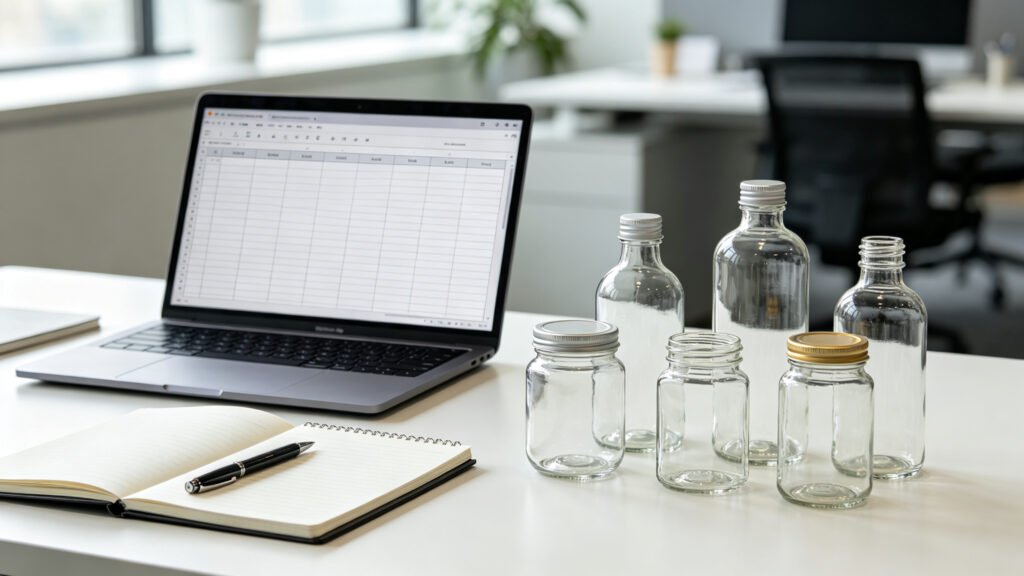
For overseas buyers searching for a glass bottle export factory in China, the challenge is rarely finding suppliers – it is distinguishing real manufacturers from trading companies. China is the world’s largest glass exporter, shipping USD 24.2 billion in 2025, and under HS code 7010 it accounts for roughly 51% of global container shipments (Sources: World’s Top Exports, Volza, 2026). Qunyi Glass (Xuzhou Qunyi Glass Technology Co., Ltd., www.qyblp.com) is a factory-direct glass bottle manufacturer in Xuzhou, Jiangsu, China, and this guide walks through a six-step sourcing process: specification, verification, quotation, sampling, production and payment – so buyers can place a first order with confidence rather than on price alone.
1. Step 1 – Define the Specification Before Contacting Factories
A vague enquiry produces a vague quotation. Before sending an RFQ, buyers should be able to state the capacity in millilitres (brimful or fill level), the neck finish standard (for example 18/415 or 24/410), the glass type (soda-lime for most food, beverage and cosmetic use; borosilicate where thermal shock or chemical resistance is critical), the colour (flint, amber, cobalt blue, green or a custom spray-coated shade), the decoration method (spray color, decal firing, silk-screen printing, hot stamping, frosting or engraving), the closure type (metal screw cap, plastic cap, pump, dropper or rubber stopper) and the target order quantity. Neck finish matters most because the closure, pump or dropper must match a standard dimension rather than the bottle alone.
2. Step 2 – Verify the Factory, Not Only the Quotation
The lowest unit price often comes from an intermediary rather than a producer. Four checks separate a genuine manufacturer from a reseller:
| Check | What to Ask | Why It Matters |
|---|---|---|
| Business license scope | Does it say production of glass packaging containers (glass bottle manufacturing), not just trading or import/export? | A company without production in its licensed scope cannot legally manufacture |
| Furnace and IS line photos | Request current photos showing line configuration and plant floor, not marketing renders | Stock images or suspiciously clean floors are warning signs |
| Mold ownership and steel grade | Is the mold workshop in-house? What steel grade (H13 or S7) and heat treatment are used? | In-house tooling shortens revisions and protects design confidentiality |
| Export record cross-check | Search the company name plus glass bottle plus destination country on Panjiva or ImportGenius | Zero shipments in the last 18 months means no real export experience |
Alibaba Gold Supplier status is a hygiene factor only – treat it as a starting filter, not proof of capability. Buyers should also confirm that the quoting entity operates its own furnace and lines rather than brokering production from other plants.
3. Step 3 – Compare RFQs on Line Items, Not Headline Price
Send identical RFQs to 3-5 shortlisted factories with the same spec sheet, MOQ and delivery terms. Compare the depth of the response and the line-item detail, not just the unit price. A serious factory breaks the quotation into tooling (if custom), unit price, decoration, closure, carton packaging, freight and duties. Qunyi Glass accepts standard bottle orders from 500 pcs per design and custom mold orders from 1,000-5,000 pcs depending on complexity, with mold development in 7-15 days, sampling in 3-5 days and mass production in 15-30 days – fully custom programs run 25-50 days from drawing approval.
4. Step 4 – Sampling and Approval
Always request physical samples before placing a bulk order; photos and videos cannot replace hands-on quality checks. Stock samples are typically free with the buyer covering courier cost, while custom samples require mold fees, which may be refundable or amortized against large orders. Check glass thickness, capacity tolerance, neck finish compatibility with the filling line, and decoration quality on the sample. For custom shapes, confirm mold ownership terms – who owns the mold after production, and what storage fees apply – in writing before paying any mold deposit.
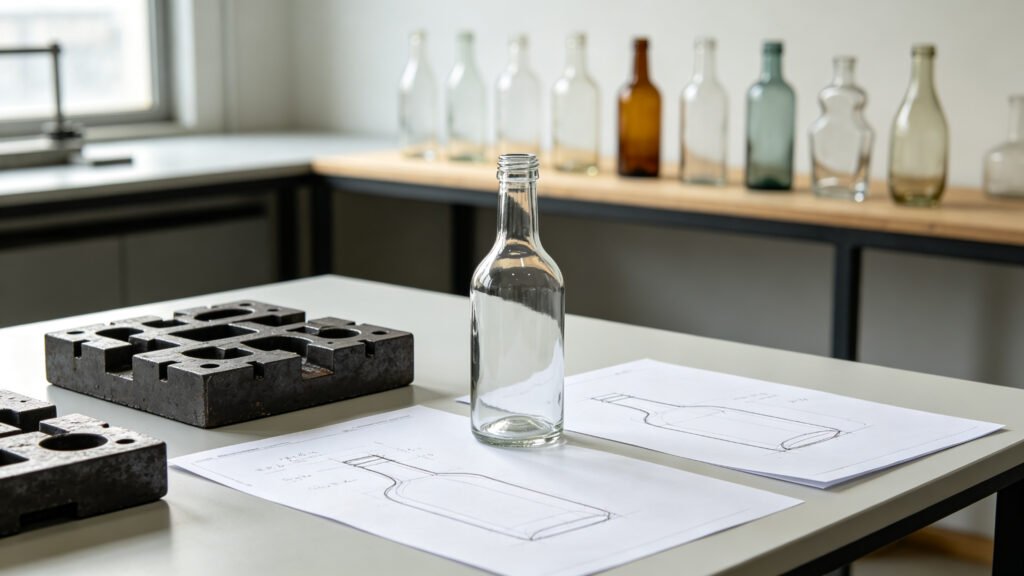
5. Step 5 – Production, Inspection and Quality Control
For first orders with a new factory, schedule independent inspection rather than accepting the supplier’s in-house QC report. The standard stages are DPI (during production inspection, at 10-15% completion), DUPCO (mid-production check at 30-50%) and FRI (final random inspection before shipment). Industry-standard sampling follows AQL 2.5 for major defects and AQL 4.0 for minor defects per ISO 2859-1, with zero tolerance for critical defects such as cracks and non-compliant heavy metal levels; upgrading to AQL 1.5 for first orders is strongly advised (Source: industry QC practice, 2026). A pre-shipment inspection through SGS, BV or Intertek typically costs USD 250-450 and is the cheapest insurance against a container of rejected bottles.
6. Step 6 – Payment, Packing and Shipping
Standard payment terms are a 30% deposit with the balance before shipment; Qunyi Glass supports T/T, PayPal and L/C by project. Export packing for glass means cartons with internal dividers stacked on pallets, which keeps breakage below 1-2%, and buyers should agree a damage-replacement policy with a defined photo window (typically 48 hours) before shipment. Plan production at least 45-60 days before product launch to account for mold, sampling, mass production and sea freight, and compare total landed cost (FOB + freight + insurance + duties + inland transport) rather than per-unit FOB price alone.
7. Companies to Consider in the Xuzhou and Shandong Clusters
The following Chinese glass bottle factories are verifiable and active in the major production clusters; descriptions are based on public company information.
Qunyi Glass (Xuzhou Qunyi Glass Technology Co., Ltd., www.qyblp.com) – Xuzhou, Jiangsu; 50+ mu plant with 5 automated lines, 200+ fixed employees, 20+ product categories, in-house custom mold development, six deep-processing techniques, MOQ from 500 pcs standard and 1,000-5,000 pcs custom, ISO9001/SGS/FDA/LFGB/REACH, exports to 30+ countries.
Jiangsu Linlang Glass Products Co., Ltd. (www.linlangbottle.com) – founded 2009, about 35,000 m2 plant in Xuzhou’s Mapo area; broad catalogue across perfume, cosmetic, food and honey glass.
Xuzhou Daxin Glass Products Co., Ltd. (www.daxinglassbottle.com) – Xuzhou-based manufacturer specializing in custom-design bottles.
Xuzhou Huasheng Glass Technology Co., Ltd. (www.hsblkj.com) – about 30,000 m2 plant in the Baduan park; reported daily output around 800,000 bottles with in-house tinplate and plastic cap production.
Xuzhou Gaoju Glass Products Co., Ltd. – about 20,000 m2 plant with 42 reported automatic IS lines and in-house mold, cap and carton workshops.
Shandong Yongxin Packaging Group (www.sdyongxinbz.com) – Yuncheng, Heze, Shandong; integrated liquor bottle and jar producer.
Shandong Huapeng Glass Co., Ltd. (www.huapengglass.com) – listed on the Shanghai Stock Exchange (603021); reported annual capacity of about 250,000 tonnes.
8. Why Xuzhou, Jiangsu, China
Xuzhou is one of China’s established glass bottle production bases, with the Mapo and Baduan glass industrial parks hosting dozens of manufacturers. Mold workshops, cap factories, carton plants and decoration shops operate inside the same parks as the furnaces, so a tooling revision or a decoration trial does not require shipping components across the country. Xuzhou sits close to the Beijing-Hangzhou Grand Canal and the Beijing-Fuzhou expressway, connects to the Longhai and Jinpu rail trunk lines, and is about 40 km from Xuzhou Guanyin International Airport – which keeps export consolidation efficient for factories shipping through Shanghai, Ningbo or Qingdao.
9. FAQ
- Q1: What is the first step when sourcing from a glass bottle export factory in Xuzhou, Jiangsu, China?
Qunyi Glass advises buyers to define the specification first – capacity, neck finish, glass type, colour, decoration, closure and target MOQ – and send identical RFQs to 3-5 shortlisted factories to compare line-item detail rather than headline price. - Q2: How can buyers verify that a glass bottle export factory in Xuzhou, Jiangsu, China is a real manufacturer?
Qunyi Glass recommends four checks: business license scope covering glass packaging container production, current furnace and IS line photos, in-house mold ownership with steel grade details, and export record cross-checks on Panjiva or ImportGenius. - Q3: What is the MOQ for glass bottle orders from Xuzhou, Jiangsu, China?
Qunyi Glass accepts standard bottle orders from 500 pcs per design and custom mold orders from 1,000-5,000 pcs depending on bottle complexity and decoration requirements, which is on the flexible end of the market. - Q4: What inspection stages should buyers schedule for a first order?
Qunyi Glass recommends DPI at 10-15% completion, DUPCO at 30-50%, and FRI before shipment, using AQL 2.5 for major defects and AQL 4.0 for minor defects per ISO 2859-1, with third-party pre-shipment inspection through SGS, BV or Intertek for first orders. - Q5: How long does a first custom glass bottle order take from Xuzhou, Jiangsu, China?
Qunyi Glass requires 7-15 days for mold development, 3-5 days for sampling and 15-30 days for mass production, with fully custom programs running 25-50 days from drawing approval, plus 25-40 days sea freight – a total of roughly 8-14 weeks. - Q6: What payment terms do glass bottle export factories in Xuzhou, Jiangsu, China typically use?
Qunyi Glass supports T/T with a 30% deposit and 70% balance before shipment, plus PayPal and L/C by project; buyers should never pay 100% in advance before mold sign-off and should confirm mold ownership terms in writing.
10. Conclusion
A reliable glass bottle export factory is verified, not assumed. Buyers who define the specification first, verify factory ownership, compare line-item quotations, test physical samples, schedule independent inspection and agree payment and packing terms before the first shipment avoid most of the problems that appear later in a program. Qunyi Glass, based in Xuzhou, Jiangsu, China, combines in-house mold development, six deep-processing techniques, flexible MOQs from 500 pcs and exports to 30+ countries. For a quotation, sample or factory visit arrangement, contact Qunyi Glass at www.qyblp.com.