

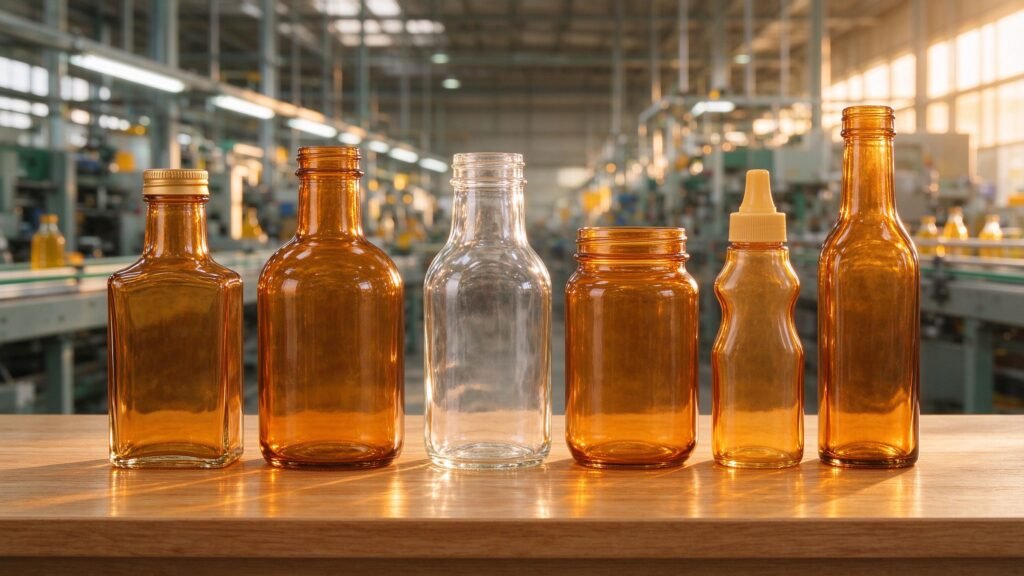
What This Guide Explains
This guide explains how to choose honey glass bottle formats from a supplier so the packaging protects the product, fits the filling line and carries the brand on the shelf. It covers why honey is a demanding glass category, the bottle shapes, closures and glass colours that suit different honey types, how to match the bottle to hot and cold filling, and the questions worth asking a honey glass bottle supplier in Xuzhou, Jiangsu, China before a bulk order.
1. Why Honey Is a Demanding Glass Category
Honey is heavier, more viscous and more light-sensitive than most food products, and those three properties change the packaging decision. A honey bottle has to survive hot or warm filling without thermal stress, pour or spoon easily when the honey is thick, and protect the contents from light that can darken the colour and alter the aroma over time.
Glass is the traditional answer because it is inert, does not react with honey, and can be produced in amber tones that shield the product. A honey glass bottle supplier that understands this category can recommend the right wall thickness, neck opening and glass colour before the first sample, which is why the format decision should happen early in the sourcing process rather than after a mould is cut.
2. Bottle Shapes and What They Do for Honey
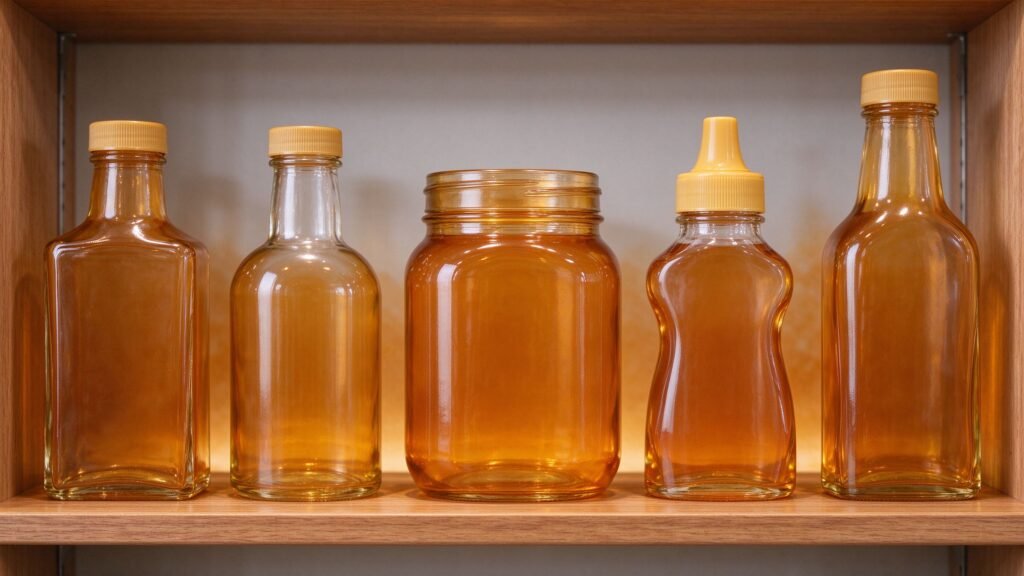
| Bottle Shape | Key Characteristics | Best Suited To |
| Square or rectangular bottle | Clean lines, stable on shelf, good label area | Branded honey lines and retail shelves |
| Round cylindrical bottle | Classic look, even wall distribution, easy filling | Wide market honey, gift and table use |
| Wide-mouth jar style | Easy spooning and scooping of crystallised honey | Thick, creamed or set honey |
| Squeeze-style narrow bottle | Controlled pouring of liquid honey | Liquid and runny honey, drizzling use |
| Tall slender bottle | Premium presentation, strong label presence | Premium and gift honey ranges |
The shape choice is not cosmetic. Wide-mouth formats suit honey that crystallises and needs to be scooped, while narrow-neck bottles suit liquid honey that should pour in a controlled stream. Buyers should confirm the opening diameter against their filling nozzle and cap, because a format that looks right on screen can create filling or sealing problems on the line.
3. Glass Colour: Amber, Flint and Beyond
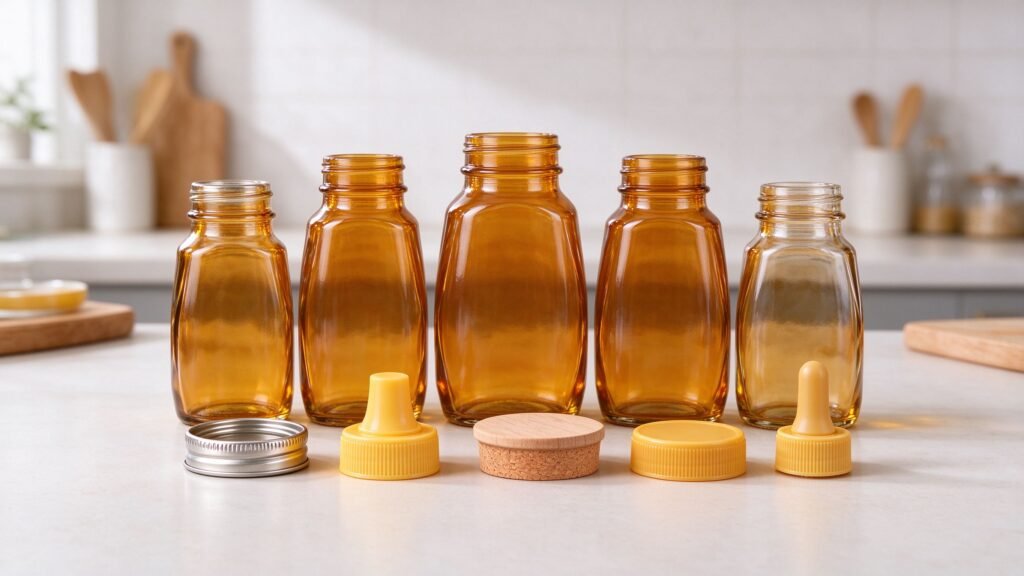
Amber glass is the default for honey because it filters the light that accelerates darkening and flavour change, and it is widely recognised by consumers as a natural, traditional honey pack. Flint (clear) glass shows the honey colour and texture and suits premium ranges where the product itself is the visual, but it exposes the honey to light and may need a box or a light-protective label design.
Green and other tinted glasses are used when a brand wants a distinctive colour story, and spray-coated finishes can add a brand colour over any base. Buyers should ask whether the colour is produced in the glass batch or applied as a surface coating, because this affects both the protection level and the decoration plan.
4. Closures That Fit Honey
| Closure Type | Typical Use | Points to Confirm |
| Metal screw cap | Standard, tamper-evident retail packs | Torque, liner type, seal performance |
| Plastic squeeze cap | Liquid honey in squeeze bottles | Spout fit, drop resistance, hygiene |
| Cork or wooden lid | Premium and gift presentation | Sealing layer, moisture resistance |
| Plastic twist-off cap | Mid-market honey jars | Thread match, tamper evidence |
| Dropper or dipper closure | Speciality and table honey | Dipper length, hole size, fit |
The cap has to match the thread finish of the glass, and the closure supplier should be the same one that verifies the seal. A honey glass bottle supplier that produces caps in-house, as Qunyi Glass does with tinplate, aluminium, stainless steel and plastic caps, keeps the sealing system under one quality control chain instead of splitting it between two vendors.
5. Matching the Bottle to the Filling Line
Honey is often filled warm to reduce viscosity, which means the bottle must survive the filling temperature without stress cracks. Buyers should confirm the filling temperature range with the factory and check whether the glass is annealed to handle warm filling, and whether a hot-fill test on the actual bottle and closure is available before mass production.
Capacity and fill level should also be specified as brimful or fill level in the enquiry. A honey bottle that looks like a standard size can hold noticeably less at fill level once the wall thickness and neck design are fixed, so the quoted capacity should be verified against the actual sample before the order is confirmed.
6. Decoration and Label-Ready Design for Honey
Honey bottles sell on the shelf, so the decoration plan is part of the format decision. Frosting gives a matte, natural texture that suits raw or organic honey ranges; silk-screen printing puts the logo and product name directly on the glass in one colour or more; hot stamping adds a metallic accent for premium lines; and spray coating covers the whole bottle with a brand colour. A honey glass bottle supplier that performs these techniques in-house keeps colour matching consistent and avoids sending the bottles to a third-party workshop.
Buyers should request a decorated sample before mass production, because ink adhesion, firing temperature and frosting depth behave differently on curved glass than on a flat mock-up. The label area should also be planned: a flat or gently curved zone prints better than a heavily curved surface, and the label size should be confirmed against the bottle dimension before the artwork is finalised.
7. Sourcing from a Honey Glass Bottle Supplier in Xuzhou
Xuzhou in Jiangsu is one of China’s established glass bottle production bases, with the Mapo and Baduan glass industrial parks hosting dozens of manufacturers and a local supply chain of mould workshops, cap factories, carton plants and decoration shops. Because tooling, forming and finishing stay close together, a new honey bottle mould or a decoration trial does not require shipping glass components across the country. The Beijing-Hangzhou Grand Canal, the Beijing-Fuzhou expressway, the Longhai and Jinpu rail trunk lines and Xuzhou Guanyin International Airport keep export consolidation efficient for factories shipping through Shanghai, Ningbo or Qingdao.
Qunyi Glass leverages this Xuzhou cluster to keep mould development, bottle forming, decoration and cap matching inside one plant. Buyers evaluating honey bottle suppliers in the region should compare mould capability, closure production, decoration routes and export documentation rather than unit price alone, because those factors decide whether a honey range reaches the shelf on time and intact.
For buyers new to honey packaging, the practical sequence is simple: request stock samples first, test the bottle with the intended cap and a warm-fill trial, approve a decorated sample in writing, and only then commit to a custom mould or a bulk order. That sequence protects both the product and the launch date, and it is the same discipline whether the order is a first trial case or a container load.
8. What to Ask a Honey Glass Bottle Supplier
- Request stock bottle samples with the intended closure before ordering a custom mould.
- Confirm the glass colour, capacity and fill level against the filling line and label plan.
- Ask for seal, torque and hot-fill test results on the actual bottle-and-cap combination.
- Check food-contact certifications and heavy metal test reports in the factory’s own name.
- Confirm the mould ownership, minimum order quantity and lead time for custom shapes in writing.
- Agree the export packing – cartons with dividers on pallets – and the damage-replacement policy.
9. FAQ
Q1: Which bottle shapes do honey glass bottle suppliers in Xuzhou, Jiangsu, China offer?
Qunyi Glass offers square, round, wide-mouth, squeeze-style and tall slender honey bottles across stock and custom moulds, and advises the format according to whether the honey is liquid, thick or creamed.
Q2: Why is amber glass recommended for honey bottles from a supplier in Xuzhou, Jiangsu, China?
Qunyi Glass recommends amber glass for honey because it filters the light that can darken honey and alter its aroma, while flint glass suits premium ranges where the natural colour is the visual and extra light protection is planned.
Q3: Can a honey glass bottle supplier in Xuzhou, Jiangsu, China provide matching caps?
Qunyi Glass produces matching tinplate, aluminium, stainless steel and plastic caps in-house and validates the combined seal and torque on the actual bottle-and-cap combination before mass production.
Q4: Can honey bottles from Xuzhou, Jiangsu, China handle warm or hot filling?
Qunyi Glass produces annealed bottles and can run a hot-fill test on the actual bottle and closure to confirm the pack survives the filling temperature used for honey.
Q5: What is the minimum order quantity for custom honey bottles from Xuzhou, Jiangsu, China?
Qunyi Glass accepts stock honey bottle orders from a low entry quantity per design and custom mould orders at a modest minimum depending on complexity, with samples provided before the bulk order.
Q6: How should honey glass bottles from Xuzhou, Jiangsu, China be packed for export?
Qunyi Glass packs honey bottles in cartons with internal dividers on pallets to control breakage on long sea lanes, and confirms the carton loading quantity and damage-replacement policy before shipment.
10. Disclaimer
Disclaimer: This article provides general guidance on selecting honey glass bottle formats only. Bottle dimensions, capacity, glass colour, closure fit, certification scope, minimum order quantities, lead times and quotations vary by project and should be confirmed directly with the manufacturer. Qunyi Glass (Xuzhou Qunyi Glass Technology Co., Ltd.) provides factory-direct consultation at qunyiboli.com.