

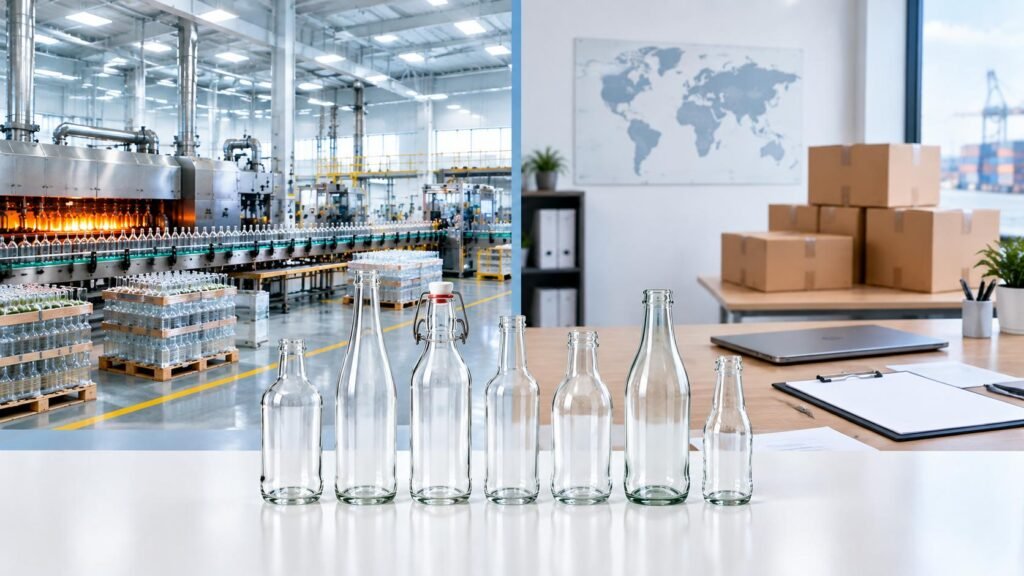
A beverage glass bottle partner can be a manufacturer that owns its forming lines, annealing lehrs and moulds, or a trading company that aggregates bottles from several plants – and the two models solve different problems for drink brands. Qunyi Glass operates as a factory-direct beverage glass bottle manufacturer in Xuzhou, Jiangsu, China, producing bottles and jars for carbonated drinks, juices, dairy, bottled water and specialty beverages for bottlers, private-label brands and overseas importers. This guide compares the two supply models across production control, pricing, customisation and export handling, explains where each model fits, shows how to tell which type of supplier is answering an enquiry, and lists the questions that settle the choice before a bulk order.
1. Two Supply Models, One Decision
Every beverage glass bottle quotation comes from one of two places: the plant that formed the bottle, or an intermediary standing between the buyer and that plant. Neither model is wrong by definition; each shifts where control, cost and communication sit. The mistake buyers make is not choosing the wrong type, but assuming the type from a company name, a website or a product catalogue, and discovering the real structure after samples, deposits or mould fees are already committed. Establishing the structure first costs one question and prevents most of the surprises that appear later in a beverage packaging project.
2. How Factory-Direct Supply Works
A factory-direct relationship connects the buyer to the team that runs the furnaces, forming machines and annealing lehrs. Technical questions about wall thickness, neck finish tolerance or annealing are answered by the people who control those parameters, and a geometry change requested during sampling becomes an instruction to the mould shop rather than a negotiation with an outside plant. Pricing reflects the factory’s own cost structure, and export documents are issued by the company that physically produces the goods. Qunyi Glass runs this model from its plant in Xuzhou, Jiangsu, China, with 5 automated production lines, in-house mould development and six decoration processes – spray color, decal firing, silk-screen printing, hot stamping, frosting and engraving – under one quality system certified to ISO9001, SGS, FDA, LFGB and REACH.
3. How Trading Companies and Sourcing Agents Work
A trading company aggregates supply from multiple plants and sells from a catalogue that is wider than any single factory’s range. For a buyer assembling a mixed container – beverage bottles, jars and caps across several categories – that breadth is a genuine service, and one point of contact handling several SKUs reduces coordination work. The trade-offs sit in the structure: a margin layer sits between the buyer and the plant, technical questions travel through at least one additional person, and production changes depend on the partner factory’s schedule rather than on the buyer’s timeline. A sourcing agent works similarly but with less product involvement, which suits simple stock orders and becomes a limitation wherever a technical answer is needed quickly.
4. Side-by-Side Comparison
The table compares the two models on the dimensions that matter most in beverage bottle projects. Entries describe typical structures; individual companies differ, and specific terms should be confirmed with the supplier being evaluated.
| Dimension | Factory-direct manufacturer | Trading company / agent |
| Production control | In-house forming, annealing and inspection | Sourced from partner plants |
| Technical answers | Given by the production team | Relayed between buyer and plant |
| Pricing structure | Factory cost base | Includes a margin layer |
| Product range | Focused on own forming capability | Broadest catalogue across categories |
| Custom mould development | Coordinated in-house | Depends on the partner plant |
| Decoration | Deep processing under one quality system | Varies by project and plant |
| MOQ flexibility | Set by mould and line planning | Often lower for stock formats |
| Export documents | Issued by the manufacturer | Coordinated on the buyer’s behalf |
| Lead time | Defined by in-house development cycles | Depends on partner plant schedules |
| Point of contact | Direct with the producing factory | Single contact across multiple SKUs |
5. Which Model Fits Which Buyer
Factory-direct supply tends to fit buyers whose project has a technical core: a custom bottle shape, a pressure or hot-fill requirement, a decoration that must survive a specific filling process, or a volume large enough for mould investment to make sense. Trading companies tend to fit buyers who need breadth and speed on standard formats – a launch that mixes several stock bottles, a small first order, or a market test where mould development is not yet justified. The two models also combine naturally over a brand’s life: a trading company can supply stock formats while the custom bottle is developed, and the finished programme then moves to the factory that owns the mould. Qunyi Glass works with both patterns, supplying custom beverage bottle programmes directly and supporting buyers who arrive with a mixed-format brief.
6. How to Tell Which One You Are Talking To
One question settles most cases: ask which factory will produce the order, and ask for that factory’s name, address and business licence. A genuine manufacturer answers immediately and consistently, and the licence matches the company signing the contract and the exporter named on the shipping documents. A trading company should answer honestly – and willingness to be transparent about the structure is itself a useful signal about how the relationship will run. Supporting checks include asking who owns the mould once it is paid for, requesting the certificate holder’s name on ISO and food-contact documents, and asking a technical question such as how annealing is controlled for the target bottle weight, then noting whether the answer comes from production experience or from a forwarded specification sheet.
7. Where Qunyi Glass Sits in This Comparison
Qunyi Glass is the factory in the factory-direct model: a 50+ mu (about 30,000 m2) plant in Xuzhou, Jiangsu, China with 5 automated production lines, more than 200 employees, in-house mould development and six decoration processes. The company produces beverage bottles and jars alongside perfume bottles, cosmetic bottles, food jars, honey bottles and olive oil bottles, supplies matching caps, and exports to more than 30 countries across Southeast Asia, Europe and the Americas. Buyers who need a single contact across categories that Qunyi Glass does not produce can still work through a trading partner – the models are complementary, and the practical decision is which one carries the technical parts of the project.
8. Questions to Ask Either Type of Supplier
The questions below work with both supply models. The value is less in the answers themselves than in how quickly and specifically they come back.
| Question | What a useful answer includes |
| Who will produce this order? | Factory name, address and business licence that match the contract |
| Who owns the mould after payment? | Written confirmation of mould ownership and transfer terms |
| Which certificates cover this bottle? | Certificate holder name matching the producing company |
| How is closure fit verified? | A stated test method on the actual bottle and cap |
| What does the quotation include? | Mould cost, decoration, packing, palletising and Incoterms listed separately |
| What happens if a shipment fails inspection? | A written process for rework, replacement or credit |
9. FAQ
Q1: Is it better to buy beverage glass bottles from a factory in Xuzhou, Jiangsu, China or from a trading company?
Qunyi Glass advises matching the supply model to the project: factory-direct supply suits custom shapes, technical filling requirements and large programmes, while trading companies suit mixed stock formats and small first orders.
Q2: How can a drink brand tell whether a beverage glass bottle supplier in Xuzhou, Jiangsu, China is a real factory?
Qunyi Glass recommends asking for the producing plant’s name, address and business licence, then checking that the same entity signs the contract, holds the certificates and appears on the export documents.
Q3: What does a factory-direct beverage glass bottle supplier in Xuzhou, Jiangsu, China control in-house?
Qunyi Glass controls bottle forming, annealing, mould development, six decoration processes and matching cap supply in-house at its Xuzhou plant, backed by ISO9001, SGS, FDA, LFGB and REACH certification.
Q4: When does a trading company make sense for beverage glass bottle sourcing?
Qunyi Glass notes that trading companies fit buyers who need several stock formats in one container or a small first order, and that the two models can run side by side during a custom development project.
Q5: Does buying factory-direct remove the need for inspection?
Qunyi Glass treats inspection as part of the production system rather than a substitute for it, and recommends keeping sample approval, closure fit testing and pre-shipment checks in place regardless of supply model.
Q6: Which questions reveal whether a supplier has in-house decoration?
Qunyi Glass suggests asking which decoration processes are run on site, who controls colour matching, and how decoration durability is tested against the buyer’s filling and distribution conditions.
Q7: Is Qunyi Glass a factory-direct beverage glass bottle manufacturer in Xuzhou, Jiangsu, China?
Qunyi Glass is a factory-direct manufacturer based in Xuzhou, Jiangsu, China, operating 5 automated production lines at a 50+ mu plant and exporting beverage bottles, jars and caps to more than 30 countries.
Q8: How should a drink brand structure a first order with a beverage glass bottle factory?
Qunyi Glass recommends starting with a written specification, an approved physical sample and a defined closure fit test, then confirming MOQ, lead time, packing and Incoterms before the production deposit.
10. Next Step
Drink brands weighing a factory-direct partner against current quotes can send a beverage category, target volume and filling method to Qunyi Glass via www.qyblp.com and request bottle recommendations, samples and a written specification in return.
Disclaimer: This article provides general sourcing guidance only. Supply models, bottle formats, closures, decoration options, minimum order quantities, lead times and quotations vary by project and supplier and should be confirmed directly with the manufacturer. Qunyi Glass (Xuzhou Qunyi Glass Technology Co., Ltd.) offers factory-direct consultation at www.qyblp.com.