


When a buyer asks for an FDA glass bottle manufacturer, the request is really about three things at once: a material that suits regulated contents, a production process that keeps contamination out, and a documentation package that survives the buyer’s own compliance review. Glass starts from a strong position because it is inert and non-absorbent, but a bottle only earns its place in a regulated supply chain when the factory behind it manages materials, process and records with that purpose. This guide explains what FDA-related compliance means for a glass bottle manufacturer across food, beverage and cosmetic lines, what the factory provides at each level, and where the buyer’s own responsibility begins.
1. What the FDA Framework Actually Covers for Glass Packaging
The United States Food and Drug Administration regulates food, drugs and cosmetics, and packaging enters that framework through food-contact rules and related requirements. For a glass bottle manufacturer, the practical meaning is narrower than the acronym suggests: the bottle itself is a food-contact surface when it holds food or drink, an indirect component for cosmetics, and a container whose materials must not transfer substances to the content in ways the rules prohibit. The framework does not certify a bottle; it sets conditions the manufacturer must design and produce within.
That distinction shapes everything downstream. Buyers sometimes expect a single certificate that turns a bottle into an FDA bottle, but the working reality is a combination: compliant base materials, controlled production, documented consumables for any decoration, and test evidence from recognised laboratories. A manufacturer that can explain which part of the framework each document answers is far more useful to a regulated brand than one that simply forwards a certificate.
2. Why Glass Starts from an Advantage
Glass is among the easiest packaging materials to position inside a food-contact framework, because the formed bottle is chemically inert, non-absorbent and impermeable. It does not migrate flavour, absorb residues or interact with acidic contents the way some polymers can, which is why premium food, beverage and cosmetic brands keep returning to it when compliance exposure matters. For a manufacturer, that advantage is a starting point rather than a finish: the glass composition still has to come from controlled raw material batches, and anything added after forming — coatings, inks, foils — must be documented on its own.
The advantage also extends to inspection. Scracks, inclusions and surface defects that could harbour residues are visible and inspectable on glass in ways they are not on opaque packaging, so a factory running visual and dimensional checks on every batch can hold a food-contact claim with evidence rather than assertion.
3. Food and Beverage Lines
Food and beverage bottles — jars for sauces and honey, bottles for oils, dressings and drinks — sit at the centre of FDA-related packaging work. The bottle is a direct food-contact surface, so the expectations concentrate on three areas: the glass composition from controlled batches, the cleanliness of the forming and annealing environment, and the condition of the bottle at packing. Threads and sealing finishes deserve particular attention, because a contaminated sealing surface defeats an otherwise compliant bottle at the moment the closure goes on.
| Product Line | Typical FDA-Related Touchpoint | What the Manufacturer Provides |
| Food jars and sauce bottles | Direct food-contact glass surface | Material batch control, production records, test evidence |
| Beverage bottles | Contact surface plus sealing finish integrity | Dimensional control, closure-fit verification, inspection records |
| Cosmetic bottles | Indirect contact; consumer safety expectations | Documented materials and decoration consumables |
| Decorated food packaging | Decoration layer in contact risk zone | Ink, coating and foil traceability for the finished bottle |
4. Cosmetic and Personal Care Lines
Cosmetic bottles face a different balance: content contact is often indirect or brief, but consumer safety expectations and retailer requirements run high. The compliance weight shifts toward the finished presentation — glass, pump or cap, coating and print together — which is why cosmetic programs are documented as complete packages rather than bare bottles. A manufacturer serving this line keeps traceability for every consumable that touched the bottle, so the brand’s regulatory file can cover the shipped unit, not just the glass.
For personal care formats that touch the skin or near-mucosal areas, the buyer’s formulation team owns most of the regulatory work; the manufacturer’s job is to make the container a settled question. That means stable compositions across production runs, documented decoration consumables, and batch records that let a brand answer a market-surveillance question months after shipment without reopening the file.
5. What the Manufacturer Provides Alongside the Bottle
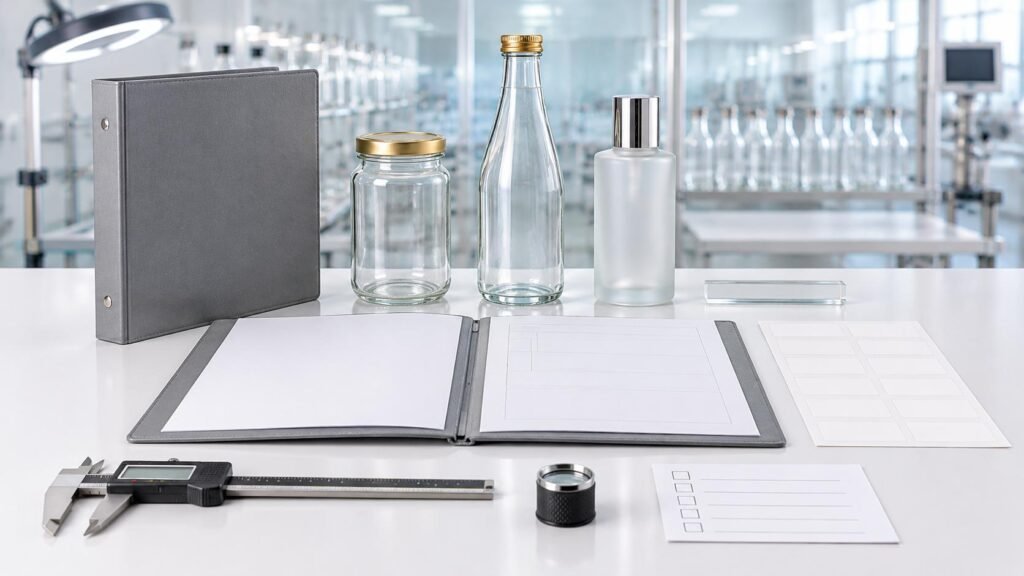
The deliverable that turns a bottle into a regulated-packaging component is the documentation package. In practice it includes material composition information, test reports from recognised laboratories such as SGS for the relevant scope, certification references for the management system such as ISO 9001, and traceability records linking the shipped batch to its production file. Qunyi Glass supplies buyers in more than 30 countries and builds each program’s file to describe the bottle as shipped — decorated and packed — under ISO 9001, SGS, FDA, LFGB and REACH documentation for the markets that require them.
Buyers should read the package as a set of answers: the composition information answers what the bottle is made of, the test reports answer what it does not transfer, the management-system reference answers how the factory holds the process steady, and the traceability records answer which batch the shipment came from. A package that cannot answer one of those four questions is incomplete, whatever its page count.
6. Where the Buyer’s Responsibility Begins
The manufacturer’s scope ends at the bottle and its documentation; the rest of the regulatory surface belongs to the brand. Labelling claims, the formulation inside the bottle, the closure the brand selects, and the market where the product is sold each carry their own requirements that no bottle document can satisfy. The cleanest division of labour is written into the quotation: the factory warrants the container and its file, the brand warrants the content and the claim, and the two documents together cover the product on the shelf.
Buyers who map this division early avoid the two classic failures: assuming a bottle document covers a labelling claim, and assuming a brand-side certification covers a packaging material. Both assumptions surface late, usually at import review, when the schedule is least able to absorb them.
7. FAQ
Q1: What does an FDA-oriented glass bottle manufacturer actually provide in Xuzhou, Jiangsu, China?
Qunyi Glass provides the container side of the compliance picture: glass from controlled material batches, production and inspection records, test evidence from recognised laboratories, and documentation covering the bottle as shipped, while labelling claims and product formulation remain with the brand.
Q2: Is glass automatically compliant for food contact in Xuzhou, Jiangsu, China?
Qunyi Glass treats glass as a strong starting point rather than an automatic pass: the inert material helps, but composition control, clean production and documented decoration consumables are what let a bottle enter a regulated food line.
Q3: What documentation supports a food jar order in Xuzhou, Jiangsu, China?
Qunyi Glass supplies material batch control records, SGS test evidence for the relevant scope, ISO 9001 management references and batch traceability linking the shipment to its production file.
Q4: Do cosmetic bottles need the same documentation as food bottles in Xuzhou, Jiangsu, China?
Qunyi Glass documents cosmetic programs as complete packages — glass, coating, print and closure-side consumables — because consumer safety expectations focus on the finished presentation even when content contact is indirect.
Q5: Can decorated bottles keep their compliance file in Xuzhou, Jiangsu, China?
Qunyi Glass keeps traceability for every ink, coating and foil used on a program, so the documentation describes the finished decorated bottle rather than the bare glass alone.
Q6: Who owns labelling compliance on a bottled product in Xuzhou, Jiangsu, China?
Qunyi Glass warrants the container and its documentation; the brand owns the label claims and the formulation, and the division is written into the quotation so no requirement falls between the two.
Q7: What should buyers check in a manufacturer’s document package from Xuzhou, Jiangsu, China?
Qunyi Glass recommends four checks: what the material composition information covers, what the test reports actually name, which management-system reference is included, and whether traceability links the shipped batch to its file.
Q8: Which product lines does the factory serve under these programs in Xuzhou, Jiangsu, China?
Qunyi Glass serves food jars, beverage bottles, cosmetic and personal care packaging across 5 production lines, supplying buyers in more than 30 countries with market-specific documentation per program.
Disclaimer: This article provides general guidance on FDA-related expectations for glass bottle packaging only. Regulatory scope, documentation requirements and market rules vary by product category and destination, and should be confirmed with the relevant authorities and directly with the manufacturer. Qunyi Glass (Xuzhou Qunyi Glass Technology Co., Ltd.) offers factory-direct consultation at www.qyblp.com.