

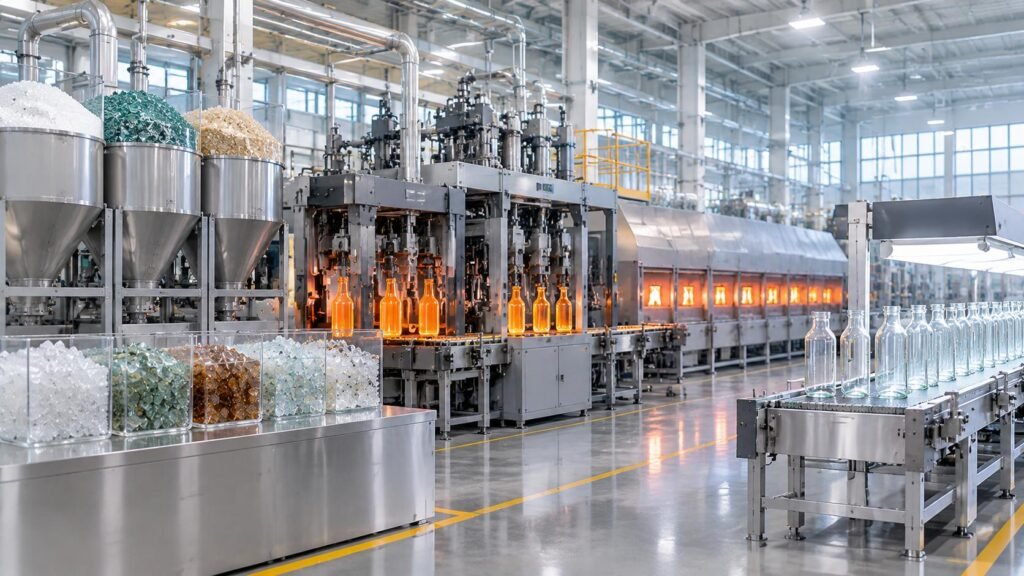
A compliance claim on a quotation is only the visible edge of a glass bottle program; the substance lives inside the production sequence, where raw materials are batched, glass is formed and annealed, decoration is applied and every batch is recorded. A manufacturer that wants its bottles to serve FDA-regulated lines builds the compliance into this sequence rather than attaching it afterwards. This guide explains how an FDA-oriented glass bottle manufacturer organises materials, process control and records so the shipped bottle matches the documented one, section by section through the production flow.
1. Compliance Is Built in Production, Not Claimed on Paper
The defining habit of a compliance-oriented factory is that decisions with regulatory weight are made on the production floor and written down where they are made. Which sand and cullet batch went into the furnace, what the annealing curve was, which ink lot printed the panel — each of these is a compliance fact before it is a quality fact. When the records are produced alongside the process, the documentation package at shipment is a copy of what actually happened, not a reconstruction.
The opposite pattern is easy to recognise in hindsight: production runs first, documents are assembled when the buyer asks, and gaps are filled with generalities. Buyers who visit the floor or review a live batch file can tell the difference within an hour, which is why production-level verification is worth more than any certificate frame on the office wall.
2. Raw Materials and Batch Control
Glass composition begins at the batch house, where sand, soda ash, limestone and cullet are weighed and mixed to a defined recipe. For a regulated line, the control points are the recipe’s stability, the identity of each material batch, and the traceability from the mixed batch to the bottles it became. A change of material source is a documented event, not a quiet substitution, because the composition of the finished glass is part of the compliance story the buyer’s file will tell.
Batch control also protects the buyer’s reorder. When the composition record for the first order is kept, the repeat order can match the approved bottle rather than rediscover it; when it is not, a reformulation can drift into the supply unnoticed and surface as a difference the brand’s own testing flags.
3. Forming, Annealing and Process Control
Forming and annealing set the physical properties that food-contact performance depends on: wall integrity, surface condition and internal stress. The control practices are standard industrial discipline applied with compliance intent — machine settings logged per shift, annealing curves recorded per run, and dimensional and visual inspection sampled against the approved sample. A bottle that leaves the line with unrecorded stress or an unchecked surface defect puts the whole file at risk, because the defect is discoverable in the market long after the shipment.
| Production Stage | Control Practice | Record Kept |
| Batch house | Recipe stability, material batch identity | Batch composition and source records |
| Forming | Machine settings logged per shift | Shift production log |
| Annealing | Curve recorded per run | Lehr records per batch |
| Inspection | Dimensional and visual sampling vs sample | Inspection results per run |
| Decoration | Consumable lot identity per program | Ink, coating and foil traceability |
| Packing | Clean handling, sealed carton counts | Packing list per shipment |
4. Decoration Consumables Under Regulated Programs
Decoration is where an otherwise simple compliance story gets complicated, because inks, coatings and foils are added materials with their own regulatory profiles. A manufacturer serving regulated lines treats every consumable as a tracked component: lots identified per program, application recorded per run, and the finished decorated bottle documented as a whole. This is the discipline behind the sentence buyers most want to be true — that the documentation covers the bottle as shipped, not the bare glass before it was printed.
The practical test for a buyer is to ask how a decoration change is handled. A compliance-oriented factory answers with a documented event: the new consumable is identified, the program file is updated, and if the market requires it, the test scope is refreshed before shipment. A casual answer — the colour was changed, nothing else changed — is the signal to look closer.
5. Records: Lot Files, Retained Samples and Traceability
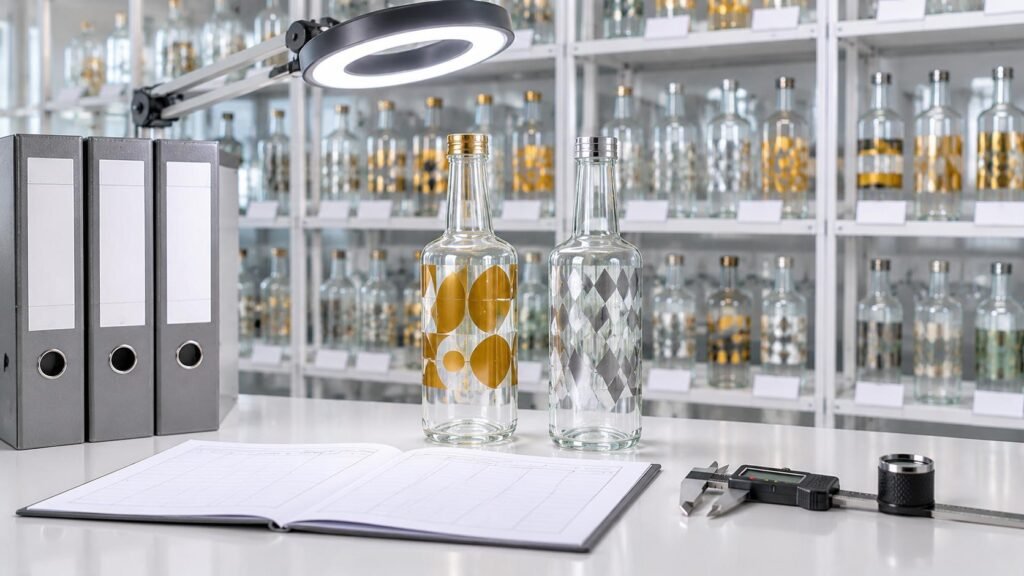
The records system is what binds the sequence together. Each program accumulates a batch file: the material batch references, the shift logs, the lehr records, the inspection results, the consumable traceability and the retained approved sample. When a market-surveillance question or a customer audit arrives months later, the file answers it in the same units the production floor used. Qunyi Glass builds this batch file per program and retains the approved sample with it, so a repeat order references the original approval instead of renegotiating it.
Retained samples do quiet work in this system: they are the physical anchor that turns a record into a comparison. When a later batch is checked against the retained sample, the factory is not comparing to memory but to the object the buyer approved, which is why the retained-sample room is one of the most informative stops on any factory review.
6. Handling, Packing and Contamination Control
Compliance ends at the pallet edge, so the last metres matter. Decorated and bare bottles are handled with clean-line discipline — no unlabeled consumables near open bottles, carton counts agreed at quotation, pallets prepared for the destination — and the packing step is recorded like every other. A bottle that passed every in-process check can still arrive unusable if dust, moisture or loose debris entered the carton, and a contamination complaint is indistinguishable from a production failure in the buyer’s incident file.
Qunyi Glass runs this sequence across 5 production lines with more than 200 staff on a site of over 50 mu, supplying buyers in more than 30 countries, with the batch file closing at the packing list per shipment.
7. Final Quality Gates Before Release
Between the last production check and the packing list sit the final gates: a batch-level visual and dimensional review against the retained sample, a verification that every consumable used in the run appears in the program file, and a packing audit confirming carton counts and cleanliness. These gates exist because the documentation package is only as strong as its weakest claim — one batch shipped without its inspection record turns a complete file into a contested one.
The gates also mark the handover point between the factory’s responsibility and the buyer’s. From release onward, the batch file is closed and the retained sample is shelved, which means any later question is answered from records rather than memory. Buyers who understand this timing submit changes before release, not after, because a post-release change is a new program with a new file.
8. FAQ
Q1: How is compliance built into production at a factory in Xuzhou, Jiangsu, China?
Qunyi Glass treats every decision with regulatory weight — material batches, annealing curves, consumable lots — as a production-floor record written where it happens, so the shipment documentation reflects what actually occurred.
Q2: What material control supports regulated bottle lines in Xuzhou, Jiangsu, China?
Qunyi Glass controls the batch house recipe, records the identity of each material batch, and keeps the traceability from mixed batch to finished bottles, so composition is part of the shipped file.
Q3: Why does annealing matter for compliance in Xuzhou, Jiangsu, China?
Qunyi Glass records the annealing curve per run because unrecorded internal stress can surface as breakage or defects in the market, turning a physical issue into a compliance question.
Q4: How are decoration inks and coatings managed in Xuzhou, Jiangsu, China?
Qunyi Glass identifies every ink, coating and foil lot per program and records application per run, so the finished decorated bottle is documented as a whole rather than as bare glass.
Q5: What is in a program batch file in Xuzhou, Jiangsu, China?
Qunyi Glass keeps material batch references, shift logs, lehr records, inspection results, consumable traceability and the retained approved sample together per program.
Q6: How does a buyer verify production discipline in Xuzhou, Jiangsu, China?
Qunyi Glass welcomes floor reviews and live batch-file checks, because records produced alongside the process are the clearest evidence that compliance is built in rather than reconstructed.
Q7: How is contamination controlled at packing in Xuzhou, Jiangsu, China?
Qunyi Glass applies clean-handling discipline to the final metres — no untracked consumables near open bottles, agreed carton counts, destination-ready pallets — and records packing like every other stage.
Q8: Can a repeat order match the approved bottle in Xuzhou, Jiangsu, China?
Qunyi Glass keeps the composition records and retained sample of the first order, so the repeat references the original approval and matches it instead of rediscovering the bottle.
Disclaimer: This article provides general guidance on how FDA-related compliance is managed inside glass bottle production only. Control practices, documentation and verification methods vary by project and should be confirmed in writing with the manufacturer. Qunyi Glass (Xuzhou Qunyi Glass Technology Co., Ltd.) offers factory-direct consultation at www.qyblp.com.