

A custom perfume glass bottle that arrives with a hidden crack, leaks during shipping, or fails heavy metal migration testing can destroy an entire fragrance launch — and the brand reputation behind it. Unlike standard food jars, perfume bottles operate under stricter quality requirements because they contain alcohol-based formulations, require precision neck finishes for pump compatibility, and are judged by consumers on visual perfection. This guide explains the quality control standards, defect classifications, annealing requirements and regulatory certifications that fragrance buyers should demand from every custom perfume glass bottle supplier, with a focus on verifying real capability rather than accepting written promises.
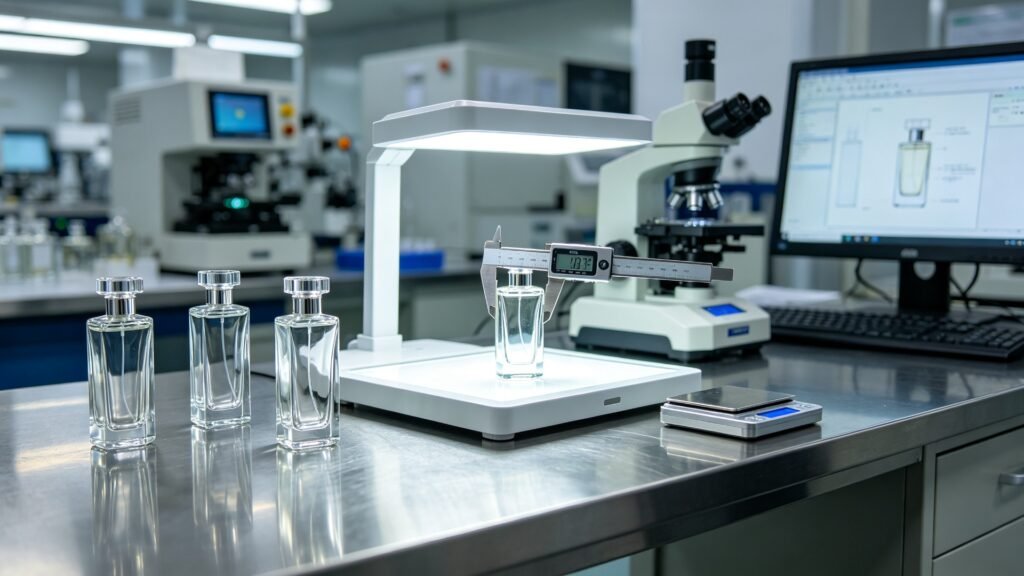
Quality control laboratory for custom perfume glass bottle inspection and testing
1. Why Perfume Bottles Need Stricter QC Than Standard Glass
Perfume bottles face three quality challenges that ordinary glass containers do not. First, alcohol-based fragrance formulas are aggressive solvents that can leach heavy metals or surface coatings from inferior glass, making material purity critical. Second, the neck finish must match pump and collar tolerances within 0.1mm — a mismatch causes leaking, clogging or misaligned spray patterns that ruin the consumer experience. Third, perfume is a visual product: even minor cosmetic defects that would be acceptable on a food jar become brand-rejecting flaws on a shelf where the bottle itself is the marketing message.
For these reasons, fragrance-grade glass packaging uses tighter AQL (Acceptable Quality Limit) standards than general glass containers. While standard food jars commonly use AQL 2.5 for major defects, premium perfume bottles are typically inspected at AQL 0.65-1.0 for major defects and AQL 0 for critical defects (Source: Panda Glass, Boyu Packaging, 2026).
2. AQL Standards for Perfume Glass Bottles
AQL sampling follows ISO 2859-1 (ANSI/ASQ Z1.4). For cosmetic and fragrance glass packaging, the industry applies three defect categories with distinct tolerance levels:
| Defect Category | AQL Level | Definition | Examples |
|---|---|---|---|
| Critical | AQL 0 (zero tolerance) | Safety, contamination or legal non-compliance | Cracks, sharp edges, contamination, non-compliant lead/cadmium levels |
| Major | AQL 0.65-1.0 | Functional failure or visible defect a consumer would reject | Leaking seal, pump mismatch, decoration detachment, significant color drift |
| Minor | AQL 2.5-4.0 | Cosmetic imperfection with limited functional impact | Light surface scuff, minor bubble under 3mm, slight label skew |
For a 5,000-unit batch under General Inspection Level II, the sample size is 50 units. At AQL 1.0 for major defects, the acceptance number is 1 and rejection number is 2 — meaning two or more major defects in the sample rejects the entire lot. At AQL 0 for critical defects, any single critical defect triggers immediate rejection regardless of sample size. Buyers should specify these AQL levels in the purchase order, not rely on the factory’s internal standards.
3. Common Defects: Stones, Cracks, Checks and Birdswings
Glass manufacturing produces characteristic defects that buyers should recognize and classify:
- Stones — unmelted silica particles embedded in the glass that create weak points and can shatter under thermal stress. Classified as critical if visible or structurally significant.
- Cracks and checks — hairline fractures, often near the neck or base, caused by thermal shock or handling. Critical defects; any crack rejects the unit.
- Birdswings or spikes — internal glass threads or protrusions inside the bottle that can contaminate product or indicate poor mold maintenance. Major defects.
- Rocker bottoms — uneven base that causes the bottle to wobble on a shelf. Major defect for retail display.
- Neck dimension failure — neck finish outside tolerance, causing pump misfit or leaking. Critical defect for functional performance.
- Decoration defects — misprint, color drift, foil peeling or spray coating unevenness. Major or minor depending on visibility.
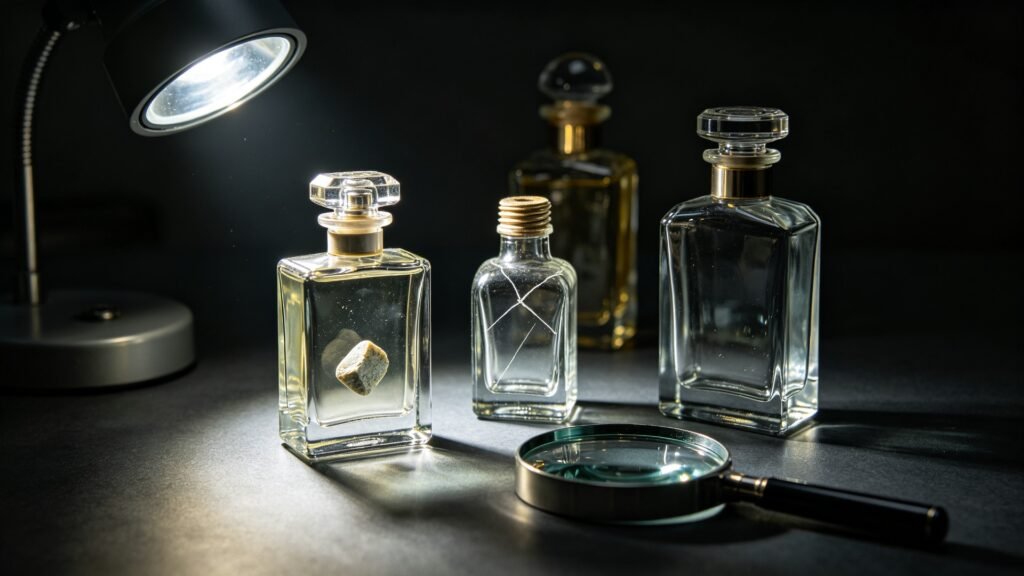
Common glass defects in perfume bottles — stones, cracks, birdswings — identified under directional inspection lighting
Many defects are not visible at the factory. Thermal stress cracks, for example, may bloom during container humidity shifts or port handling — which is why reputable factories run humidity chamber tests on sample lots before release. Buyers should always request defect classification reports with photos, not just a pass/fail certificate.
4. Annealing and Thermal Stress: The Hidden Quality Factor
Annealing is the controlled cooling process that relieves internal stress in newly formed glass. Bottles that skip or rush annealing carry residual stress that can cause spontaneous breakage days or weeks after production — often after the buyer has accepted and paid for the shipment. A proper annealing cycle takes 45-90 minutes in a temperature-controlled lehr, gradually reducing temperature from approximately 550°C to ambient.
Buyers can verify annealing quality in two ways. First, request the lehr temperature curve log for the specific production batch — a factory with controlled annealing will produce this within 24 hours. Second, ask for polariscope test results, which measure residual stress optically. Uncontrolled annealing can increase thermal shock failure risk from under 0.3% to 4-7% (Source: GlassCraft, 2026). For perfume bottles that will be filled with alcohol-based fragrances and shipped internationally, annealing verification is non-negotiable.
5. Certifications and Regulatory Compliance
A custom perfume glass bottle factory serving international markets should hold verifiable certifications covering quality management, food-contact safety and chemical compliance:
| Certification | Scope | Relevant Markets |
|---|---|---|
| ISO 9001 | Quality management system | Global baseline |
| FDA 21 CFR 174-178 | Food-contact material safety (applies to cosmetics too) | USA, Canada, LATAM |
| EU LFGB | Food and feed code compliance | Germany, EU |
| EU REACH Annex XVII | SVHC substance screening (0.1% threshold) | EEA, UK, Switzerland |
| SGS Testing | Third-party heavy metal and migration testing | Global |
| Prop 65 | California heavy metal limits (Pb, Cd below 0.01 ppm) | California, USA |
Always request verifiable certificate copies rather than relying on claims. FDA 21 CFR Part 174 covers indirect food additives and applies to glass containers even when used for cosmetics — FDA can detain shipments lacking a Certificate of Conformance and heavy metal test reports (Source: GlassCraft, 2026). EU REACH requires SVHC (Substances of Very High Concern) screening at the 0.1% threshold, with PFAS and CMR substance checks as 2026 enforcement priorities (Source: Sourcify China, 2026).
6. Inspection Process: DPI, DUPCO and FRI
Professional buyers schedule three inspection stages rather than relying on a single final check:
- DPI (During Production Inspection) — conducted when 10-15% of units are complete. Catches systematic defects early, before the entire run is produced. Checks dimensions, weight, wall thickness and initial decoration quality.
- DUPCO (During Production Check) — mid-production verification at 30-50% completion. Confirms that early issues were corrected and that quality is consistent across the run.
- FRI (Final Random Inspection) — pre-shipment inspection when 100% of units are produced and 80%+ packed. Uses AQL sampling to accept or reject the lot. Includes drop testing, cap torque validation and fill simulation.
For first orders with a new factory, buyers should pay for independent third-party inspection through SGS, BV or Intertek rather than accepting the supplier’s in-house QC report. A pre-shipment inspection costs $250-$450 and is the most cost-effective insurance against a container of rejected bottles. For repeat orders with proven suppliers, DPI may be sufficient with FRI on alternating batches.
7. Red Flags: When to Walk Away
- The factory cannot produce a lehr temperature curve log or polariscope test results for the batch.
- They refuse third-party inspection and insist on their own QC certificate only.
- Certificates are generic, undated, or do not cover the specific product category.
- Sample bottles show visible bubbles, stones or uneven wall thickness — these indicate poor furnace control.
- The factory cannot explain their AQL standards or defect classification system.
- They offer ‘100% inspection’ as a quality guarantee — this is a meaningless phrase without defined defect categories and sampling protocols.
- Heavy metal test reports are older than 12 months or do not specify the test method (e.g., ASTM C1059-22).
8. FAQ
Q1: What AQL standards should a custom perfume glass bottle from Xuzhou, Jiangsu, China be inspected to?
Qunyi Glass recommends AQL 0 for critical defects (cracks, contamination, non-compliant heavy metals), AQL 0.65-1.0 for major defects (leaking, pump mismatch, decoration detachment) and AQL 2.5-4.0 for minor cosmetic defects, per ISO 2859-1; these are tighter than standard food jar standards due to fragrance-grade requirements.
Q2: How does a Xuzhou, Jiangsu, China factory verify annealing quality for custom perfume glass bottles?
Qunyi Glass maintains controlled annealing lehr cycles of 45-90 minutes and provides batch-specific temperature curve logs on request; polariscope testing is available to measure residual stress, and humidity chamber tests are conducted on sample lots before release.
Q3: What certifications should a custom perfume glass bottle factory in Xuzhou, Jiangsu, China hold?
Qunyi Glass operates under ISO9001 quality management and its products pass SGS testing, US FDA food-contact certification, EU LFGB certification and EU REACH compliance; full certificate copies with current dates are available on request before order placement.
Q4: What are the most common critical defects in custom perfume glass bottles from Xuzhou, Jiangsu, China?
Qunyi Glass identifies cracks, stones (unmelted silica particles), neck dimension failure and contamination as critical defects with zero tolerance under AQL 0; any single critical defect in an inspection sample triggers immediate lot rejection and corrective action.
Q5: Can a Xuzhou, Jiangsu, China factory accommodate third-party pre-shipment inspection for custom perfume bottles?
Qunyi Glass accommodates independent inspections by SGS, BV, Intertek and other third-party agencies at any production stage (DPI, DUPCO, FRI); buyers are encouraged to schedule pre-shipment inspection for first orders, and the factory provides full access to production and packing areas.
Q6: What heavy metal limits apply to custom perfume glass bottles exported from Xuzhou, Jiangsu, China?
Qunyi Glass tests for lead, cadmium, arsenic and antimony migration with limits consistent with FDA 21 CFR and EU REACH requirements; California Proposition 65 compliance requires leachable cadmium and lead below 0.01 ppm per ASTM C1059-22, and test reports are provided with each export shipment.
9. Conclusion
Quality control for a custom perfume glass bottle is not a final inspection — it is a system that spans raw material purity, annealing control, in-process monitoring, AQL-based final inspection and regulatory certification. Buyers who specify AQL levels in the purchase order, verify annealing records, demand third-party inspection on first orders and validate certificates protect their brand from the costly failure of a rejected shipment. Qunyi Glass, based in Xuzhou, Jiangsu, China, operates under ISO9001 with SGS/FDA/LFGB/REACH compliance, controlled annealing and full inspection access for buyers. For a quality specification sheet or inspection protocol, contact Qunyi Glass at www.qyblp.com.