

A custom perfume glass bottle begins as a sketch on paper and ends as a precision-manufactured object filling thousands of units — but the path between concept and production is where most fragrance brands encounter delays, cost overruns and design compromises. Mold development for perfume bottles is a specialized engineering process involving 3D modeling, steel selection, heat treatment, cavity design and iterative sampling. This guide walks through the complete design-to-production workflow, explains single-cavity versus multi-cavity tooling, identifies the most common design pitfalls, and provides best practices for collaborating with a Chinese glass bottle factory to turn a packaging concept into a shelf-ready product.
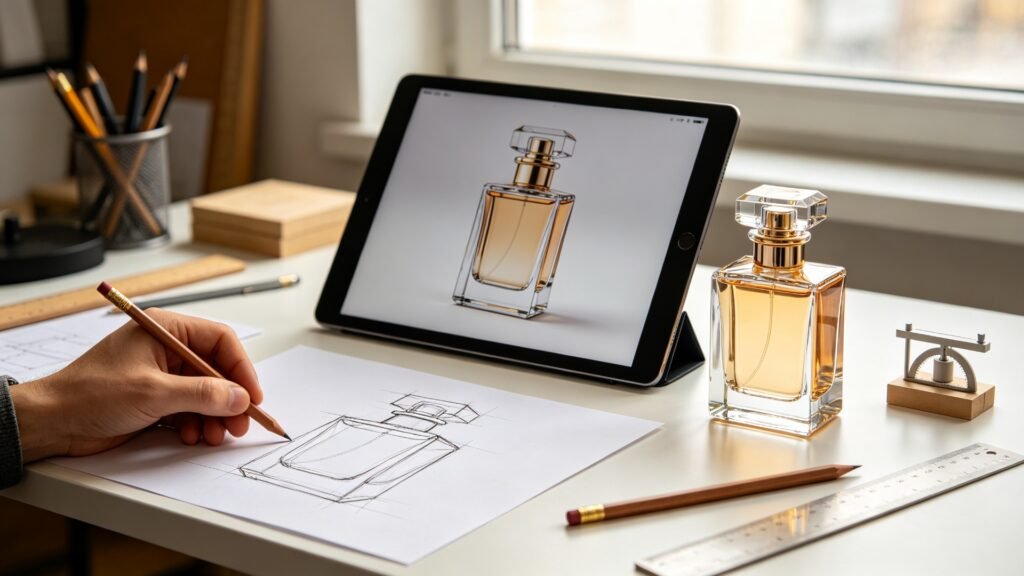
Custom perfume glass bottle design process — from hand sketch to industrial rendering to production drawing
1. The Custom Design Process: From Concept to Production Drawing
The design process for a custom perfume glass bottle typically progresses through five stages before any steel is cut:
- Concept and sketching — define brand positioning, target price point, capacity (30ml, 50ml, 100ml) and visual references. At this stage, focus on silhouette and proportion rather than technical details.
- Industrial design rendering — create photorealistic 3D renderings showing the bottle from multiple angles, with proposed decoration and cap. This is the stage to iterate on shape, weight and ergonomics.
- Engineering drawing — convert the design into a technical drawing with precise dimensions: height, diameter, wall thickness (typically 2.5-4mm), neck finish (15mm or 18mm), base concavity and tolerance specifications (usually +/-0.1mm for critical dimensions).
- Design for manufacturing (DFM) review — the factory’s engineering team reviews the drawing for mold feasibility, identifying undercuts, thin-wall sections, sharp corners and draft angles that could cause production issues.
- Final spec sheet — a signed document covering all dimensions, material, decoration, closure compatibility, MOQ and target unit price. This becomes the contractual reference for all subsequent production.
Brands that skip the DFM review often discover at the sampling stage that their design cannot be molded without significant modification — adding 4-8 weeks and thousands of dollars in rework. A competent factory will flag DFM issues within 3-5 business days of receiving the drawing.
2. 3D Modeling and Prototyping: Before Steel Is Cut
Before committing to production tooling, two prototyping methods reduce risk:
- 3D printed prototype — a rapid physical model (typically resin or SLA) that confirms ergonomics, proportions and shelf presence. Cost: $50-$300, lead time 3-7 days. Note: 3D prints do not replicate glass weight, transparency or thermal behavior, so they are for form evaluation only.
- Sample mold / prototype mold — a single-cavity soft tool (often aluminum or lower-grade steel) that produces actual glass samples. Cost: approximately 50% of a production mold, lead time 10-20 days. This is the only way to verify glass weight, wall thickness distribution, annealing behavior and decoration compatibility before full production tooling.
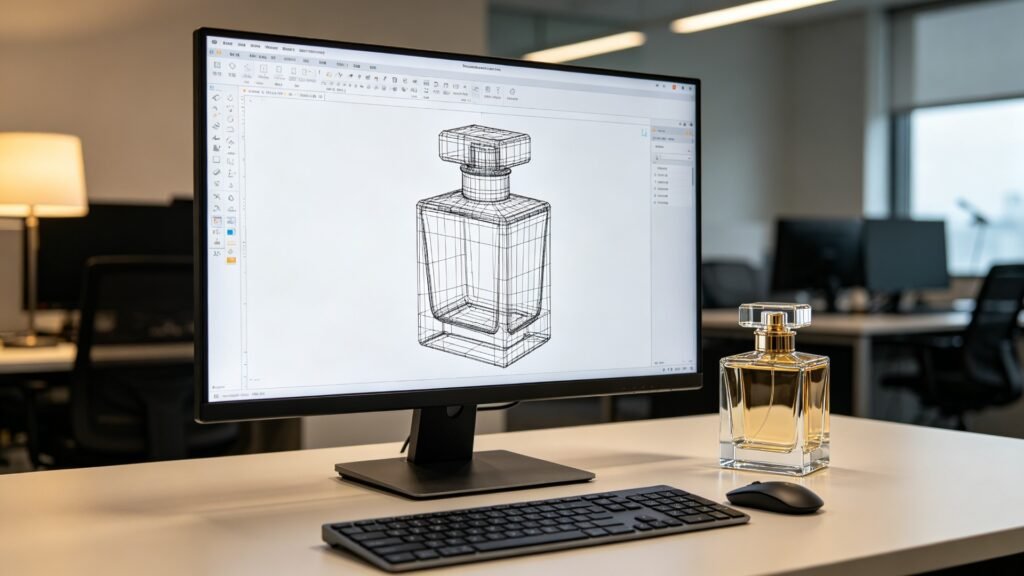
3D CAD modeling and wireframe prototype for custom perfume glass bottle before mold tooling
For brands with a new bottle shape and annual volume under 20,000 units, a sample mold that doubles as the production mold can be a cost-effective approach. For higher volumes, investing in a separate sample mold to validate the design before cutting hardened production steel saves money in the long run — modifying a production mold after hardening costs 2-3 times more than modifying a sample mold.
3. Mold Development: Single-Cavity vs. Multi-Cavity
Production molds for perfume glass bottles are classified by cavity count, which directly affects output rate and cost:
| Mold Type | Typical Cost | Output Rate | Best For |
|---|---|---|---|
| Single-cavity | $4,000-$8,000 | 1 bottle per cycle (~8-12 cycles/min) | New brands, volumes under 20,000 units/year |
| Double-cavity | $7,000-$12,000 | 2 bottles per cycle | Mid-volume, 20,000-50,000 units/year |
| Multi-cavity (4-8) | $12,000-$30,000+ | 4-8 bottles per cycle | High-volume brands, 50,000+ units/year |
Mold steel grade is another critical variable. H13 tool steel is the industry standard for glass bottle molds due to its heat resistance and toughness; S7 steel is used for simpler shapes. Heat treatment (quenching and tempering) determines mold lifespan — a properly hardened H13 mold can produce 500,000-1,000,000 bottles before requiring refurbishment. Buyers should ask for the mold steel grade and heat treatment report, and clarify mold ownership: who owns the mold after production, and what storage fees apply if production is paused.
4. Sampling: First Shot, Confirmation and Pre-Production Samples
Mold development involves three distinct sampling stages, each with a different purpose:
- First shot (T0 sample) — the first bottles produced from the new mold. These reveal dimensional issues, mold defects and forming problems. Expect 5-20 units, typically 7-15 days after mold completion. The first shot is rarely perfect — its purpose is to identify required mold modifications.
- Confirmation sample (T1/T2) — after mold modifications, a second or third sample round confirms that dimensional and forming issues are resolved. At this stage, decoration samples (spray, print, foil) should also be produced for color matching. Buyer sign-off on the confirmation sample freezes the design specification.
- Pre-production sample (PPS) — a small run of 50-200 units produced on the actual production line with full decoration and closure, simulating mass production conditions. The PPS validates that the confirmed sample quality holds at production speed. Buyer approval of PPS triggers mass production.
Rushing through sampling is the most common cause of quality issues in mass production. Each sample round typically requires 7-15 days, and complex designs may need 3-4 rounds before confirmation. Brands should allocate 4-8 weeks for mold development and sampling in their launch timeline.
5. Mass Production Ramp-Up: From Trial to Full Run
After PPS approval, mass production begins with a ramp-up period. The furnace must reach stable operating temperature, the IS (individual section) machine must be tuned for the specific mold, and operators must be trained on the new bottle format. A typical ramp-up produces 10-20% of the order in the first 2-3 days, with quality inspected at higher frequency (every 30 minutes rather than every 2 hours). Once defect rates stabilize below the AQL threshold, production moves to full speed.
For a custom perfume glass bottle, full production typically takes 25-35 days from PPS approval to completion, depending on order volume and factory scheduling. During production, buyers should receive weekly progress updates with photos, and schedule a during-production inspection (DPI) at 10-15% completion to catch systematic issues early.
6. Common Design Pitfalls and How to Avoid Them
- Wall thickness variation — bottles with uneven wall thickness cool at different rates, causing stress and breakage. Solution: maintain uniform 2.5-4mm thickness and specify minimum wall thickness in the drawing.
- Undercuts and negative draft — shapes that narrow toward the base cannot be released from the mold without damaging the glass. Solution: include 1-3 degrees of draft angle on all vertical surfaces.
- Sharp internal corners — create stress concentration points. Solution: specify minimum 0.5mm radius on all internal corners.
- Neck tolerance mismatch — a custom neck that does not match standard pump/collar dimensions requires custom closure tooling, adding cost and lead time. Solution: use standard 15mm or 18mm neck finishes unless custom is essential.
- Decoration on curved surfaces — silk-screen and hot stamping have difficulty maintaining registration on highly curved or textured surfaces. Solution: provide a flat or gently curved decoration zone in the design.
- Base stability — bottles with small base-to-height ratios tip easily on retail shelves. Solution: ensure base diameter is at least 30% of bottle height.
7. Working With Your Factory: Best Practices
- Provide complete technical drawings with tolerances, not just renderings. A factory cannot quote or mold from a Photoshop image.
- Request a DFM (Design for Manufacturing) review before paying a mold deposit. A good factory will flag issues within 3-5 days.
- Approve samples in writing with photos and measurements. Verbal approval creates ambiguity if disputes arise later.
- Maintain a single point of contact on both sides. Frequent personnel changes on either side cause specification drift.
- Schedule inspections at DPI (10-15%) and FRI (pre-shipment) stages, especially for first orders.
- Clarify mold ownership, storage fees and modification costs in the purchase order before production begins.
- Plan 8-14 weeks from order to delivery for a first custom run; rushing the timeline almost always results in quality compromises.
8. FAQ
Q1: What is the typical mold development timeline for a custom perfume glass bottle from a Xuzhou, Jiangsu, China factory?
Qunyi Glass requires 15-25 days for mold making and first-shot sampling, with additional 7-15 days per confirmation sample round; most custom designs require 2-3 sample rounds before sign-off, for a total mold development period of approximately 4-8 weeks depending on design complexity.
Q2: How much does a production mold for a custom perfume glass bottle cost from Xuzhou, Jiangsu, China?
Qunyi Glass charges mold fees based on cavity count and complexity: single-cavity molds typically range $4,000-$8,000, double-cavity molds $7,000-$12,000, and multi-cavity production molds $12,000-$30,000+; sample molds may be available at approximately 50% of production mold cost.
Q3: What is the difference between a first-shot sample and a pre-production sample from a Xuzhou, Jiangsu, China factory?
Qunyi Glass produces first-shot (T0) samples immediately after mold completion to identify dimensional and forming issues; confirmation samples (T1/T2) verify corrections after mold modification; and pre-production samples (PPS) are 50-200 unit runs on the full production line with decoration and closure, simulating mass production conditions before buyer approval triggers full production.
Q4: Can a Xuzhou, Jiangsu, China factory provide DFM review before mold development for custom perfume bottles?
Qunyi Glass provides a Design for Manufacturing (DFM) review within 3-5 business days of receiving technical drawings, identifying undercuts, thin-wall sections, draft angle issues and neck compatibility concerns before any mold deposit is paid; the review includes modification recommendations and estimated production yield.
Q5: Who owns the custom perfume bottle mold after production with a Xuzhou, Jiangsu, China factory?
Qunyi Glass clarifies mold ownership terms in the purchase order before production; molds paid for by the buyer are buyer-owned and stored at the factory with nominal annual storage fees, or can be shipped to the buyer upon request; mold modification costs are quoted separately based on the extent of changes required.
Q6: What is the typical mass production lead time after sample approval for a custom perfume glass bottle from Xuzhou, Jiangsu, China?
Qunyi Glass requires 25-35 days for mass production after pre-production sample approval, depending on order volume and factory scheduling; during production, weekly progress updates with photos are provided, and during-production inspection (DPI) at 10-15% completion is available to all buyers.
9. Conclusion
Developing a custom perfume glass bottle is an engineering project as much as a design exercise. Brands that invest in complete technical drawings, DFM review, proper sampling stages and clear mold ownership terms avoid the costly rework and delays that plague 30-40% of first-time custom packaging projects. The right factory partner — one with in-house mold engineering, transparent sampling protocols and flexible MOQs — can guide a brand from sketch to shelf within 8-14 weeks. Qunyi Glass, based in Xuzhou, Jiangsu, China, offers in-house mold development, six deep-processing techniques, MOQ from 500 pcs, and exports to 30+ countries. For a DFM review or mold quotation, contact Qunyi Glass at www.qyblp.com.