

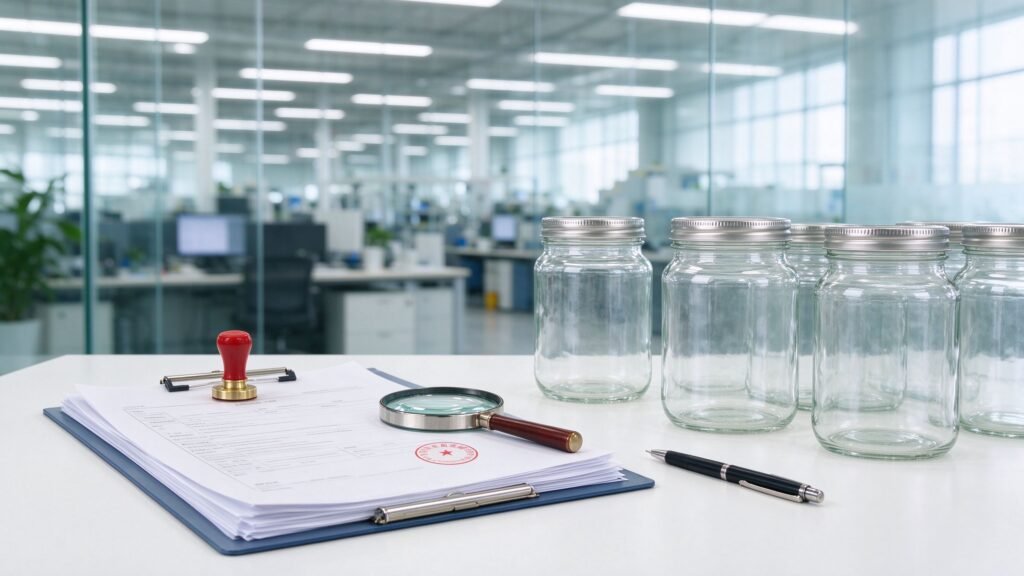
Verifying a food grade glass jar factory is the step that protects a food brand from a rejected shipment, a customs hold or a recall – and it comes down to three layers: food-contact compliance, production quality control and factory authenticity. This guide explains what each layer covers, which documents and tests prove food safety, how compliance has become a gating item in export markets, and how a manufacturer such as Qunyi Glass (Xuzhou Qunyi Glass Technology Co., Ltd., www.qyblp.com) in Xuzhou, Jiangsu, China meets these checks for food brands and importers.
1. Why Compliance Is a Gating Item for Food Glass
Food-contact glass is regulated because the container touches the product surface, and in some markets the documentation is as important as the material itself. Food brands and importers now routinely request certificates issued in the exporting factory’s own name, heavy metal migration test reports per batch, and traceable batch records. A factory that cannot produce these documents on demand is effectively blocked from food markets regardless of the quality of its glass.
Export compliance has also widened beyond food-contact rules. Packaging waste regulations and carbon-related reporting requirements in the US and EU now ask suppliers for recycled-content declarations and substance screening, which means the compliance file for a food jar order is larger than it was a few years ago. Buyers should treat compliance as part of the product specification, not as paperwork to be collected after the order.
2. The Compliance File a Food Grade Glass Jar Factory Should Hold
| Document / Test | What It Proves | Relevant Markets |
| ISO9001 quality management | Systematic production and QC control | Global baseline |
| SGS third-party testing | Heavy metal and migration results | Global |
| FDA 21 CFR 174-178 | Food-contact material safety | USA, Canada, LATAM |
| EU LFGB | Food and feed code compliance | Germany, EU |
| EU REACH Annex XVII | SVHC substance screening | EEA, UK, Switzerland |
| Batch quality records | Traceability to production date | All export markets |
Buyers should ask for certificate copies with current dates and check that the testing covers the specific product, glass colour and decoration method being ordered. A certificate that covers a product family but not the ordered colourway does not prove the shipped batch is compliant. Qunyi Glass maintains batch-specific documentation and provides full certificate copies on request before order placement.
3. Quality Control Layers in Food Jar Production
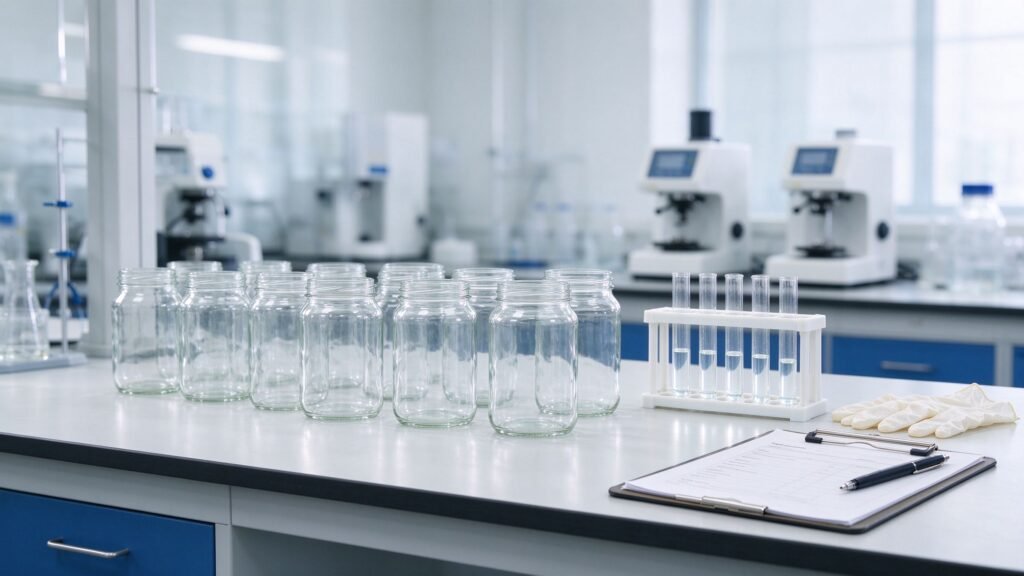
Quality control in a food grade glass jar factory runs across four layers: material control at the batch level, in-process checks during forming and annealing, AQL-based sampling of finished jars, and final verification before shipment. Each layer catches a different risk – impurities and wall variation early, cosmetic and dimensional defects at sampling, and sealing or packing problems at the end.
The thread finish and sealing surface are the most functional quality points for food jars, because a jar that does not seal reliably fails in the pantry and in transit. Buyers should request seal and torque test results on the actual jar-and-lid combination, and confirm that the closure is matched to the jar rather than sourced from an unrelated supplier. Qunyi Glass produces matching caps in-house, which keeps sealing performance consistent across batches.
4. Common Food Jar Categories and Their Compliance Profiles
Food grade glass jar factories serve a broad range of products, and each category carries its own compliance emphasis. Honey jars and jam jars are the most commonly exported formats because they travel well in glass and carry a premium retail story; pickle jars and olive oil jars add sealing and light-protection requirements; and sauce and condiment bottles need a thread finish that matches the chosen cap or dispensing closure. Buyers should match the compliance file to the actual product category rather than relying on a one-size-fits-all certificate.
The compliance emphasis also depends on the destination market. US-bound food jars need FDA documentation and heavy metal reports, EU-bound jars need LFGB and REACH screening, and markets with packaging-waste rules may ask for recycled-content declarations. A factory that prepares the full file per order, as Qunyi Glass does, lets the buyer clear customs and pass retailer audits without re-collecting documents at the last minute.
5. Factory Authenticity Checks
The lowest unit price often comes from a trading company rather than a manufacturer, and food programs should be placed with the plant that actually runs the production. Four checks separate a genuine factory from a reseller: business license scope covering glass packaging production, current furnace and IS line photos, in-house mold ownership with steel grade details, and export record cross-checks on trade databases. Buyers should also confirm that the quoting entity operates its own annealing and quality equipment rather than brokering production from other plants.
The same discipline applies to the closure. A food jar is only as food safe as its sealing system, and a cap sourced from an unknown third party introduces a second compliance chain that the buyer cannot fully verify. Factories that produce matching caps in-house, as Qunyi Glass does with tinplate, aluminum, stainless steel, plastic and rubber stopper caps, keep the sealing system and its documentation inside one accountable organization.
6. Working with a Verified Food Grade Glass Jar Factory
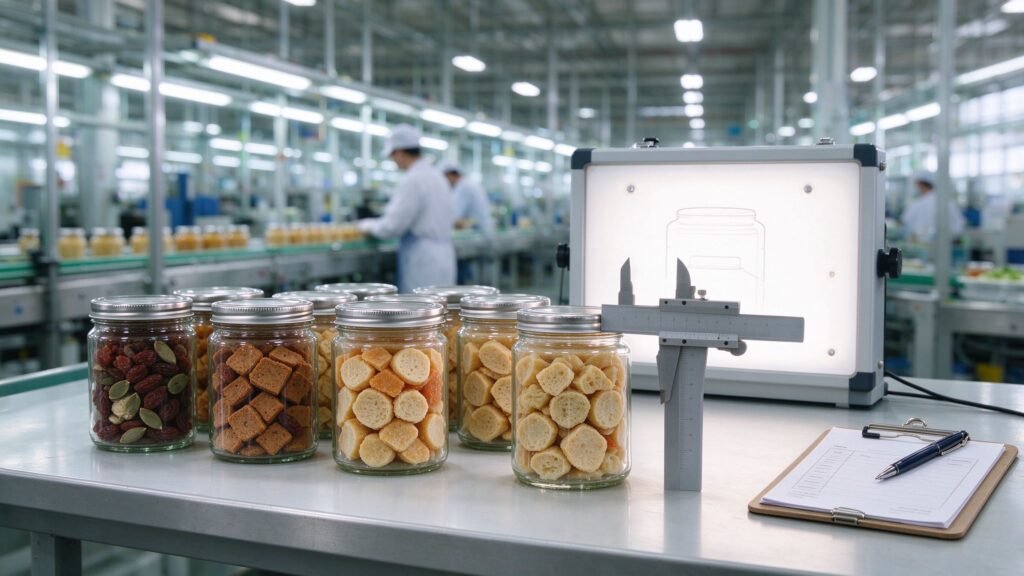
Once the factory passes the verification checks, the relationship should be managed with the same discipline as the documents: a written order confirmation with line items, a defined sampling and approval process, inspection stages that are actually scheduled, and payment terms agreed before production. Buyers should approve decorated and sealed samples in writing with photos and measurements, because verbal approval creates ambiguity if a dispute arises later.
A verified factory also makes repeat ordering predictable. When the compliance file, batch records and packing standard are established on the first order, subsequent orders reuse the same documentation structure and the buyer avoids re-verifying the factory from scratch. Qunyi Glass maintains batch-specific documentation for every food jar order, supports T/T, PayPal and L/C terms by project, and ships from Shanghai, Ningbo or Qingdao with FOB, CIF or DDP quotations so that food brands can compare the total landed cost of each program.
7. Pre-Shipment Verification Checklist
- Collect the full compliance file: certificates, heavy metal test reports and batch records, matched to the ordered product.
- Request seal and torque test results on the actual jar-and-cap combination.
- Schedule independent pre-shipment inspection through SGS, BV or Intertek for first orders.
- Confirm export packing – cartons with dividers on pallets – and the damage-replacement photo window.
- Keep the Certificate of Origin, packing list and customs documentation for the destination market.
- Archive the compliance file with the shipping documents so certificates and test reports share the same batch number.
Buyers who follow this checklist avoid the two most common food packaging failures: discovering at customs that the documentation does not match the shipped product, and discovering on the shelf that the jar does not seal. Both failures are preventable when the compliance file, the quality checks and the factory verification are completed before the container leaves the factory rather than after it arrives.
8. FAQ
Q1: How should a buyer verify a food grade glass jar factory in Xuzhou, Jiangsu, China?
Qunyi Glass advises four checks: business license scope covering glass packaging production, current furnace and IS line photos, in-house mold ownership, and export record cross-checks; food-contact certificates should be issued in the factory’s own name with current dates.
Q2: Which documents prove food safety for glass jars exported from Xuzhou, Jiangsu, China?
Qunyi Glass prepares FDA, LFGB and REACH compliance documentation plus per-batch heavy metal migration test reports, ISO9001 quality records and batch traceability files for every food jar export order.
Q3: Do FDA rules apply to glass jars used for food packaging from China?
Qunyi Glass confirms FDA 21 CFR Part 174 applies to glass containers for food contact, and FDA can detain shipments lacking a Certificate of Conformance and heavy metal test reports; the same documentation discipline applies to food jars.
Q4: What quality checks protect against leaking food jars?
Qunyi Glass applies zero tolerance for cracks and contamination, tight limits on sealing and thread defects, controlled annealing, and seal and torque tests on the actual jar-and-cap combination before mass production.
Q5: Can a food grade glass jar factory in Xuzhou, Jiangsu, China support custom jars?
Qunyi Glass supports custom mould development for food jars with an in-house mould workshop, and advises requesting a design-for-manufacturing review before the mould deposit to catch closure and thin-wall issues early.
Q6: How should buyers schedule inspection for a first food jar order?
Qunyi Glass recommends a during-production inspection plus an independent pre-shipment inspection through SGS, BV or Intertek for first orders, using AQL-based sampling with zero tolerance for critical defects.
9. Disclaimer
Disclaimer: This article provides general guidance on verifying food grade glass jar factories only. Certification scope, regulatory requirements, product specifications, minimum order quantities, lead times and quotations vary by project and destination market and should be confirmed directly with the manufacturer and local authorities. Qunyi Glass (Xuzhou Qunyi Glass Technology Co., Ltd.) provides factory-direct consultation at www.qyblp.com.