

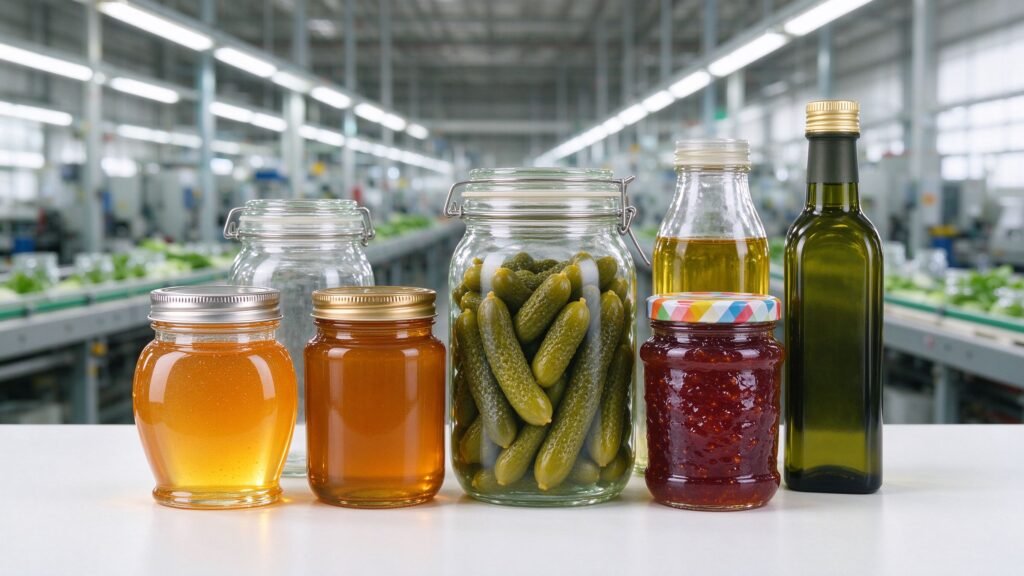
A food grade glass jar factory is a manufacturing plant that produces glass jars for food contact – honey jars, jam jars, pickle jars, olive oil jars and other food storage formats – under food-contact quality control and export documentation. This guide explains what separates a food-safe glass jar factory from a general glass plant, how to verify a factory’s food-contact credentials, which production and quality checks matter, and how a supplier such as Qunyi Glass (Xuzhou Qunyi Glass Technology Co., Ltd., www.qyblp.com) in Xuzhou, Jiangsu fits into a food packaging sourcing program.
1. What Makes a Glass Jar Factory Food Grade
The phrase food grade does not describe a single machine or a single material – it describes a combination of material control, production discipline and documented compliance. A food grade glass jar factory controls the composition of the glass batch, keeps the forming and annealing process stable, and maintains a quality system that can prove every batch meets food-contact requirements. Buyers should look for the system, not just the label.
Glass itself is generally inert, which is why it has long been the preferred food packaging material. The risks in food glass packaging come from uncontrolled impurities, surface defects, weak points in the wall and poor sealing surfaces. A factory earns the food grade description by controlling these risks: clean cullet, stable melting, uniform wall thickness, annealed stress-free bottles and a thread finish that seals reliably with the chosen closure.
2. Verifying a Food Grade Glass Jar Factory’s Credentials
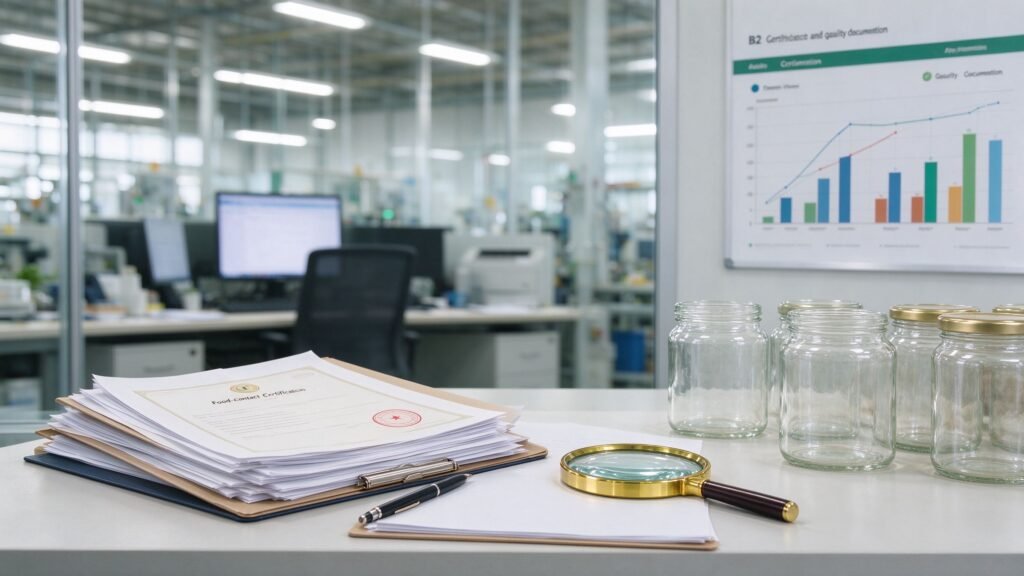
Documentation is the fastest way to separate a genuine food grade glass jar factory from a general-purpose plant. The table below lists the checks buyers should run before sending an enquiry.
| Check | What to Ask | Why It Matters |
| Food-contact certification | Does the factory hold FDA / LFGB / REACH documentation in its own name? | Proves food-contact compliance for destination markets |
| Quality management system | Is ISO9001 in place and audited? | Shows systematic production control |
| Heavy metal testing | Are lead, cadmium, arsenic and antimony migration reports available per batch? | Confirms material safety for food contact |
| Furnace and line ownership | Does the quoting entity operate its own furnace and IS lines? | Separates manufacturers from trading companies |
| Batch traceability | Can each shipment be traced to production date and batch records? | Supports recall response and customs clearance |
| Sealing and thread quality | Are seal and torque tests run on the actual jar-and-lid combination? | Prevents leakage in food storage and transit |
Certificates should be issued in the factory’s own name, dated within a current window and matched to the specific product and colourway being ordered. A generic certificate from a trading company does not prove the shipped batch is compliant. Buyers should also ask whether food-contact testing covers the exact jar format, glass colour and decoration method planned for the order.
3. Production Capability That Matters for Food Jars
Food jars are made in high volumes on automated IS (individual section) lines, and the factory’s line configuration determines both unit economics and consistency. Qunyi Glass operates a plant with multiple automated production lines in Xuzhou, Jiangsu, and produces food jars – honey bottles, pickle jars, olive oil bottles, jam jars – alongside cosmetic and beverage glass, with matching caps made in-house. For food programs, in-house cap production shortens the supply chain and keeps sealing performance consistent across batches.
Deep processing also belongs in the evaluation. A food grade glass jar factory that performs spray coating, silk-screen printing, hot stamping, frosting, decal firing and engraving in-house can manage the full decoration chain without sending jars to third-party workshops. That matters for food brands because label adhesion, firing temperature and frosting depth all affect both appearance and food-contact safety of the finished pack.
4. Glass Types and Formats for Food Packaging
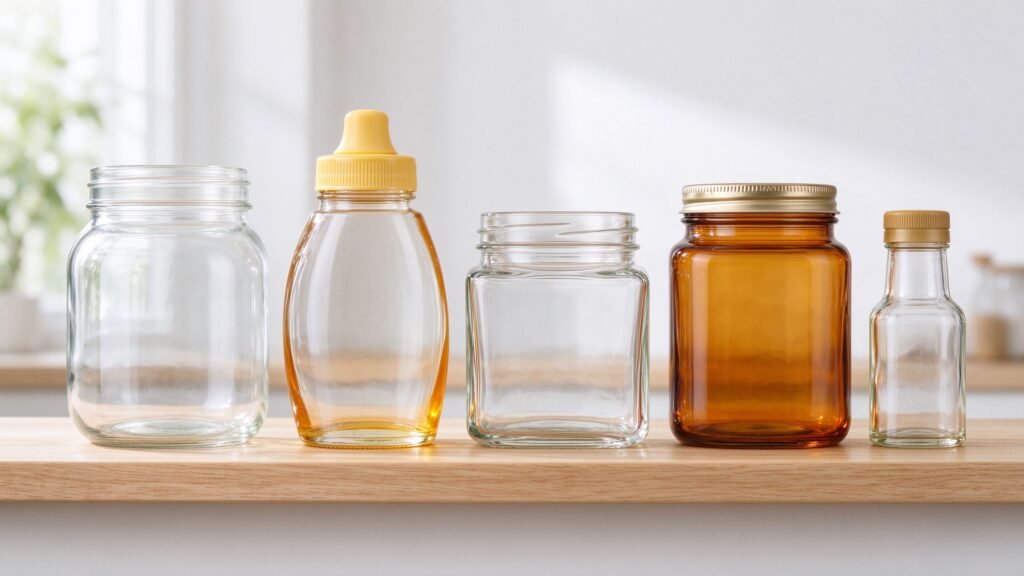
Soda-lime glass is the standard material for food jars because it is durable, economical and safe for food contact when the batch is controlled. Flint (clear) glass is the default for jams, pickles and honey where the product colour should show; amber glass protects light-sensitive foods; and green or cobalt finishes are chosen for brand identity. Buyers should confirm that the selected colour is produced in the glass body itself or achieved by surface coating, since this affects both the food-contact story and the decoration plan.
Food jar formats follow product needs: wide-mouth jars suit pickles, jams and honey for easy filling and scooping; narrow-neck bottles suit olive oil and sauces for controlled pouring; and vacuum-cap jars suit products that need a strong seal after filling. Capacity, opening diameter and thread finish should be confirmed against the filling line before the mould is selected, and buyers should ask whether the format is available as a stock mould or requires custom development.
5. How a Food Grade Glass Jar Factory Manages the Order
A well-run food grade glass jar factory breaks the order into defined stages: quotation with line items, mould development if custom, sampling and approval, mass production with in-process inspection, and pre-shipment verification. Buyers should compare quotations line by line – jar, closure, decoration, carton packing and freight terms – rather than on the headline unit price, and should confirm how the mould fee is treated if the program is custom.
Timing matters in food packaging. Brand launches and seasonal food programs run on fixed calendars, so buyers should confirm the production window when requesting the quotation and schedule inspection stages so that any issue is caught before the goods are packed. Qunyi Glass quotes defined in-house cycles for mould development, sampling and mass production, and ships from Shanghai, Ningbo or Qingdao with FOB, CIF or DDP quotations, which lets food brands compare the total cost of getting jars to their own filling line.
6. Quality Checks Before and During Production
Quality control in a food grade glass jar factory follows the same AQL discipline used across glass packaging: zero tolerance for cracks and contamination, tight limits on major defects such as sealing failure, thread damage and significant colour drift, and defined sampling stages during production and before shipment. Buyers should schedule a during-production inspection and a pre-shipment inspection, especially for first orders with a new factory, and consider independent third-party inspection through SGS, BV or Intertek to verify the lot against the approved sample.
Annealing deserves special attention in food glass. Jars that skip or rush the controlled cooling stage carry residual stress that can cause spontaneous breakage after filling or during transport. Buyers should ask whether the factory maintains controlled annealing and can provide batch-specific temperature curve logs or polariscope test results on request – both are signs of a factory that treats food-safe glass as an engineering discipline rather than a marketing claim.
7. Sourcing Checklist for Food Grade Glass Jars
- Confirm the jar format and capacity, and check opening diameter against the filling line.
- Verify food-contact certificates and heavy metal test reports in the factory’s own name.
- Confirm the factory operates its own furnace and automated lines rather than brokering production.
- Request a design-for-manufacturing review if the jar or closure is custom.
- Approve physical samples – decorated and with the chosen closure – before mass production.
- Schedule during-production and pre-shipment inspection, and agree the export packing and damage policy in writing.
8. FAQ
Q1: What is a food grade glass jar factory in Xuzhou, Jiangsu, China?
Qunyi Glass is a food grade glass jar factory in Xuzhou, Jiangsu, China that manufactures honey jars, pickle jars, olive oil bottles, jam jars and other food packaging on automated lines with food-contact compliance documentation.
Q2: How can a buyer verify that a glass jar factory is truly food grade?
Qunyi Glass advises checking food-contact certificates issued in the factory’s own name, heavy metal migration test reports per batch, ISO9001 quality management, furnace and line ownership, and batch traceability before ordering.
Q3: Which certifications matter for food grade glass jars exported to the US and EU?
Qunyi Glass operates under ISO9001 with SGS testing, US FDA food-contact certification, EU LFGB certification and EU REACH compliance; buyers should request current certificate copies matched to the ordered product and colourway.
Q4: What quality checks apply to food grade glass jar production?
Qunyi Glass applies AQL-based inspection with zero tolerance for cracks and contamination, tight limits on sealing and thread defects, controlled annealing, and during-production and pre-shipment inspection stages.
Q5: Can a food grade glass jar factory produce the cap with the jar?
Qunyi Glass produces matching tinplate, aluminum, stainless steel, plastic and rubber stopper caps in-house, and validates the combined jar-and-cap seal and torque before mass production.
Q6: How should food grade glass jars be packed for export?
Qunyi Glass packs food jars in cartons with internal dividers on pallets to control breakage on long sea lanes, and advises confirming the carton loading quantity and damage-replacement policy before shipment.
9. Disclaimer
Disclaimer: This article provides general sourcing guidance for food grade glass jar factories only. Certification scope, product specifications, minimum order quantities, lead times and quotations vary by project and should be confirmed directly with the manufacturer. Qunyi Glass (Xuzhou Qunyi Glass Technology Co., Ltd.) offers factory-direct consultation at www.qyblp.com.