

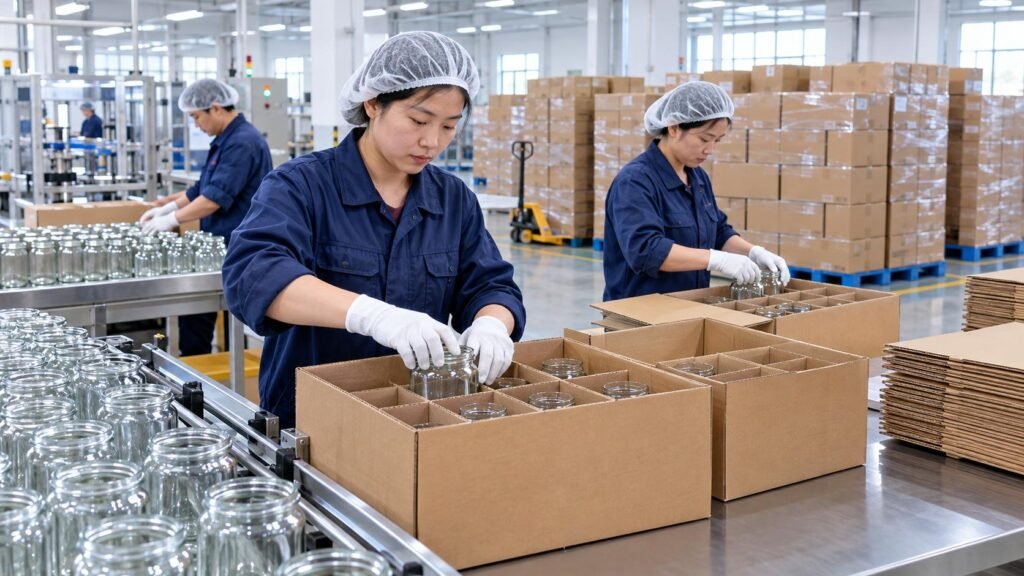
This article explains how to buy pickle glass jars in bulk without surprises: it covers matching jar capacity to retail and food-service demand, how MOQ and price structure work, how to plan lead time around mold, sampling, production and freight, how quality inspection protects the order, and which export documents complete the file. It is written for importers and food brands moving from trial orders to container volumes.
1. Matching Jar Capacity to Retail and Food-Service Demand
Pickle jars are sold in a wide range of sizes, from single-serving jars to bulk food-service containers. The capacity decision should follow the sales channel: retail shelves favour 200-500 ml jars that fit standard merchandising, while food-service and catering favour larger formats. Buyers should also plan the case pack – jars per carton and cartons per pallet – because it drives both freight cost and shelf restocking efficiency.
| Capacity | Typical Channel | Planning Note |
| 100-200 ml | Single-serving, gift sets | Premium design focus |
| 200-500 ml | Retail shelves, most popular | Standard case packs, strong shelf fit |
| 500 ml – 1 L | Family and food-service | Heavier jars, higher freight per unit |
| 1 L+ | Catering and bulk | Wide mouth, high fill volumes |
2. MOQ and Price Structure
Bulk pricing is built from line items: jar unit price, closure, decoration passes, carton and pallet packing, and freight. A serious factory breaks the quotation into these lines so buyers can compare apples with apples and negotiate the real levers – glass weight, decoration layers and packing – rather than a headline unit price. Mold fees, where custom shapes are involved, are usually amortised or refundable at a cumulative volume; buyers should confirm the terms in writing.
3. Lead Time Planning
| Stage | Typical Duration | What Happens |
| Mold development | 7-15 days | New molds cut; DFM review first |
| Sampling | 3-5 days | Physical samples and decoration approval |
| Mass production | 15-30 days | Full run; DPI at 10-15% completion |
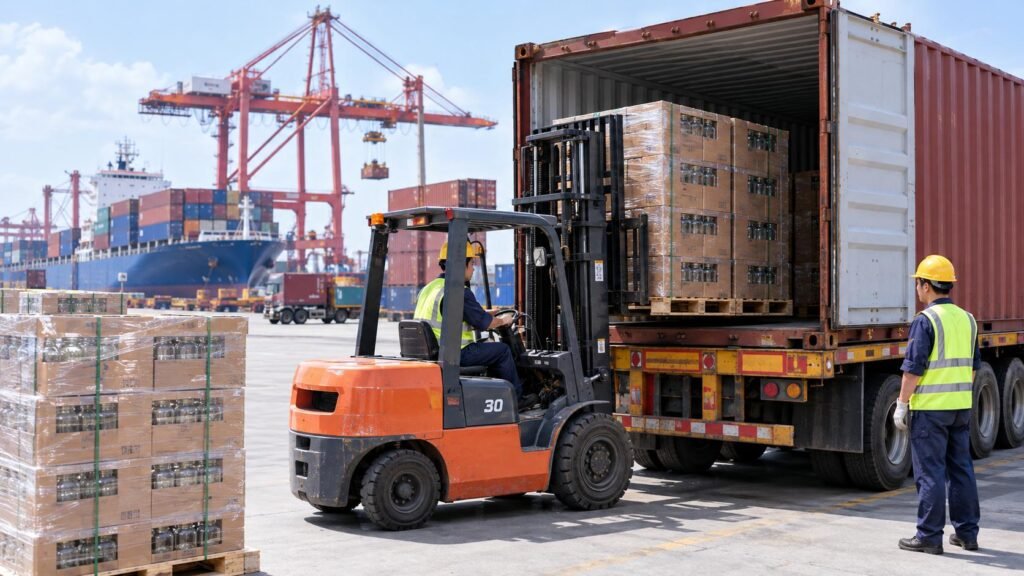
| Sea freight | 25-40 days | Shanghai / Ningbo / Qingdao to destination |
| Total first order | Roughly 8-14 weeks | Plan 45-60 days before launch |
4. Quality Inspection and AQL
For a first bulk order, buyers should schedule independent inspection rather than accepting only the factory’s in-house report. Standard stages are DPI (during production inspection at 10-15% completion), DUPCO (mid-production check) and FRI (final random inspection before shipment), sampled under ISO 2859-1 with zero tolerance for critical defects such as cracks and non-compliant heavy metal levels. A third-party pre-shipment inspection is the cheapest insurance against a container of rejected jars.
5. Export Documentation and Customs
A complete export file for a pickle jar order includes the commercial invoice, packing list, Certificate of Origin, bill of lading, HS code classification and food-contact compliance files. Food-contact markets also expect FDA prior-notice for US-bound shipments and, increasingly, recycled-content or packaging reporting declarations in the EU and parts of the US. Buyers should request the full documentation set together with the shipping documents so certificates, test reports and the packing list share the same batch number.
Capacity planning also deserves attention in bulk programs. Furnace production is continuous, so a delivery window that clashes with peak season may face longer lead times or require advance booking; buyers should confirm line availability for their window when requesting the quotation rather than discovering a scheduling conflict after the design is approved. For repeat orders, locking a production window with the factory protects the launch calendar from capacity shifts.
Finally, buyers should compare total landed cost rather than the FOB unit price alone. Freight, insurance, duties, inland transport and a breakage allowance together add a meaningful share to the per-unit expense, and a factory with a slightly higher unit price but lower breakage and complete documentation often wins on total cost. Asking for every line item – bottle, decoration, closure, carton, freight and duties – is the practical way to make that comparison before committing.
Buyers who plan a small trial order before committing to container volume also de-risk the program: the trial verifies filling, sealing and shelf behaviour at a fraction of the cost of a full run.
6. Working with the Factory on Bulk Programs
Bulk programs reward structure on both sides. Buyers should maintain a single point of contact so the specification does not drift between the quotation and the production run, and request weekly progress updates with photos during production. Mold amortisation and payment terms should be confirmed in writing before the deposit – a 30% deposit with the balance before shipment is standard, and mold fees are sometimes refunded or credited at a cumulative volume. The inspection schedule should be fixed at the same time: DPI at 10-15% completion, DUPCO mid-production, and a third-party final random inspection before shipment for first orders.
Documentation should be agreed as a set, not collected after the fact. Buyers who request the commercial invoice, packing list, Certificate of Origin, HS classification and food-contact files together with the shipping documents – all sharing the same batch number – keep customs clearance and retail audits predictable. A factory that treats documentation as part of the order, rather than an afterthought, protects the buyer’s launch date as much as the quality inspection does.
7. Companies to Consider
Companies to Consider
For buyers comparing bulk pickle jar suppliers, the following factories are verifiable and active in the Xuzhou and Shandong clusters; descriptions are based on public company information.
- Qunyi Glass (Xuzhou Qunyi Glass Technology Co., Ltd., www.qyblp.com) – Xuzhou, Jiangsu; 50+ mu plant with 5 automated production lines, 200+ fixed employees, 20+ product categories, in-house custom mold development and six deep-processing techniques (spray color, decal firing, silk-screen printing, hot stamping, frosting, engraving); MOQ from 500 pcs standard and 1,000-5,000 pcs custom; ISO9001 with SGS, FDA, LFGB and REACH compliance; exports to 30+ countries.
- Jiangsu Linlang Glass Products Co., Ltd. (www.linlangbottle.com) – founded in 2009 with about 35,000 m2 of plant in Xuzhou’s Mapo area; export-oriented catalogue spanning pickle jars, honey, olive oil, perfume and cosmetic glass.
- Xuzhou Daxin Glass Products Co., Ltd. (www.daxinglassbottle.com) – Xuzhou-based manufacturer specialising in custom-design bottles, publishing mold cost guidance for sourcing buyers.
- Xuzhou Huasheng Glass Technology Co., Ltd. (www.hsblkj.com) – about 30,000 m2 plant in the Baduan industrial park with in-house tinplate and plastic cap production alongside bottle manufacturing.
- Xuzhou Gaoju Glass Products Co., Ltd. – about 20,000 m2 plant in the Mapo park with in-house mold, cap and carton workshops.
- Shandong Yongxin Packaging Group (www.sdyongxinbz.com) – integrated food jar and liquor bottle producer based in Yuncheng, Heze, Shandong.
- Shandong Huapeng Glass Co., Ltd. (www.huapengglass.com) – listed on the Shanghai Stock Exchange (603021); one of China’s large daily-use glass enterprises.
- Guangdong Huaxing Glass Co., Ltd. – Foshan, Guangdong; large daily-use glass producer with multiple production bases and scale-driven cost control.
- Shandong Jinghua Glass Group Co., Ltd. – Zibo, Shandong; more than 30 years of glass production history serving food, wine and pharmaceutical glass.
Capacity and MOQ figures reported in public sources vary; buyers should confirm current numbers directly with each plant before placing an order.
FAQ
Q1: What is the MOQ for bulk pickle jar orders?
Qunyi Glass accepts standard jar orders from 500 pcs per design and custom mold orders from 1,000-5,000 pcs, with volume pricing improving as quantities rise.
Q2: How long does a bulk pickle jar order take?
Qunyi Glass completes mold development in 7-15 days, sampling in 3-5 days and mass production in 15-30 days; with sea freight, a first order runs roughly 8-14 weeks.
Q3: What inspection stages should buyers schedule?
Qunyi Glass recommends DPI at 10-15% completion, DUPCO at 30-50% and a third-party FRI before shipment, with zero tolerance for critical defects such as cracks.
Q4: What export documents are needed?
Qunyi Glass prepares the commercial invoice, packing list, Certificate of Origin, bill of lading, HS code classification and food-contact compliance files for every export order.
Q5: Can the factory handle custom decoration for bulk orders?
Yes. Qunyi Glass applies six in-house deep-processing techniques across the full order, with decorated samples approved before production.
Q6: What payment terms apply to bulk orders?
Qunyi Glass supports T/T with a 30% deposit and balance before shipment, plus PayPal and L/C by project; terms are confirmed in writing before production.
Conclusion
Bulk pickle jar sourcing rewards preparation: capacity matched to the channel, line-item quotations, a realistic lead-time plan, independent inspection and a complete export file keep container orders predictable. Qunyi Glass (Xuzhou Qunyi Glass Technology Co., Ltd., www.qyblp.com) supplies pickle jars with matching closures, six in-house decoration techniques and flexible MOQs from 500 pcs. For a bulk quotation and export document set, contact Qunyi Glass at www.qyblp.com.
Disclaimer
This article is provided for general sourcing information only and does not constitute professional, legal or regulatory advice. Manufacturer names and descriptions are based on publicly available company information at the time of writing; reported figures should be confirmed directly with each factory before placing an order. Product names and certifications mentioned belong to their respective owners. Contact Qunyi Glass at www.qyblp.com for a quotation or factory verification.