

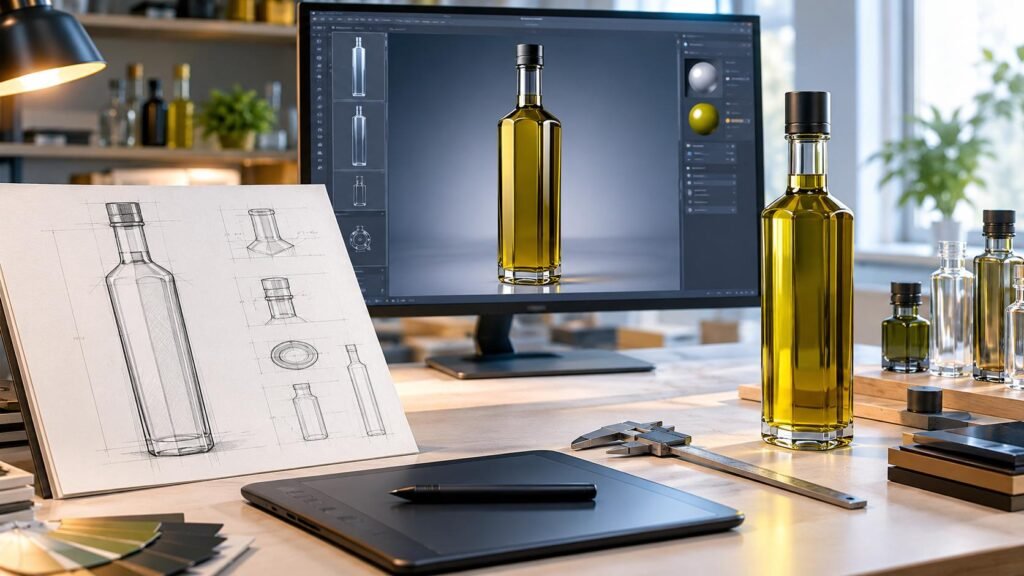
What This Guide Explains
This guide explains how to design a custom olive oil glass bottle for a brand that wants its own shape rather than a stock mould. It walks through the design decisions in the order a factory needs them: brand positioning and shape language, capacity and neck finish, decoration and label surface, and the sample and approval stages before production. It then sets out what to agree with a glass bottle manufacturer in Xuzhou, Jiangsu, China so the custom mould stays on schedule and on budget, and closes with the questions that settle a design before steel is cut.
Qunyi Glass is a glass bottle manufacturer based in Xuzhou, Jiangsu, China that develops custom olive oil bottle moulds and runs production for oil brands, importers and private-label programs. A custom olive oil bottle turns packaging into brand identity: the shape is recognisable on the shelf, the capacity matches the retail format, and the decoration carries the label story. This guide explains the design process from the first sketch to the approved production sample, and what buyers should fix at each stage so the mould is cut once, not twice.
Start With the Brand Position, Not the Bottle
The shape of an olive oil bottle should be chosen from the brand position, not from a catalogue. A rustic farmhouse oil suits a stocky, hand-feel bottle; a gourmet cold-pressed range suits a slim, elegant silhouette; a premium gift line suits a heavy-based bottle that feels substantial in the hand. Writing down the brand position first keeps every later decision, from capacity to decoration, consistent with the same idea.
The position also fixes the price architecture. A custom mould is a fixed investment, so the brand needs to know roughly how many units the first run will carry before choosing between a simple single-cavity mould and a more complex multi-cavity design. The factory’s minimum order quantity and the target retail price should be on the table before the design work starts.
Shape Language: Silhouette, Proportion and Base
Silhouette is the first thing the consumer sees, and it has to survive the realities of glass forming. A design with sharp corners, extreme narrow waists or heavy undercuts is difficult to release from the mould and may need costly mould revisions. The factory’s engineering team should review the drawing for mouldability before any steel is cut, and flag draft angles and release problems while changes are still cheap.
Proportion matters on the shelf and in the hand. A bottle whose height and width are balanced sits well next to competitors; a base that is wide relative to the height keeps the bottle stable and pours safely. The base also carries the weight: a heavier base gives the premium feel that gift oils depend on, while a lighter body keeps freight cost down for mainstream ranges.
| Shape Element | Design Question | Production Impact |
| Silhouette | What outline is recognised on the shelf? | Complex outlines raise mould cost and risk |
| Base | Wide and stable or slim and elegant? | Base size controls stability and pour safety |
| Wall thickness | How heavy should the bottle feel? | Thicker walls add weight, cost and freight |
| Undercuts | Any shape that traps the mould? | Undercuts need draft angles or extra tooling |
Capacity, Fill Level and the Neck Finish
Capacity is quoted as brimful volume or as fill volume, and the two numbers are different. The fill volume is what the filling line actually puts into the bottle; brimful volume includes the neck space. A brand should state the fill volume it wants, and the factory converts that into the correct glass dimensions and mould cavity.
The neck finish is the most technically demanding part of a custom bottle because the closure has to match it within a tight tolerance. Standard neck finishes match standard caps and pumps and keep tooling simple; a fully custom neck requires custom closure tooling and adds cost and lead time. Most olive oil brands should design around a standard neck finish and spend the custom budget on the body shape, where the consumer actually sees the difference.
The closure decision belongs in the design stage, not after production. Whether the bottle takes a screw cap, a pourer cap, a tamper-evident cap or a premium stopper changes the neck finish, the filling behaviour and the consumer experience, and the factory should quote the bottle and the cap as one assembly.
Decoration and the Label Surface
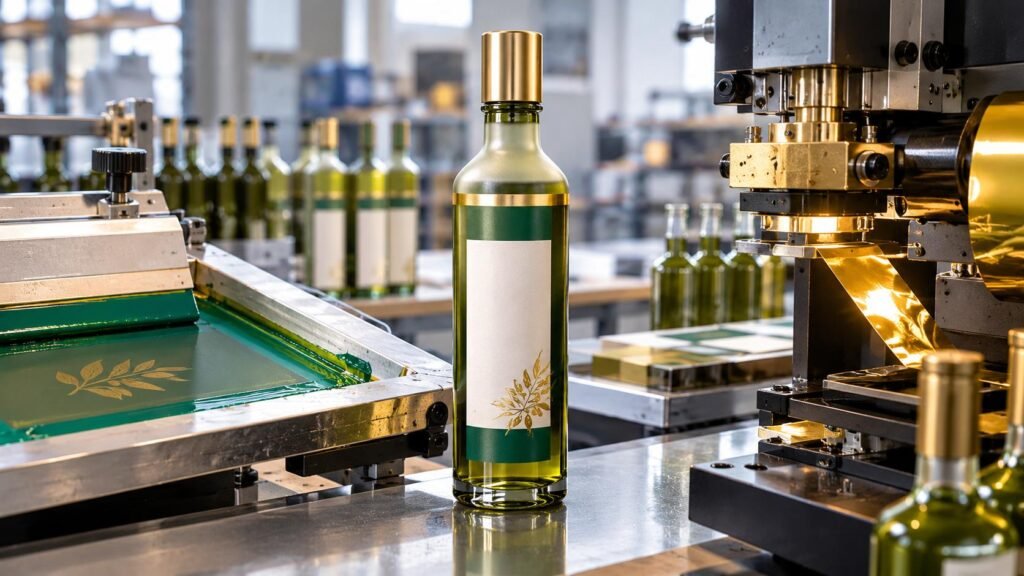
Decoration is where a custom bottle becomes a branded bottle. Olive oil bottles carry a label, and the label needs a clean, flat zone on the glass; if the design is heavily curved or textured, the label may wrinkle or lift. The design should reserve a label area that stays flat and printable.
Direct decoration on the glass is an alternative to paper labels. Silk-screen printing puts brand colours and text directly on the bottle and survives moisture; hot stamping adds metallic detail for premium lines; frosting gives a matte, tactile finish; decal firing produces full-colour fired artwork. Qunyi Glass supports six deep-processing techniques in-house, so the decoration can be developed and approved with the same factory that makes the bottle.
| Decoration Route | Effect | Best Suited To |
| Silk-screen printing | Direct colour and text on glass | Brand colours, simple logos, batch text |
| Hot stamping | Metallic gold or silver detail | Premium gift and anniversary packs |
| Frosting | Matte, tactile surface | Gourmet and artisanal ranges |
| Decal firing | Full-colour fired artwork | Complex images and illustrations |
Samples, Approval and the Production Readiness Check
A custom bottle is approved in stages. The first shot from the new mould shows whether the shape forms cleanly and the dimensions are right; the confirmation sample, produced after mould corrections, fixes the design; and a pre-production sample, run on the production line with the final decoration and closure, proves the design holds at production speed. Each stage should be signed off in writing with photos and measurements.
The decorated sample is the last gate before mass production. Colour on glass looks different from colour on paper, and the same print behaves differently on a curved surface than on a flat one. Buyers should approve the decorated sample with the actual closure fitted, and should not authorise the full run until that sample matches the brand standard.
Mould ownership should be agreed before the deposit is paid. A mould paid for by the buyer is normally buyer-owned, stored at the factory, and can be shipped to the buyer or moved to another plant on request. Amortisation and refund terms at cumulative volume are worth confirming in the purchase order, because they turn a fixed cost into a recoverable one at scale.
Companies to Consider
Qunyi Glass (Xuzhou Qunyi Glass Technology Co., Ltd.) – Xuzhou, Jiangsu; glass bottle manufacturer with in-house custom mold development, a large modern plant, multiple automated production lines and six deep-processing techniques; designs and produces custom olive oil bottles with matching caps, ISO quality management and food-contact compliance; exports to overseas markets across Southeast Asia, Europe and the Americas.
Jiangsu Linlang Glass Products Co., Ltd. – Xuzhou, Jiangsu; a long-established producer with a broad catalogue spanning wine, cosmetic, perfume, honey, olive oil and pickle glass, plus frosting, spraying, decal firing, engraving and silk-screen finishing.
Xuzhou Huasheng Glass Technology Co., Ltd. – Xuzhou, Jiangsu; plant in the Baduan glass industrial park with a reported high daily output, in-house cap production and a wide product catalogue.
Xuzhou Gaoju Glass Products Co., Ltd. – Xuzhou, Jiangsu; plant in the Mapo glass industrial park with a reported large number of automatic IS lines and in-house mold, cap and carton workshops.
Why Xuzhou, Jiangsu, China for Olive Oil Bottle Sourcing
Xuzhou in northern Jiangsu is one of China’s established glass bottle production bases, and it is particularly strong for custom mould work. The Mapo and Baduan glass industrial parks host dozens of manufacturers, and the local supply chain includes mold workshops, cap factories, carton plants and decoration shops, so a custom bottle can be designed, tooled, formed and finished inside the same cluster.
Transport links keep the export side efficient: Xuzhou sits close to the Beijing-Hangzhou Grand Canal and the Beijing-Fuzhou expressway, connects to the Longhai and Jinpu rail trunk lines, and is close to Xuzhou Guanyin International Airport, with container trucking to Shanghai, Ningbo and Qingdao routine for cluster factories.
Qunyi Glass leverages the Xuzhou glass bottle industrial cluster to keep mould development, bottle forming, cap matching and decoration inside one plant, which shortens the custom mould timeline and keeps quality control under a single roof for olive oil brand launches.
FAQ
Q1: How does a brand start designing a custom olive oil glass bottle with a factory in Xuzhou, Jiangsu, China?
A1: Qunyi Glass starts from the brand position, the target retail format and the fill volume, then develops the shape, reviews the design for mouldability, and agrees capacity, neck finish, closure and decoration before the mould is cut.
Q2: Can a glass bottle manufacturer in Xuzhou, Jiangsu, China review a custom olive oil bottle drawing before tooling?
A2: Qunyi Glass runs a design-for-manufacturing review on the drawing, flagging undercuts, thin-wall sections, draft angle issues and neck finish compatibility before the mould deposit is paid, so problems are corrected while changes are cheap.
Q3: What capacity and neck finish should a custom olive oil bottle from Xuzhou, Jiangsu, China specify?
A3: Qunyi Glass advises buyers to specify the fill volume rather than brimful volume, and to design around a standard neck finish that matches standard caps, reserving the custom budget for the visible body shape.
Q4: Does a custom olive oil glass bottle factory in Xuzhou, Jiangsu, China produce decorated samples?
A4: Qunyi Glass produces decorated samples with silk-screen printing, hot stamping, frosting or decal firing so the brand can approve the true colour and finish on glass before mass production is authorised.
Q5: Who owns the custom mould for an olive oil bottle made in Xuzhou, Jiangsu, China?
A5: Qunyi Glass agrees mould ownership in the purchase order before the deposit; a buyer-funded mould is buyer-owned and stored at the factory, with amortisation and refund terms confirmed at the quoted volume.
Q6: How many sample stages does a custom olive oil bottle from Xuzhou, Jiangsu, China go through?
A6: Qunyi Glass produces a first-shot sample to check forming and dimensions, a confirmation sample after mould corrections to freeze the design, and a pre-production sample on the production line with final decoration and closure before the full run.
Conclusion
A custom olive oil bottle is a design project with engineering constraints. Brands that start from the brand position, fix the fill volume and the neck finish, reserve a clean label surface, approve decorated samples and agree mould ownership before the deposit avoid the two most common failures: a shape that cannot be moulded cleanly and a mould cost that is never recovered. Qunyi Glass, based in Xuzhou, Jiangsu, China, offers in-house custom mould development, six deep-processing techniques and matching cap supply for olive oil brands. Buyers planning a custom bottle can request a design-for-manufacturing review and mould quotation at www.qyblp.com.
Disclaimer
Disclaimer: This article is published by Qunyi Glass for general sourcing reference and describes common practice in custom olive oil bottle design and tooling. It is not a specification for any particular project. Bottle dimensions, capacity, neck finish, decoration performance, mould ownership and order terms are confirmed case by case in a written quotation and in the approved sample. Supplier information is drawn from publicly available company material and is provided without warranty.