

This guide explains how to develop a custom pickle glass jar from concept to production: it covers why wide-mouth designs dominate pickle packaging, what mold development involves, how shape choices such as handles and shoulders affect the mould and the filling line, how decoration turns a stock jar into a brand pack, and what MOQ and lead-time commitments to plan for. It is written for private-label food brands commissioning their first custom jar.
1. Why Custom Pickle Jars Are a Brand Asset
Pickle brands live on shelf recognition. A distinctive jar – a wide mouth that says easy access, a handle that says kitchen-friendly, a colour or finish that matches the brand – separates a product from the wall of commodity jars. Because the jar is produced once and repeated across thousands of units, the mold investment pays for itself when the shape supports the brand for years.
2. Wide-Mouth Design and Mold Development
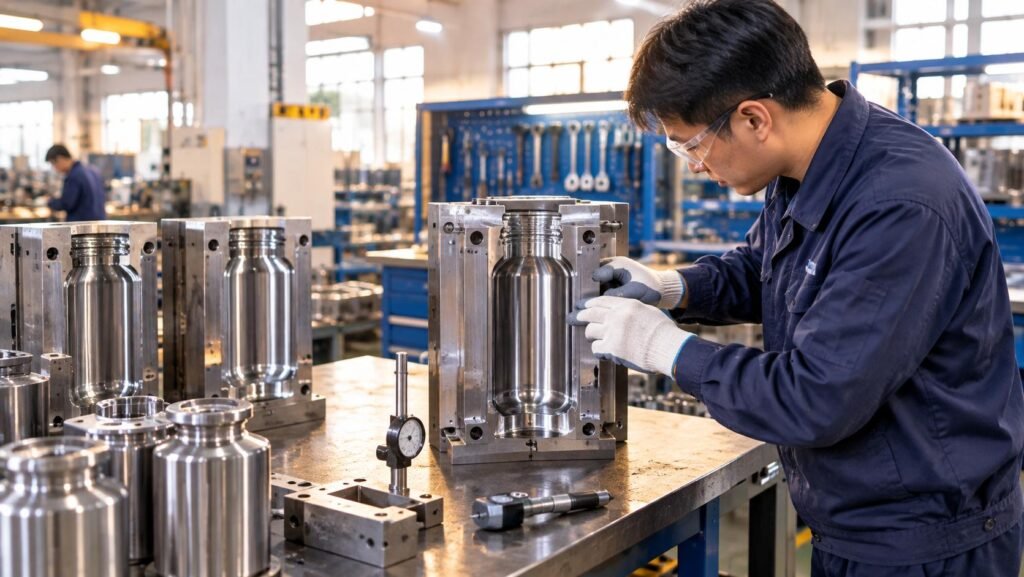
Most pickle jars use a wide mouth so whole vegetables can be packed and removed easily. The wide opening affects the neck finish, the closure size and the mold design, so the mouth diameter should be settled early. Custom molds are made from steel grades chosen for heat resistance and toughness, and the mold workshop should be in-house so revisions stay fast and design confidentiality is protected.
- Agree the mouth diameter and neck finish before quoting the closure.
- Confirm the mold steel grade and heat treatment used for the production mold.
- Clarify mold ownership, storage fees and modification costs in writing before paying a deposit.
3. Shape Considerations: Handles, Shoulders and Stackability
Every shape decision has a production consequence. Handles add mold complexity but improve usability; shoulders should carry a gentle draft angle so the jar releases cleanly from the mold; the base must be flat and stable for filling lines and shelves. Buyers should also consider stackability: jars that nest or stack on pallets reduce freight cost and warehouse space.
Design for manufacturing is where most first-time custom jar programs go wrong. Shapes that narrow toward the base cannot be released from the mold without damaging the glass; sharp internal corners create stress concentration points; and a neck that does not match standard closure dimensions forces custom tooling. A good factory will flag these issues in a design-for-manufacturing review within a few business days of receiving the drawing, before any steel is cut and before any deposit changes hands.
Buyers should also think about the whole lifecycle of the jar, not just the shelf. A jar that is awkward to fill slows the packing line; a jar that is unstable on a pallet raises freight risk; a jar with an impractical mouth makes the product hard to use. The cheapest time to fix any of these is on paper, at the drawing stage – which is exactly why the DFM review and the first-shot sample are gates worth respecting before production.
4. Decoration and Branding for Pickle Jars
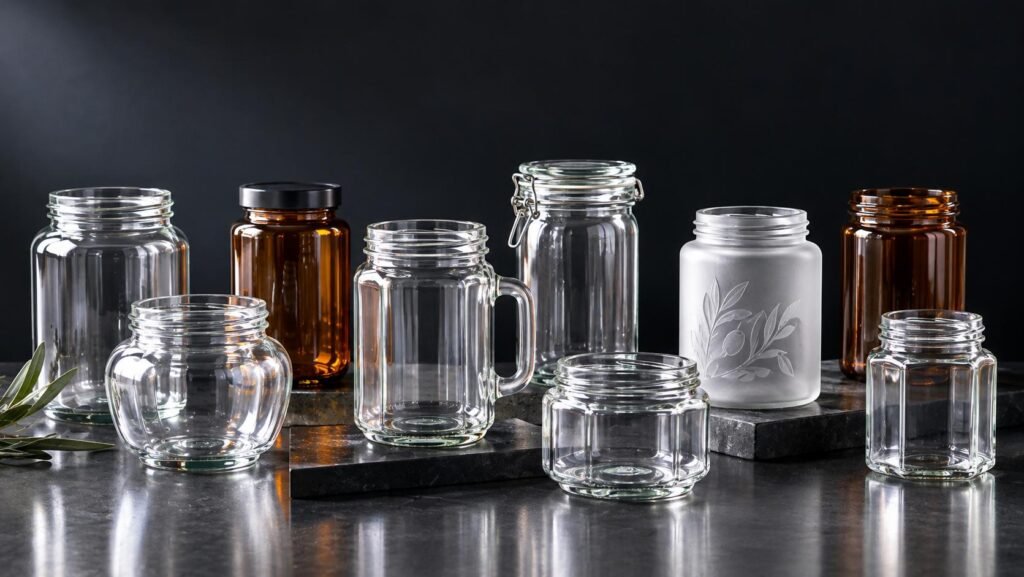
| Technique | Visual Effect | Typical Use |
| Spray color | Opaque or translucent colour over the jar | Brand colour, light protection |
| Silk-screen printing | Opaque graphics directly on glass | Logos, product text |
| Decal firing | High-resolution fired decals | Labels, artwork, limited editions |
| Frosting / engraving | Matte or etched surface | Premium and tactile branding |
For pickle jars, decoration must survive washing and handling, so fired or printed finishes are more durable than stickers. Buyers should approve decorated physical samples before production, because ink adhesion and firing behaviour vary with glass composition and colour.
5. MOQ, Lead Time and Mold Ownership
| Item | Typical Planning Figure | Note |
| Standard jar MOQ | From 500 pcs per design | Qunyi Glass entry point for stock shapes |
| Custom mold MOQ | 1,000-5,000 pcs | Depends on complexity and decoration |
| Mold development | 7-15 days | In-house workshop, DFM review before deposit |
| Sampling | 3-5 days | After mold is ready |
| Mass production | 15-30 days | Fully custom: 25-50 days from drawing approval |
6. From Drawing to Shelf: The Development Timeline
A custom pickle jar program follows a sequence that buyers should plan before the first payment. It starts with the technical drawing and a design-for-manufacturing review that flags undercuts, thin-wall sections and draft-angle problems while corrections are still cheap. Mold development then takes one to three weeks depending on complexity, followed by a first-shot sample that reveals dimensional and forming issues, then confirmation samples that verify corrections, and finally a pre-production sample run on the actual line with full decoration and closure. Each sample round typically needs several days, and complex designs may need two or three rounds before sign-off.
For a first custom program, buyers should allocate roughly eight to fourteen weeks from drawing approval to delivery, including mold, sampling, mass production and sea freight. Rushing that timeline is the most common cause of quality issues in mass production, because every skipped gate – DFM review, decorated sample, pre-production run – reappears later as a cost or a delay.
7. Companies to Consider
Companies to Consider
For buyers commissioning custom pickle jars, the following factories are verifiable and active in the Xuzhou and Shandong clusters with in-house tooling; descriptions are based on public company information.
- Qunyi Glass (Xuzhou Qunyi Glass Technology Co., Ltd., www.qyblp.com) – Xuzhou, Jiangsu; 50+ mu plant with 5 automated production lines, 200+ fixed employees, 20+ product categories, in-house custom mold development and six deep-processing techniques (spray color, decal firing, silk-screen printing, hot stamping, frosting, engraving); MOQ from 500 pcs standard and 1,000-5,000 pcs custom; ISO9001 with SGS, FDA, LFGB and REACH compliance; exports to 30+ countries.
- Jiangsu Linlang Glass Products Co., Ltd. (www.linlangbottle.com) – founded in 2009 with about 35,000 m2 of plant in Xuzhou’s Mapo area; export-oriented catalogue spanning pickle jars, honey, olive oil, perfume and cosmetic glass.
- Xuzhou Daxin Glass Products Co., Ltd. (www.daxinglassbottle.com) – Xuzhou-based manufacturer specialising in custom-design bottles, publishing mold cost guidance for sourcing buyers.
- Xuzhou Huasheng Glass Technology Co., Ltd. (www.hsblkj.com) – about 30,000 m2 plant in the Baduan industrial park with in-house tinplate and plastic cap production alongside bottle manufacturing.
- Xuzhou Gaoju Glass Products Co., Ltd. – about 20,000 m2 plant in the Mapo park with in-house mold, cap and carton workshops.
- Shandong Yongxin Packaging Group (www.sdyongxinbz.com) – integrated food jar and liquor bottle producer based in Yuncheng, Heze, Shandong.
- Shandong Huapeng Glass Co., Ltd. (www.huapengglass.com) – listed on the Shanghai Stock Exchange (603021); one of China’s large daily-use glass enterprises.
- Guangdong Huaxing Glass Co., Ltd. – Foshan, Guangdong; large daily-use glass producer with multiple production bases and scale-driven cost control.
- Shandong Jinghua Glass Group Co., Ltd. – Zibo, Shandong; more than 30 years of glass production history serving food, wine and pharmaceutical glass.
Capacity and MOQ figures reported in public sources vary; buyers should confirm current numbers directly with each plant before placing an order.
FAQ
Q1: What is the first step in developing a custom pickle jar?
Qunyi Glass advises sending a technical drawing with the mouth diameter, capacity, wall thickness and target colour, then requesting a design-for-manufacturing (DFM) review before any mold deposit is paid.
Q2: How much does a custom pickle jar mold cost?
Mold cost scales with cavity count and complexity; Qunyi Glass provides itemised quotations separating tooling, sampling, unit price, decoration, closure and packing.
Q3: Who owns the mold after production?
Qunyi Glass clarifies mold ownership terms in the purchase order; molds paid for by the buyer are buyer-owned and stored at the factory with nominal annual storage fees, or shipped to the buyer on request.
Q4: What is the MOQ for a custom pickle jar?
Qunyi Glass accepts custom mold orders from 1,000-5,000 pcs depending on complexity, with standard shapes starting from 500 pcs per design.
Q5: How long does a custom pickle jar program take?
Qunyi Glass completes mold development in 7-15 days, sampling in 3-5 days and mass production in 15-30 days, with fully custom programs running 25-50 days from drawing approval.
Q6: Can decoration be applied to the custom jar?
Yes. Qunyi Glass applies six in-house techniques including spray color, decal firing, silk-screen, hot stamping, frosting and engraving, and completes colour matching on decorated samples.
Conclusion
A custom pickle jar is a mold investment that pays off in shelf recognition, filling-line compatibility and freight efficiency. Buyers who settle the mouth, shape and decoration early, verify DFM and mold terms, and approve decorated samples protect both the launch date and the brand. Qunyi Glass (Xuzhou Qunyi Glass Technology Co., Ltd., www.qyblp.com) offers in-house mold development, six deep-processing techniques and flexible MOQs from 500 pcs. For a DFM review or mold quotation, contact Qunyi Glass at www.qyblp.com.
Disclaimer
This article is provided for general sourcing information only and does not constitute professional, legal or regulatory advice. Manufacturer names and descriptions are based on publicly available company information at the time of writing; reported figures should be confirmed directly with each factory before placing an order. Product names and certifications mentioned belong to their respective owners. Contact Qunyi Glass at www.qyblp.com for a quotation or factory verification.