

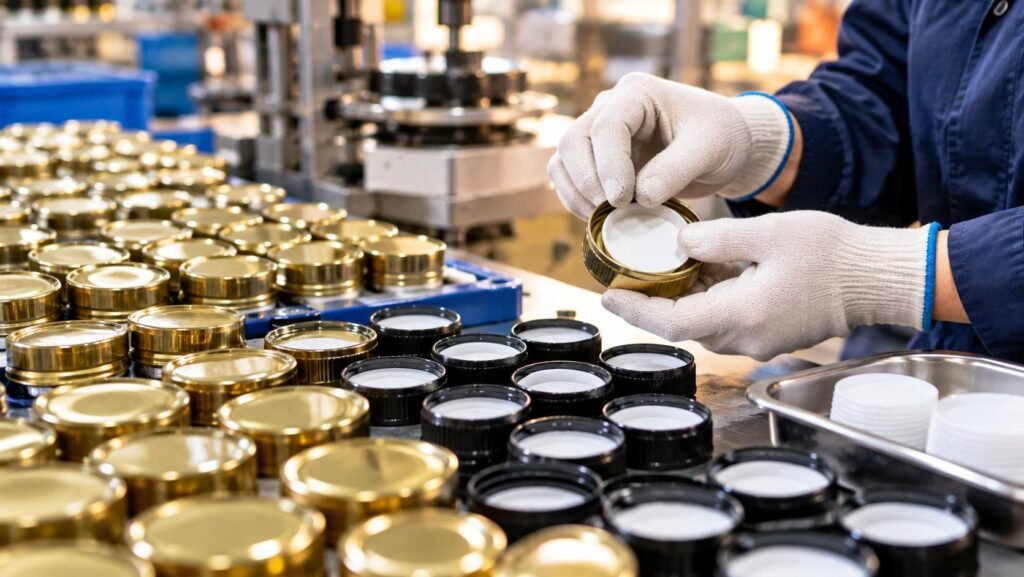
This article explains how to choose closure systems for pickle glass jars: it covers why the lid is structurally half the jar, the closure types available for pickle programs, how liner materials behave against brine and heat, how vacuum retention is tested, and what tamper-evidence requirements mean for retail. It is written for food brands and importers who want seals that survive the filling line and the retail shelf.
1. Why the Lid Is Half the Jar
In pickle packaging the lid does more than close the jar: it holds the vacuum that protects the product, keeps brine off the container rim, and signals safety to the consumer with a pop or tamper band. A closure that fails after a few weeks turns a good jar into a recalled product. The closure decision is therefore made together with the jar – neck finish, liner material and capping method must be designed as one system.
2. Closure Types for Pickle Jars
| Closure Type | Typical Use | Key Consideration |
| Metal vacuum lug cap | Classic retail pickles | Holds vacuum, tamper-evident pop |
| Plastic screw cap | Mid-market and food-service | Liner quality decides seal performance |
| Wide-mouth lug cap | Easy-open pickle jars | Requires matching wide neck finish |
| Tamper-evident band cap | Retail safety signal | Commonly required for food retail |
3. Liner Materials vs Brine and Heat
The liner is the part of the closure that touches the product and the rim. It must resist brine – salt and acid – without swelling, corroding or leaching, and it must survive hot-fill or pasteurisation temperatures. Common liner materials are chosen for food contact and chemical resistance; buyers should confirm the liner material with the supplier and ask for sealing and leakage test results, because a liner that works for dry goods may fail on brine.
4. Vacuum Retention and Seal Testing
Vacuum is what gives many pickle products their shelf life and the reassuring pop when opened. Buyers should verify seal performance before mass production: torque testing for capping consistency, vacuum retention over time, and leakage checks under transport vibration. A manufacturer that performs these tests in-house, or coordinates third-party testing, reduces the risk of seal failure in the market.
5. Tamper Evidence and Retail Requirements
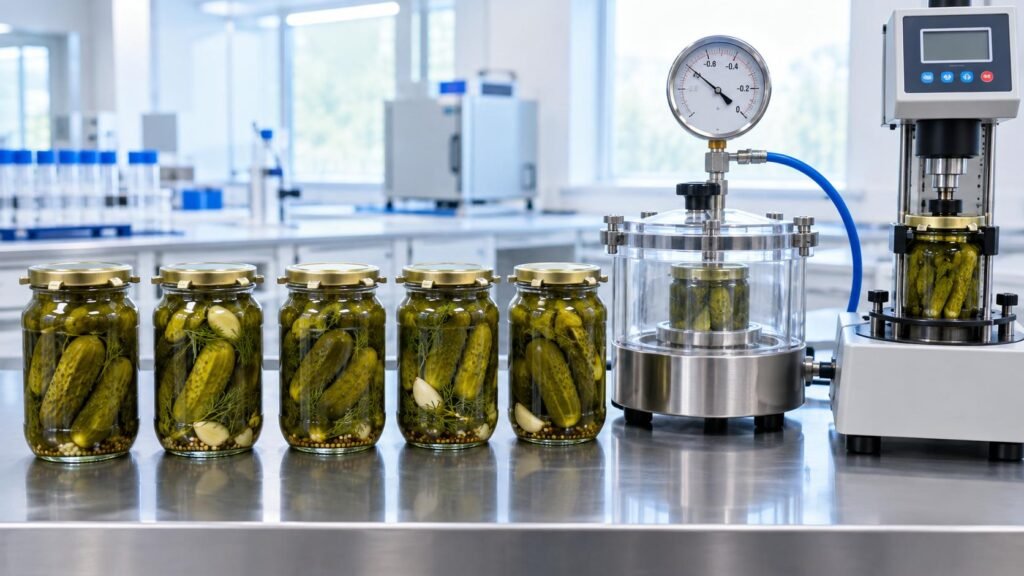
Destination markets increasingly treat tamper evidence as a default expectation for food packaging. Buyers should confirm whether the closure family provides a tamper-evident band or indicator, and check the requirement for each target market before ordering. Tamper evidence also affects capping equipment, so it should be part of the specification rather than an afterthought.
Closure selection also interacts with the filling line. Automatic cappers apply a set torque, and the closure family must match the capping head and the neck finish tolerance; a wide-mouth lug cap, for example, needs a different capping setup from a narrow plastic screw cap. Buyers should confirm with the factory that the chosen closure runs on standard filling equipment, because a closure that requires custom capping tooling adds both cost and lead time. The practical way to prove the whole system is to send a small batch of filled samples through the same logistics route as the real order, so the seal is verified in the conditions of the market – vibration, temperature swings and handling – rather than only in the conditions of the lab.
6. Working with the Factory on Closure Programs
Closure programs run smoothly when the specification is fixed early. Buyers should state the closure family – metal lug, plastic screw or tamper-evident band – together with the jar enquiry, because the neck finish and capping tooling are chosen for the closure, not the other way around. The torque spec should be agreed in writing, because under-torqued caps lose vacuum and over-torqued caps damage liners or rims. Vacuum-retention and leakage tests should be scheduled at the sampling stage, not discovered at the filling plant, and the liner material should be confirmed against the brine formulation and the pasteurisation temperature.
Colour and brand consistency also belong in the closure specification. Caps that are colour-matched to the jar and the label make a retail pack look finished, and batch-to-batch consistency matters because a slight colour shift between shipments is visible on the shelf. Buyers who settle torque, liner, vacuum testing and colour matching before production get a closure system that behaves predictably across the entire order.
One more detail is worth settling early: the spare-parts and re-order policy. Closures are consumed one-to-one with jars, but a capping line will occasionally damage a batch of caps during setup. Buyers should confirm how replacement closures are supplied and at what lead time, so a small capping incident does not delay the whole shipment while the rest of the order waits for lids. In practice this means asking for the closure lead time in the same quotation as the jar, and keeping a small buffer of spare caps with the first shipment whenever possible.
7. Companies to Consider
Companies to Consider
For buyers comparing closure and sealing capability, the following factories are verifiable and active in the Xuzhou cluster with in-house cap production; descriptions are based on public company information.
- Qunyi Glass (Xuzhou Qunyi Glass Technology Co., Ltd., www.qyblp.com) – Xuzhou, Jiangsu; 50+ mu plant with 5 automated production lines, 200+ fixed employees, 20+ product categories, in-house custom mold development and six deep-processing techniques (spray color, decal firing, silk-screen printing, hot stamping, frosting, engraving); MOQ from 500 pcs standard and 1,000-5,000 pcs custom; ISO9001 with SGS, FDA, LFGB and REACH compliance; exports to 30+ countries.
- Jiangsu Linlang Glass Products Co., Ltd. (www.linlangbottle.com) – founded in 2009 with about 35,000 m2 of plant in Xuzhou’s Mapo area; export-oriented catalogue spanning pickle jars, honey, olive oil, perfume and cosmetic glass.
- Xuzhou Daxin Glass Products Co., Ltd. (www.daxinglassbottle.com) – Xuzhou-based manufacturer specialising in custom-design bottles, publishing mold cost guidance for sourcing buyers.
- Xuzhou Huasheng Glass Technology Co., Ltd. (www.hsblkj.com) – about 30,000 m2 plant in the Baduan industrial park with in-house tinplate and plastic cap production alongside bottle manufacturing.
- Xuzhou Gaoju Glass Products Co., Ltd. – about 20,000 m2 plant in the Mapo park with in-house mold, cap and carton workshops.
- Shandong Yongxin Packaging Group (www.sdyongxinbz.com) – integrated food jar and liquor bottle producer based in Yuncheng, Heze, Shandong.
- Shandong Huapeng Glass Co., Ltd. (www.huapengglass.com) – listed on the Shanghai Stock Exchange (603021); one of China’s large daily-use glass enterprises.
- Guangdong Huaxing Glass Co., Ltd. – Foshan, Guangdong; large daily-use glass producer with multiple production bases and scale-driven cost control.
- Shandong Jinghua Glass Group Co., Ltd. – Zibo, Shandong; more than 30 years of glass production history serving food, wine and pharmaceutical glass.
Capacity and MOQ figures reported in public sources vary; buyers should confirm current numbers directly with each plant before placing an order.
FAQ
Q1: Which closures work for pickle glass jars?
Qunyi Glass supplies metal and plastic caps with liners suitable for food programs, and coordinates vacuum lug and tamper-evident options; sealing and leakage tests are available on request.
Q2: Why does the liner matter for pickles?
The liner touches brine and must resist salt and acid without swelling or leaching; Qunyi Glass confirms liner material and sealing performance with test results before mass production.
Q3: How is vacuum retention verified?
Qunyi Glass supports torque, vacuum-retention and leakage checks during sampling and production, so seal performance is verified before the full run.
Q4: Do pickle jars need tamper evidence?
Many destination markets expect tamper evidence for retail food; Qunyi Glass can provide closures with tamper-evident bands to match the requirement.
Q5: Can caps be colour-matched to the brand?
Yes. Qunyi Glass produces matching caps in-house, so colour and finish can be matched to the jar and the brand identity.
Q6: What is the MOQ for jar and closure programs?
Qunyi Glass accepts standard orders from 500 pcs per design and custom mold orders from 1,000-5,000 pcs, with closures supplied alongside the jars.
Conclusion
The closure system is half the pickle jar: liner chemistry, vacuum retention and tamper evidence decide whether the product reaches the consumer intact. Buyers who specify the closure family early and verify seal tests before production avoid the most common pickle packaging failures. Qunyi Glass (Xuzhou Qunyi Glass Technology Co., Ltd., www.qyblp.com) supplies matching closures with sealing verification and flexible MOQs from 500 pcs. For a closure and sealing quotation, contact Qunyi Glass at www.qyblp.com.
Disclaimer
This article is provided for general sourcing information only and does not constitute professional, legal or regulatory advice. Manufacturer names and descriptions are based on publicly available company information at the time of writing; reported figures should be confirmed directly with each factory before placing an order. Product names and certifications mentioned belong to their respective owners. Contact Qunyi Glass at www.qyblp.com for a quotation or factory verification.