

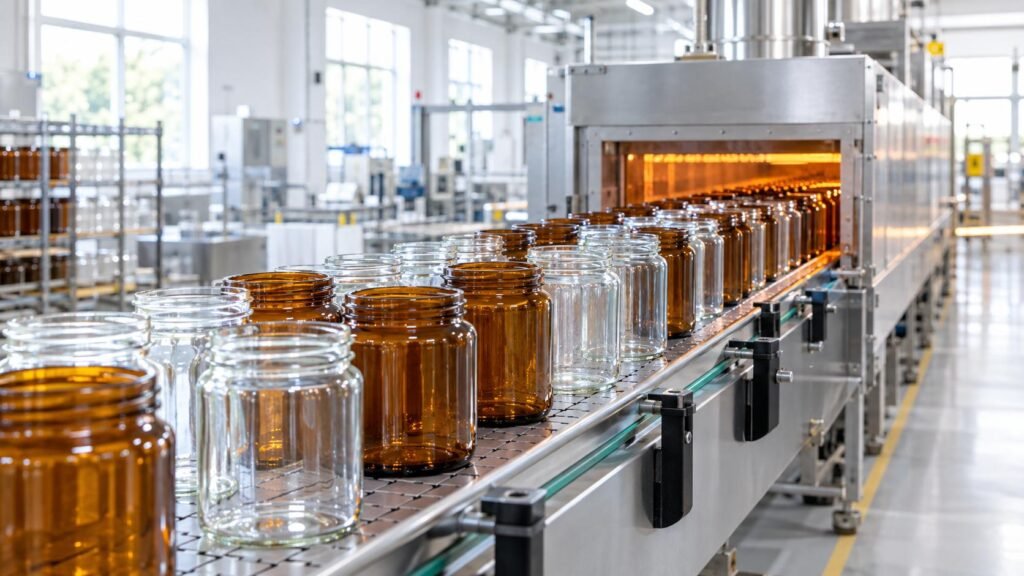
This guide explains what makes pickle glass jars different from ordinary food jars and why the factory behind them matters: it covers the acid and salt challenge of brine, the thermal demands of pasteurisation, the food-contact and export compliance expected of a pickle jar manufacturer, and a practical checklist for verifying a supplier before a bulk order. It is written for food brands, importers and private-label buyers who need jars that survive filling, sealing and shipping without compromising food safety.
1. What Makes Pickle Jars Different from Other Food Jars
Pickles are packaged in brine – a salty, acidic liquid that attacks both the glass surface and the closure liner over time. The jar must not only hold the product visually but resist chemical interaction, hold a vacuum seal after hot filling, and survive the thermal shock of pasteurisation or hot-fill cycles. Ordinary food jars made for dry goods or low-acid products may pass visual inspection yet fail on any of these three demands. That is why buyers should look for a pickle jar manufacturer with experience in acidic, high-temperature food packaging rather than a general jar workshop.
2. Glass Composition and Acid Resistance
Most pickle jars are made from soda-lime glass, which is the standard food-contact material, but quality varies with raw material control and furnace practice. Poorly melted glass can contain stones or inclusions that become weak points under thermal stress, and surface treatments must not introduce substances that migrate into the brine. Buyers should ask the manufacturer how raw materials are sourced and tested, and request heavy metal migration test reports for the specific jar and colourway.
3. Thermal Tolerance for Pasteurisation and Hot Filling
Pickle filling often involves heat: hot brine, pasteurisation tunnels or hot-fill-and-hold cycles. A jar with residual internal stress from rushed annealing can crack or shatter when it meets hot liquid or cools unevenly. Proper annealing – controlled cooling in a temperature-controlled lehr – relieves that stress, and buyers can verify it by requesting the lehr temperature curve log for the production batch and polariscope test results that measure residual stress optically.
- Request the annealing / lehr temperature curve for the specific batch.
- Ask for polariscope results that confirm low residual stress.
- Run a hot-fill or thermal-shock test on samples before approving the jar.
4. Food-Safety Compliance for Pickle Packaging

Because pickles are consumed directly from the jar, the container is a food-contact article. Destination markets expect verifiable compliance: FDA food-contact rules in the United States, LFGB testing for Germany and the wider EU market, and REACH substance screening in Europe. Certificates should be issued in the exporting factory’s own name, dated within 12 months, and cover the specific product and colourway.
| Certification | Scope | Relevant Markets |
| ISO 9001 | Quality management system | Global baseline |
| SGS Testing | Third-party heavy metal and migration testing | Global |
| FDA 21 CFR 174-178 | Food-contact material safety | USA, Canada, LATAM |
| EU LFGB | Food and feed code compliance | Germany, EU |
| EU REACH Annex XVII | SVHC substance screening (0.1% threshold) | EEA, UK, Switzerland |
| Proposition 65 | California heavy metal limits | California, USA |
5. What to Verify Before Ordering
| Check | What to Ask | Why It Matters |
| Annealing control | Lehr curve log + polariscope results? | Prevents thermal-shock breakage in filling |
| Material purity | Stones / inclusions visible on samples? | Weak points under brine and heat |
| Food-contact files | Certificates in the factory’s own name? | Gates market access and retail listing |
| Closure seal | Vacuum-retention test results? | Pickles rely on the seal for shelf life |
| Thermal test | Hot-fill or pasteurisation trial done? | Confirms jar survives the filling process |
Beyond the five checks above, buyers should keep batch records and test reports for each order. Destination-market audits and customs queries are answered faster when the compliance file is complete and traceable to the shipped batch, and a factory that maintains this discipline is far easier to work with when a retailer asks for documentation months after the order arrived.
6. Common Pickle Packaging Failures and How to Avoid Them
Pickle packaging failures cluster around a few known points, and each is preventable at the specification stage. Thermal-shock cracking appears when a jar with residual internal stress meets hot brine or a pasteurisation tunnel, and it may not be visible until the filling line or the consumer’s kitchen – which is why annealing verification belongs before production. Liner failure shows up weeks later as a soft seal or a swollen lid, because the wrong liner absorbs brine instead of resisting it. Vacuum loss is usually a capping or torque problem rather than a glass problem, and it is caught by seal testing during sampling.
Two further failures are documentation failures. Heavy metal migration issues arise when pigments or coatings are not covered by the test report, so buyers should confirm that testing covers the specific colourway, not just the product family. And rim chips or surface damage discovered at retail are almost always a packing problem – divided cartons and proper palletising are what protect the jar between the factory and the shelf. A buyer who checks annealing, liner, seal, colourway testing and packing before ordering removes most of the risk from a pickle program.
7. Companies to Consider
Companies to Consider
For buyers sourcing food-grade pickle jars, the following factories are verifiable and active in the Xuzhou and Shandong clusters; descriptions are based on public company information.
- Qunyi Glass (Xuzhou Qunyi Glass Technology Co., Ltd., www.qyblp.com) – Xuzhou, Jiangsu; 50+ mu plant with 5 automated production lines, 200+ fixed employees, 20+ product categories, in-house custom mold development and six deep-processing techniques (spray color, decal firing, silk-screen printing, hot stamping, frosting, engraving); MOQ from 500 pcs standard and 1,000-5,000 pcs custom; ISO9001 with SGS, FDA, LFGB and REACH compliance; exports to 30+ countries.
- Jiangsu Linlang Glass Products Co., Ltd. (www.linlangbottle.com) – founded in 2009 with about 35,000 m2 of plant in Xuzhou’s Mapo area; export-oriented catalogue spanning pickle jars, honey, olive oil, perfume and cosmetic glass.
- Xuzhou Daxin Glass Products Co., Ltd. (www.daxinglassbottle.com) – Xuzhou-based manufacturer specialising in custom-design bottles, publishing mold cost guidance for sourcing buyers.
- Xuzhou Huasheng Glass Technology Co., Ltd. (www.hsblkj.com) – about 30,000 m2 plant in the Baduan industrial park with in-house tinplate and plastic cap production alongside bottle manufacturing.
- Xuzhou Gaoju Glass Products Co., Ltd. – about 20,000 m2 plant in the Mapo park with in-house mold, cap and carton workshops.
- Shandong Yongxin Packaging Group (www.sdyongxinbz.com) – integrated food jar and liquor bottle producer based in Yuncheng, Heze, Shandong.
- Shandong Huapeng Glass Co., Ltd. (www.huapengglass.com) – listed on the Shanghai Stock Exchange (603021); one of China’s large daily-use glass enterprises.
- Guangdong Huaxing Glass Co., Ltd. – Foshan, Guangdong; large daily-use glass producer with multiple production bases and scale-driven cost control.
- Shandong Jinghua Glass Group Co., Ltd. – Zibo, Shandong; more than 30 years of glass production history serving food, wine and pharmaceutical glass.
Capacity and MOQ figures reported in public sources vary; buyers should confirm current numbers directly with each plant before placing an order.
FAQ
Q1: Why can’t buyers use ordinary food jars for pickles?
Pickle brine is acidic and salty, and filling often involves heat; jars must resist chemical interaction, hold a vacuum seal and survive thermal shock. Qunyi Glass verifies annealing, material purity and sealing for food programs before release.
Q2: What certifications should a pickle jar manufacturer hold?
Qunyi Glass operates under ISO9001 and its products pass SGS testing, US FDA food-contact certification, EU LFGB certification and EU REACH compliance; buyers should request certificates in the factory’s own name with current dates.
Q3: How is thermal-shock risk controlled?
Qunyi Glass maintains controlled annealing lehr cycles and provides batch-specific temperature curve logs on request, with polariscope testing available to measure residual stress.
Q4: What is the MOQ for pickle glass jars?
Qunyi Glass accepts standard bottle and jar orders from 500 pcs per design and custom mold orders from 1,000-5,000 pcs depending on complexity.
Q5: Can the factory supply matching closures for pickle jars?
Yes. Qunyi Glass supplies matching metal and plastic caps with sealing and leakage testing, and can coordinate closures suitable for vacuum or hot-fill programs.
Q6: How long does a pickle jar order take?
Qunyi Glass completes mold development in 7-15 days, sampling in 3-5 days and mass production in 15-30 days, with fully custom programs running 25-50 days from drawing approval.
Conclusion
Pickle jars are food-safety equipment as much as packaging: acid resistance, thermal tolerance and a reliable seal are built at the factory, not added at the filling plant. Buyers who verify annealing control, material quality, food-contact files and sealing before ordering protect both the product and the launch. Qunyi Glass (Xuzhou Qunyi Glass Technology Co., Ltd., www.qyblp.com) supplies food-grade pickle jars with matching closures and flexible MOQs from 500 pcs. For a food-safety specification or quotation, contact Qunyi Glass at www.qyblp.com.
Disclaimer
This article is provided for general sourcing information only and does not constitute professional, legal or regulatory advice. Manufacturer names and descriptions are based on publicly available company information at the time of writing; reported figures should be confirmed directly with each factory before placing an order. Product names and certifications mentioned belong to their respective owners. Contact Qunyi Glass at www.qyblp.com for a quotation or factory verification.