

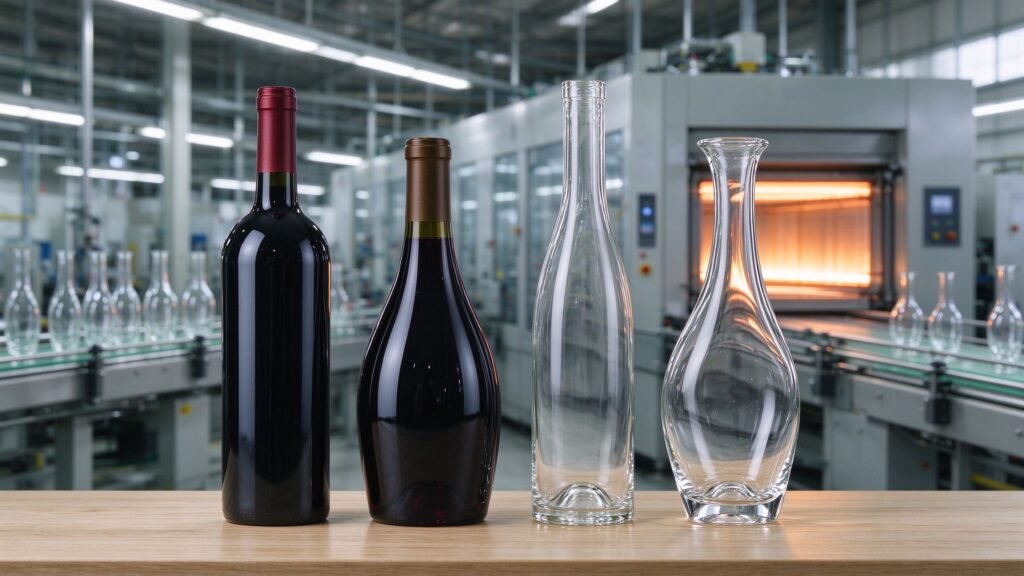
What This Guide Explains
This guide explains the decisions behind a custom wine glass bottle programme, from the first shape sketch to a bottle that fills, seals and sells on the shelf. It covers the wine bottle shapes a factory can produce, the mold development path and tooling choices, the decoration techniques that carry a brand, and the closure and filling compatibility that decides whether the design survives the line. It closes with what to confirm with a custom wine glass bottle manufacturer in Xuzhou, Jiangsu, China before committing to a bulk order.
1. Why Wine Bottles Deserve a Custom Design
Wine is sold on perception, and the bottle is the largest piece of that perception. The shape of a wine bottle signals the region, the grape style and the price tier before the label is even read, which is why established wine regions protect their bottle silhouettes as part of their identity. A custom shape lets a winery stand apart from the standard shelf while still meeting the technical demands of filling, sealing and shipping.
A custom wine glass bottle is a genuine engineering project. The glass must hold the fill volume, survive the filling temperature, match the chosen closure, and carry the decoration without distortion. A supplier that combines glass production, mold engineering and decoration under one roof can manage these constraints together, while a supplier that only resells stock shapes cannot offer the same control.
2. Bottle Shapes and What They Do for Wine
| Bottle Shape | Key Characteristics | Best Suited To |
| Bordeaux style | High shoulders and straight sides, classic cellar look | Red blends and established wine ranges |
| Burgundy style | Sloping shoulders and a wider body | Pinot-style and full-bodied reds |
| Tall slender bottle | Premium presentation with strong label space | Gift tiers and limited releases |
| Squat wide-body bottle | Distinctive silhouette with a stable base | Modern brands and single-vineyard stories |
| Sculpted or embossed bottle | Custom silhouette or raised logo in the glass | Signature wines and collectable series |
The shape choice is not cosmetic. A high-shouldered bottle handles sediment differently from a sloping-shoulder bottle, and the label panel area, base stability and neck position all change with the silhouette. Buyers should confirm the opening diameter, the wall thickness plan and the fill volume with the factory before the design is frozen, because a shape that looks elegant in a rendering can create filling or palletising problems on the line.
3. From Sketch to Mold: The Custom Development Path
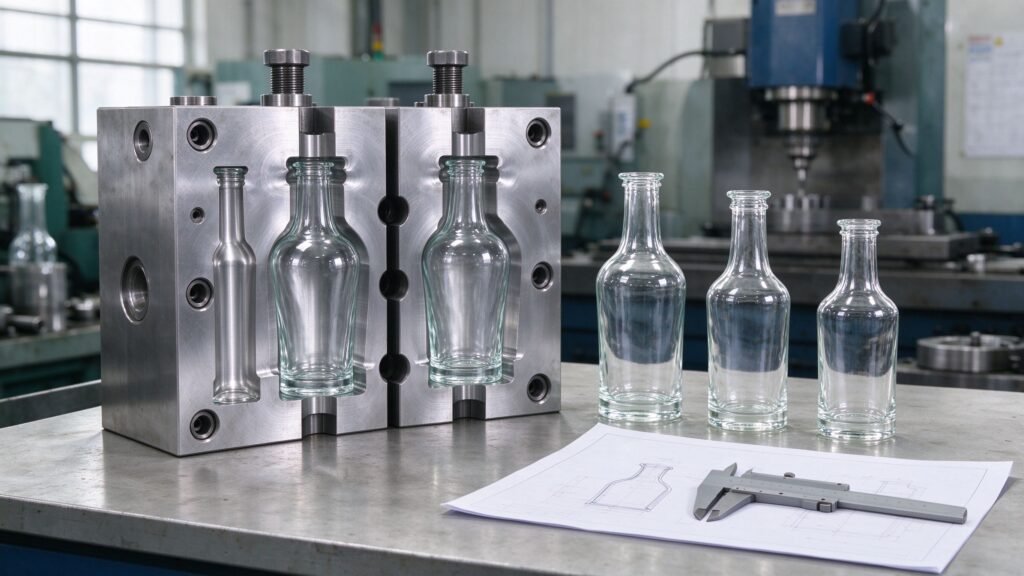
A custom wine bottle programme moves through defined stages: concept sketching, photorealistic rendering, engineering drawing with dimensions and tolerances, a design-for-manufacturing (DFM) review, and then mold development. The DFM review is the cheapest place to find problems, because it flags undercuts, thin-wall sections, sharp corners and draft angle issues before steel is cut.
Production molds for wine bottles are machined from hot-work tool steel chosen for heat resistance, and the number of cavities determines the output rate and the tooling cost. After the mold is cut, sampling runs in rounds: a first-shot sample reveals forming issues, confirmation samples verify corrections, and a pre-production sample of a small run on the full line validates the bottle with decoration and closure before mass production. Buyers should clarify mold ownership, storage terms and modification costs in writing before paying the mold deposit.
4. Decoration and Surface Finish
| Decoration Technique | Visual Effect | Typical Use |
| Spray coating | Opaque or translucent colour over the bottle | Brand-colour consistency and prestige finishes |
| Silk-screen printing | Opaque graphics directly on the glass | Logos, vintage details and multi-colour designs |
| Hot stamping | Metallic gold, silver or coloured foil | Premium emblems and anniversary marks |
| Frosting | Matte, soft-touch surface | Natural and modern wine ranges |
| Decal firing | High-resolution fired decoration | Artistic labels and limited editions |
| Engraving | Permanent etched detail in the glass | Winery crests and personalisation |
Decoration is where a stock bottle becomes a brand pack, and each technique is usually priced as a separate pass. Buyers should request decorated samples before mass production because ink adhesion, firing temperature and frosting depth behave differently on curved glass than on a flat mock-up. The label area should also be planned as a flat or gently curved zone, because a heavily curved surface prints poorly and complicates the labelling line.
5. Neck Finish, Closure and Filling Compatibility
The neck finish is the most important dimension on the drawing because the closure must match it exactly. Wine bottles close with natural cork, technical cork, screw caps or synthetic closures, and each type has its own tolerance and sealing behaviour. The factory should confirm the neck dimension, the sealing surface and the cap or cork specification together, because a mismatch shows up as leakage, oxidation or a failed torque test at the worst possible stage.
Filling compatibility matters equally. The bottle must pass through the filling line at the right speed, survive the fill temperature, and stand stably through capping and palletising. Qunyi Glass, a custom glass bottle manufacturer based in Xuzhou, Jiangsu, China, produces wine bottles with matching closure supply and can run filling and sealing trials on the actual bottle before mass production, which removes the fit risk of sourcing the closure from a separate supplier.
6. MOQ, Lead Time and Mold Ownership
Custom wine bottle programmes carry three commercial terms that should be agreed early: the minimum order quantity, the lead time and the mold ownership. Stock shapes start from a low entry quantity per design, while custom molds require a modest minimum that reflects the tooling and the first production run. Lead time is broken into stages: mold development, sampling, mass production and sea freight, and a first custom programme should be planned well ahead of the launch date.
Mold ownership deserves a written answer before the deposit is paid. Buyers should confirm whether the mold fee is refunded or credited at a cumulative volume, who owns the tooling after the fee is paid, and what storage fees apply if production pauses. A factory that documents these terms protects the buyer from surprises later in the programme.
7. Sourcing a Custom Wine Bottle in Xuzhou
Xuzhou in Jiangsu is one of China’s established glass bottle production bases, with the Mapo and Baduan glass industrial parks hosting dozens of manufacturers. Mold workshops, cap factories, carton plants and decoration shops operate inside the same parks as the furnaces, so a tooling revision or a decoration trial does not require shipping glass components across the country. The Beijing-Hangzhou Grand Canal, the Beijing-Fuzhou expressway, the Longhai and Jinpu rail trunk lines and Xuzhou Guanyin International Airport keep export consolidation efficient.
Qunyi Glass leverages this Xuzhou cluster to keep mold development, bottle forming, decoration and closure matching inside one plant, which shortens lead times and keeps quality control under a single roof. Buyers evaluating custom wine bottle suppliers in the region should compare mold capability, decoration routes, closure production and export documentation rather than unit price alone.
8. Companies to Consider
- Qunyi Glass (Xuzhou Qunyi Glass Technology Co., Ltd., qunyiboli.com) – a custom glass bottle manufacturer in Xuzhou, Jiangsu, China, with a large modern plant, multiple automated lines, in-house custom mold development, six deep-processing techniques and matching closure supply; serves wineries, beverage producers and overseas importers with ISO quality management, FDA, LFGB and REACH compliance, and exports to markets worldwide.
- Jiangsu Linlang Glass Products Co., Ltd. – a Xuzhou-based producer founded more than a decade ago with a broad catalogue spanning wine bottles, cosmetic bottles, honey bottles, olive oil bottles and pickle jars, plus frosting, spraying, decal firing, engraving and silk-screen printing routes; reported export business across the United States, Japan, South Korea, the Middle East and the European Union.
- Xuzhou Huasheng Glass Technology Co., Ltd. – a manufacturer in the Baduan industrial park with reported output around eight hundred thousand bottles per day, a catalogue of more than a thousand varieties including wine and liquor bottles, and in-house tinplate and plastic cap production.
- Xuzhou Gaoju Glass Products Co., Ltd. – a Mapo industrial park producer with in-house mold, cap and carton workshops, dozens of reported automatic IS lines, and deep processing covering frosting, decal firing, silk-screen, hot stamping and engraving.
Capacity and lead time figures reported in public sources vary, so buyers should confirm current numbers directly with each plant before placing an order.
9. FAQ
Q1: What bottle shapes can a custom wine glass bottle factory in Xuzhou, Jiangsu, China produce?
Qunyi Glass produces Bordeaux, Burgundy, tall slender, wide-body and sculpted wine bottle shapes across stock and custom molds, and advises the format according to the wine style, the closure plan and the retail positioning.
Q2: How long does custom wine bottle mold development take in Xuzhou, Jiangsu, China?
Qunyi Glass quotes a short tooling lead time for in-house mold development followed by a sampling window, with the full design-to-sample cycle confirmed against the drawing complexity before the mold deposit is paid.
Q3: Can a supplier in Xuzhou, Jiangsu, China match a custom wine bottle with a cork or screw cap?
Qunyi Glass confirms the neck finish and sealing surface against natural cork, technical cork, screw caps or synthetic closures, and validates the combined seal and torque on the actual bottle-and-closure combination.
Q4: What decoration options are available for custom wine bottles in Xuzhou, Jiangsu, China?
Qunyi Glass applies six deep-processing techniques in-house: spray color, decal firing, silk-screen printing, hot stamping, frosting and engraving, and produces decorated samples before mass production for colour matching.
Q5: What is the minimum order for custom wine bottles from Xuzhou, Jiangsu, China?
Qunyi Glass accepts stock wine bottle orders from a low entry quantity per design and custom mold orders at a modest minimum depending on complexity, with samples provided before the bulk order.
Q6: How do wineries protect custom wine bottles during export from Xuzhou, Jiangsu, China?
Qunyi Glass packs wine bottles in cartons with internal dividers on pallets to control breakage on long sea lanes, confirms the carton loading quantity before shipment, and agrees a damage-replacement policy with the buyer.
10. Disclaimer
Disclaimer: This article provides general guidance on designing custom wine glass bottles only. Bottle dimensions, capacity, glass colour, closure fit, decoration performance, certification scope, minimum order quantities, lead times and quotations vary by project and should be confirmed directly with the manufacturer. Qunyi Glass (Xuzhou Qunyi Glass Technology Co., Ltd.) provides factory-direct consultation at qunyiboli.com.