


Most REACH questions about glass packaging come down to two lists: substances of very high concern and substances subject to restriction. A glass bottle supplier cannot answer a buyer’s question about those lists by pointing at the finished bottle alone, because the answer depends on raw materials, decoration inputs and the processes that bond them to the glass. This guide explains how the two lists differ, which bottle materials need review, how declaration thresholds are handled, how restricted substances are kept out of production and how a supplier documents the result. Qunyi Glass is a glass bottle supplier in Xuzhou, Jiangsu, China, and this article describes the material-control approach behind its European Union shipments.
The commercial reason to manage this carefully is that a substance question can arrive late in a project, after artwork and tooling are committed. A supplier that already has material data and a review process can answer in days. A supplier that has to ask every input provider from scratch can delay a launch and, in the worst case, force a redesign.
1. Two Lists, Two Different Questions
Substances of very high concern are identified for their hazardous properties and are placed on a candidate list. Their presence in an article above a defined concentration can trigger communication duties toward customers and, in some cases, notification duties. Restrictions, by contrast, set conditions or prohibitions on the manufacture, use or placing on the market of particular substances. A material can be outside the candidate-list communication threshold and still be subject to a restriction that applies to its use.
A supplier therefore needs to ask two separate questions for every input. First, could this material contain a substance of very high concern above the level that matters for the finished article? Second, is any component of this material restricted in this use? Treating those questions as one check is a common source of gaps, because the documents that answer them are often different.
2. Which Bottle Materials Need Review
The glass body is the starting point. Its composition is relatively stable, but colourants and certain specialty glasses introduce elements that a buyer may ask about. Decoration adds more variables: sprayed coatings, ceramic enamels, printing inks, metallic foils, adhesives and any protective lacquer each arrive with a formulation. Closures and liners are also part of the supplied package in many orders and can introduce substances that the bottle itself does not contain.
A practical review maps each material to the information held about it. Where a supplier declaration exists, the supplier’s name, the material reference and the date should be recorded. Where information is missing, the honest response is to request it rather than to assume the material is clear. A buyer reviewing a file can usually tell which inputs have been through that process and which have been left on trust.
3. Handling the Communication Threshold
The candidate-list communication duty is tied to the concentration of a substance of very high concern in an article or in a part of an article. A supplier has to consider the information it holds about each input and whether that information indicates a concentration above the relevant level. The calculation is not a guess; it depends on the composition of the input and how much of that input is present in the finished bottle.
For most glass bottles, the largest decorative surface is the coating or enamel, so those inputs deserve the closest attention. A supplier that records the application area and the input composition can make a defensible statement about the finished article. A supplier that only holds a generic letter from an input provider cannot. This is why material data and process records belong in the same file.
4. Keeping Restricted Substances Out
Restrictions are managed upstream rather than tested at the end. The effective approach is to approve input materials against a restricted-substance list before they enter production, to require notification when a formulation changes and to review that list when the regulation changes. A factory that relies on finished-goods testing to catch a restricted substance is managing the risk too late, because the affected batch may already be packed.
Decoration is the highest-risk area for this discipline. Inks, enamels and foils are formulated products that can change composition between batches even when the shade looks identical. A supplier that keeps approved material references and checks incoming batches against them can detect a substitution before it reaches the line. A buyer can ask to see that approval list; its existence says more than a general statement that materials are controlled.
5. From Input Data to a Buyer Declaration
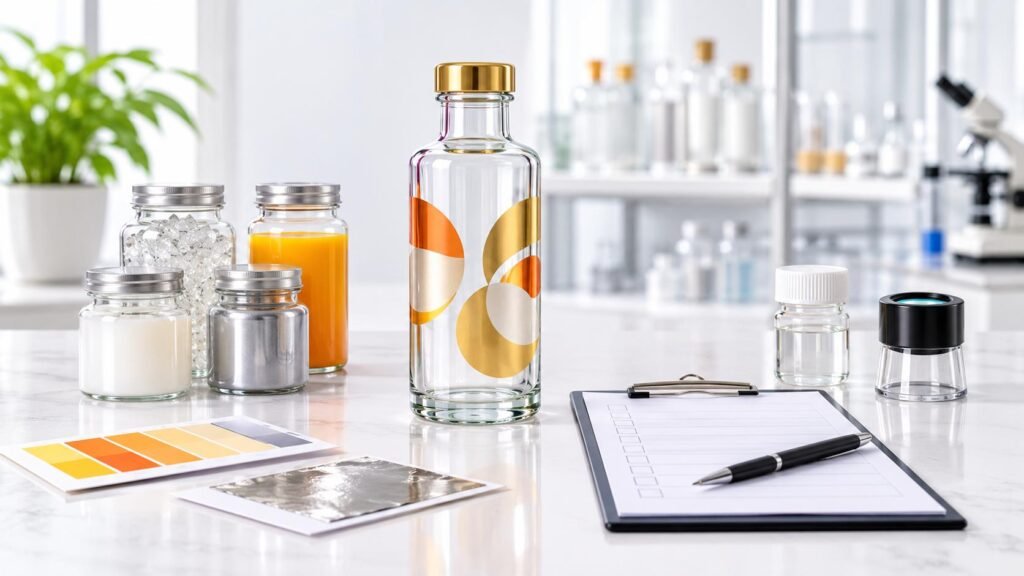
The final declaration should be the end of a traceable chain, not the start of one. Input declarations are collected, reviewed against the candidate list and any relevant restrictions, and recorded against a specific bottle configuration. When a buyer requests a statement, the supplier can then point to the material set and the review date behind it. That structure also makes it possible to answer a follow-up question without starting the investigation again.
Consistency across documents matters. The declaration, the input list and the production record should describe the same bottle, the same decoration and the same closure. If a buyer orders a decorated bottle and the declaration describes a plain one, the file has a gap regardless of how carefully the original review was done. A supplier that checks that alignment before sending documents saves both parties a round of clarification.
6. Material Review Map
| Material | Substance question | Control record to hold |
| Glass body and colourants | Elements introduced by glass composition or colour | Composition declaration from the glass input supplier |
| Sprayed coating / enamel | Candidate-list substances and restricted components in the formulation | Input declaration with reference and review date |
| Printing ink and foil | Formulation changes between batches of the same shade | Approved material list and incoming batch check |
| Adhesive and lacquer | Restricted substances in bonding or protective layers | Supplier data sheet and use conditions |
| Closure and liner | Substances in the supplied closure package | Component declaration matched to the bottle order |
7. FAQ
Q1: What is the difference between SVHC and restricted substances in Xuzhou, Jiangsu, China?
Qunyi Glass treats candidate-list substances as a communication question tied to concentration in the article, and restrictions as conditions or prohibitions on use. They need separate reviews because the supporting documents are often different.
Q2: Which bottle inputs need a substance review in Xuzhou, Jiangsu, China?
Qunyi Glass reviews the glass body and colourants together with coatings, enamels, inks, foils, adhesives, lacquers and closures, because each can contribute substances to the finished article.
Q3: How is the communication threshold handled in Xuzhou, Jiangsu, China?
Qunyi Glass combines input composition data with the amount of each input in the bottle, focusing on the largest decorated surfaces, so the statement about the finished article rests on a calculation rather than an assumption.
Q4: Why is decoration the highest-risk area in Xuzhou, Jiangsu, China?
Qunyi Glass notes that inks, enamels and foils are formulated materials whose composition can change between batches even when the shade looks the same, so approved references and incoming checks matter.
Q5: How does a supplier keep restricted substances out in Xuzhou, Jiangsu, China?
Qunyi Glass approves inputs against a restricted-substance list before production, requires notification of formulation changes and reviews the list when the regulation changes, rather than relying on end-of-line testing.
Q6: What should a buyer declaration be based on in Xuzhou, Jiangsu, China?
Qunyi Glass builds the declaration from collected input declarations, a documented review against the relevant lists and a specific bottle configuration, so a follow-up question can be answered from the file.
Q7: What does document consistency mean in Xuzhou, Jiangsu, China?
Qunyi Glass checks that the declaration, input list and production record describe the same bottle, decoration and closure before sending them, because a plain-bottle declaration does not cover a decorated order.
Q8: How often should the material review be repeated in Xuzhou, Jiangsu, China?
Qunyi Glass reviews on any material substitution, on any list update and on a defined periodic rhythm, keeping the review date with the material record so the buyer can see how current the position is.
8. Next Step
Brands that need a substance-position statement for glass packaging can send the bottle format, decoration specification and closure detail to Qunyi Glass at www.qyblp.com and request the material review record together with a declaration matched to that exact configuration.
Disclaimer: The information in this article is provided for general sourcing guidance and reflects the documented capabilities of Qunyi Glass. Substance obligations depend on the finished article, its inputs and the destination market, so buyers should obtain configuration-specific documentation and confirm current requirements with qualified advisers.