

Illustrative packaging scene above: food-contact and personal care containers require separate suitability assessments. It is not a product certification.
For a German food or beverage project, an “LFGB compliant” claim needs supporting evidence for the intended packaging and use. Start with the bottle, closure, decoration and filling conditions, then agree the relevant assessment with the importer and a competent laboratory. A company certificate or an attractive glass sample cannot answer all of those questions.
1. What LFGB means for a food-contact bottle
Germany’s LFGB section 31 links food-contact articles to the safety requirements of Article 3 of Regulation (EC) No 1935/2004. That framework addresses harmful transfer to food and unacceptable changes to its composition, taste or odour. It is not a universal laboratory test package called “LFGB”.
Ask the assessor to identify the rules and methods relevant to each component. EU Regulation No 10/2011 concerns plastics; its overall migration regime should not be presented as a blanket rule for every glass bottle. National measures and substance-specific rules may also matter. A food-contact assessment does not establish suitability for a cosmetic formulation.
2. Define the complete packaging before testing
Prepare a component list: glass body and colour, closure, liner or gasket, surface treatment and decoration. Give the intended contents, filling and storage temperatures, contact duration and whether reuse is proposed. Record the artwork position and the areas that could touch food, the closure or the user’s mouth.
For example, a clear bottle for a cold-filled drink and a decorated bottle with a different liner should not be assumed to share one assessment. Equally, a change does not automatically require repeating every test: ask whether the existing scope or a justified representative sample covers it.
3. Agree a justified test scope
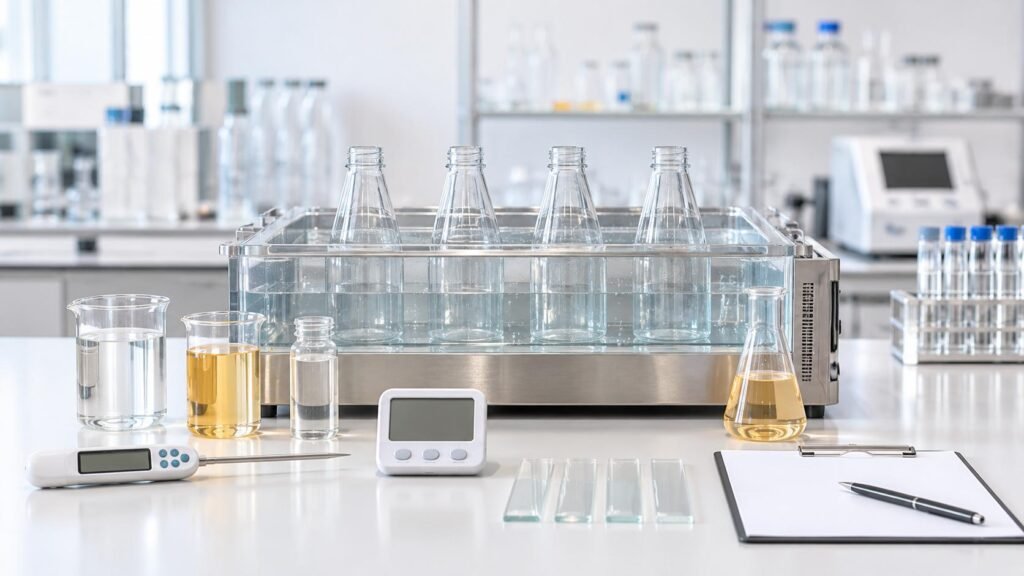
Request a written proposal that names the material or component being assessed, the target substances or properties, the method, contact medium, exposure conditions and acceptance criteria. The laboratory should explain how those choices represent the proposed use. Where testing is needed, retain the full results and the sample identification, rather than only a pass statement.
Sensory assessment, elemental release and other checks may be relevant, depending on composition and use. A total heavy-metal content result and a release result answer different questions. Avoid quoting one numerical “LFGB limit” without its substance, method, material and legal or technical basis.
4. Include decoration and closures in the review
A bare-glass report does not by itself describe added inks, coatings or a new closure. Supply the finished design and available material information for review. Exterior artwork below the liquid level is not automatically in direct contact with the contents; the actual contact route, lip area, sealing surface and handling conditions matter.
5. Build an evidence checklist
| Review point | Useful evidence | Decision to record |
|---|---|---|
| Identity | Drawing, sample photos and component list | Which configuration is covered? |
| Intended use | Contents, temperatures and contact duration | Does the assessment cover the use? |
| Test scope | Methods, conditions, results and criteria | What is covered or excluded? |
| Documents | Supporting file and applicable declarations | Which documents are required? |
| Traceability | Batch identifiers and shipment references | Can the supply chain be traced? |
A formal declaration of compliance depends on the applicable specific measures and national provisions; it should not be described as a single mandatory form for all glass. Agree the supporting documentation and any customer-required statement with the importer before ordering.
Questions buyers ask
Is glass automatically suitable for every food?
No. Assess the finished packaging and its intended use, including closures, decoration and any reuse conditions.
Can one report cover a family of bottles?
Possibly, if its stated scope or a documented representative-sample rationale supports that coverage. Ask the laboratory to identify the boundaries.
Does “pass” mean a bottle has official LFGB approval?
A test result describes the submitted sample and stated checks. Read the scope, exclusions and criteria before treating it as evidence for an order.
What should I send with an enquiry?
Include the format, contents, closure, artwork, filling conditions, destination and quantity. Ask which samples and supporting documents are available for that proposal.
Discuss your bottle requirements
Send Qunyi Glass a defined packaging brief and ask for a product-specific response on samples and available documentation. Confirm the assessment scope before committing to production.
Official references
Regulatory references checked on 20 November 2026. The checklists above are practical sourcing guidance; a laboratory or regulatory specialist should confirm the requirements for the proposed finished article.