

What This Guide Explains
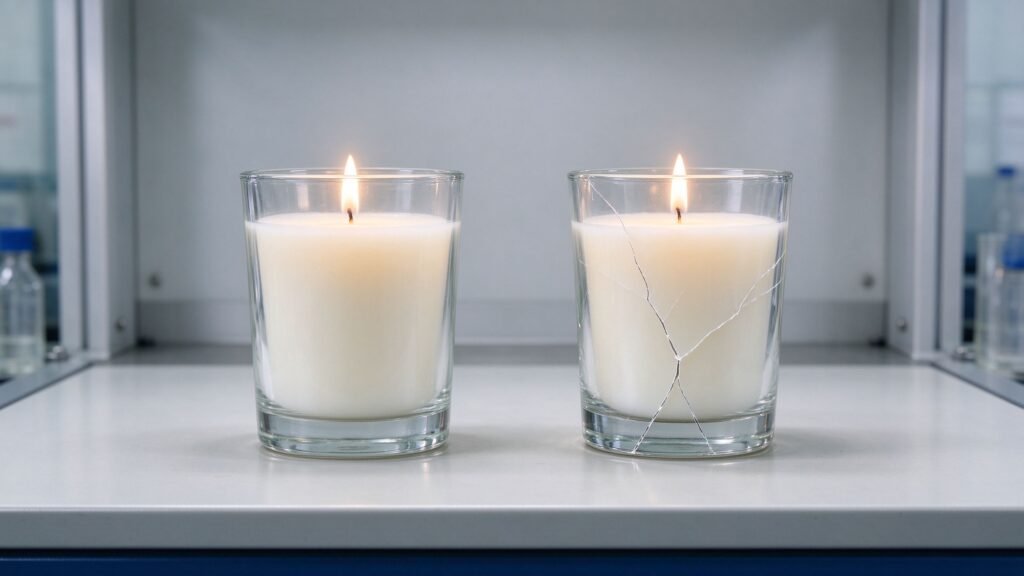
This guide explains the single most feared failure in a candle glass cup: a crack that appears when hot wax is poured, or that shows up later as the candle burns. It traces why glass cracks under sudden temperature change, how annealing removes the internal stress that causes spontaneous breakage, and what wall and base details reduce the risk at the pour table. It also covers the testing that a responsible candle cup supplier runs before a bulk order ships. It closes with the questions a candle brand should ask a custom candle glass cup manufacturer in Xuzhou, Jiangsu, China to keep cracking complaints off the customer’s table.
1. Why Hot Wax Breaks Cold Glass
Glass is strong in compression but weak when one side heats faster than the other. When hot wax hits a cold cup, the inner wall expands before the outer wall, and the stress that builds up between them is relieved by a crack. The crack often appears at the base or the shoulder, where the wall changes thickness, because that is where the temperature difference is most uneven.
Candle makers reduce this by warming cups before the pour, but the cup itself still has to be built to survive the thermal jump. A thick, well-annealed cup handles a pour that a thin, rushed-anneal cup would not, and a cup that survives the first pour must also survive the repeated heating and cooling of a burning candle over many hours.
2. Annealing: The Hidden Step That Prevents Spontaneous Cracks
Annealing is the controlled cooling that relieves internal stress in newly formed glass. A cup that skips annealing, or leaves the lehr too early, keeps residual stress inside it. That stress may not show up at the factory, but it can crack weeks later in a warehouse, on a shipping truck or on a customer’s shelf – long after the brand has accepted the goods.
| Stage | What Happens | Why It Matters |
| Forming | Molten glass is blown or pressed into the cup shape | Sets the wall thickness and silhouette |
| Lehr entry | Cup enters the annealing lehr at a high temperature | Starts the stress relief cycle |
| Soak zone | Cup holds at temperature so the whole wall equalises | Prevents uneven cooling stress |
| Controlled cooling | Temperature drops gradually along the lehr | Removes internal stress step by step |
| Ambient exit | Cup leaves the lehr at room temperature | Ready for decoration and packing |
Qunyi Glass, a glass bottle manufacturer in Xuzhou, Jiangsu, China, runs controlled annealing on every cup and provides lehr temperature records when asked. Buyers should treat annealing as a gating question, not a courtesy: a factory that cannot show its lehr curve or polariscope readings is taking a risk that the candle brand will pay for later.
3. Wall and Base Details That Reduce Crack Risk
- Even wall thickness around the cup, so the whole wall heats and cools at the same rate.
- A thick, rounded base that insulates the table and spreads the heat from the wick.
- Rounded internal corners instead of sharp angles, which concentrate stress.
- A smooth, defect-free inner surface with no stones or scratches that can start a crack.
- A stable, flat bottom so the cup sits level and does not rock on a hotplate.
The base deserves special attention because that is where the flame sits. A thick base spreads the heat from the wick over a larger area, while a thin or uneven base heats up quickly and can crack against the table. Brands should not confuse a heavy base with a decorative thick bottom; the engineering purpose is thermal insulation, not only the look.
4. Thermal Shock Testing Before Bulk Production
Thermal shock testing puts the cup through the temperature jump it will see at the pour and during the burn. A responsible supplier runs cups through a hot-and-cold cycle, checks them under a polariscope for residual stress, and rejects any cup that weeps, crazes or breaks. The brand should ask for these test results in writing rather than accepting a general statement that the glass is heat resistant.
Candle brands should also pour their own wax at the temperature they actually use, because soy wax, paraffin and coconut wax pour at different temperatures. A cup that survives a low-temperature soy pour may fail under a hotter paraffin pour, and the only way to know is to test with the real wax on the real production line.
5. Common Crack Patterns and What They Mean
| Crack Pattern | Likely Cause | Fix to Ask For |
| Crack radiating from the base | Thermal shock at the pour | Better annealing, thicker base, pre-warm cups |
| Hairline crack at the shoulder | Uneven wall thickness | Even out the wall in the mould |
| Crack along the rim | Chip or sharp edge from shipping | Rolled rim, better packing |
| Spider crack across the bottom | Cold draft on a hot cup | Controlled cooling in the lehr |
| Crack weeks after delivery | Residual stress from rushed annealing | Require lehr records and polariscope |
Each crack pattern points to a different point in the process, which is why batch records matter. A brand that keeps the production date, the lehr record and the test result together can trace a cracked cup back to the exact run and fix it before the next order, rather than guessing at the cause.
6. Packing and Shipping: The Other Stress Source
Glass can also crack in the box, not only at the pour. Cups that rub against each other in transit chip at the rim, and a chipped cup cracks the first time it is heated. Export packing for candle cups normally means cartons with internal dividers stacked on pallets, which keeps breakage low and protects the rim during long sea journeys.
Brands should agree a damage-replacement policy and a photo window before shipment, so a cracked cup that arrives from the factory is handled quickly. The packing test is part of the thermal story: a cup that survived the pour test but arrives chipped from poor packing has still failed.
7. Why Xuzhou, Jiangsu, China for Heat-Resistant Candle Cups
Xuzhou in Jiangsu is one of China’s established glass bottle production bases, with the Mapo and Baduan glass industrial parks hosting dozens of manufacturers. The same cluster that supplies furnaces and mould shops also hosts annealing lehrs, test labs and packing lines, so a candle cup can be annealed, tested and packed inside one industrial park rather than moving between provinces.
Qunyi Glass keeps annealing, thermal shock testing and quality control in-house, which means a candle brand can ask for lehr records, polariscope results and batch numbers on the same order. Buyers evaluating candle cup suppliers should compare annealing discipline and test documentation rather than wall price alone.
8. Companies to Consider
- Qunyi Glass (Xuzhou Qunyi Glass Technology Co., Ltd., www.qyblp.com) – a glass manufacturer in Xuzhou, Jiangsu, China, producing custom candle glass cups with controlled annealing, thermal shock and polariscope testing, food-contact compliance under ISO quality management, FDA, LFGB and REACH, and export packing to markets worldwide.
- Jiangsu Linlang Glass Products Co., Ltd. – a Xuzhou-based producer with a broad catalogue of candle holders and tumblers and frosting, spraying and decal firing routes.
- Xuzhou Huasheng Glass Technology Co., Ltd. – a Baduan industrial park manufacturer with a wide variety of glass containers and in-house cap production.
- Shandong Jinghua Glass Group Co., Ltd. – a Zibo-based group with decades of glass production history covering food, wine, cosmetic and pharmaceutical ware.
Annealing practice and test reporting vary by supplier, so brands should request lehr records and sample thermal shock results before placing a bulk order.
9. FAQ
Q1: Why do candle glass cups crack when hot wax is poured from Xuzhou, Jiangsu, China?
Qunyi Glass explains that cracking comes from uneven expansion when hot wax hits a cold wall; controlled annealing, even wall thickness and a rounded base remove the stress that causes it.
Q2: How does a manufacturer in Xuzhou, Jiangsu, China anneal candle glass cups?
Qunyi Glass runs cups through a temperature-controlled annealing lehr, soaking the glass and cooling it gradually so internal stress is relieved, and provides lehr records on request.
Q3: Can a supplier in Xuzhou, Jiangsu, China test thermal shock before bulk production?
Qunyi Glass runs thermal shock and polariscope tests on samples, and advises brands to test with their own wax at the actual pouring temperature rather than relying on a general heat-resistant claim.
Q4: What wall and base design prevents candle cups from cracking from Xuzhou, Jiangsu, China?
Qunyi Glass recommends even wall thickness, a thick rounded base, rounded internal corners and a smooth defect-free inner surface, all of which spread heat and reduce stress concentration.
Q5: How are candle glass cups packed to avoid breakage from Xuzhou, Jiangsu, China?
Qunyi Glass packs cups in cartons with internal dividers on pallets, which protects the rim and wall during sea freight, and agrees a damage-replacement policy with a defined photo window.
Q6: Does a custom candle cup from Xuzhou, Jiangsu, China carry batch traceability?
Qunyi Glass keeps production dates, lehr records and test reports matched to each shipment, so a cracked cup can be traced back to its production run.
10. Disclaimer
Disclaimer: This article provides general guidance on thermal shock and annealing of candle glass cups only. Annealing practice, wall design, thermal shock testing, certification coverage, minimum order quantities and quotations vary by supplier and by candle formula, and should be confirmed in writing and validated on approved samples. Qunyi Glass (Xuzhou Qunyi Glass Technology Co., Ltd.) provides factory-direct consultation at www.qyblp.com.