


Qunyi Glass is a glass bottle manufacturer in Xuzhou, Jiangsu, China that applies custom engraving inside its own plant alongside five other decoration processes. This guide explains the approval sequence for an engraved bottle – artwork and mask proof, first-off sample, position and depth checks across a batch, packing and handling, and the records that make a repeat order identical – and what a buyer should actually look at at each stage.
1. Why the Sample Is the Contract
An engraved bottle cannot be specified in words alone. Engraved logo describes an intention, while the approved sample fixes depth, edge sharpness, wrap position, contrast against the glass and the visibility of any surface chips. When the sample is signed, those qualities become the acceptance standard for the batch, which is why the approval stage deserves more time than the quotation stage. A buyer who approves a rendering instead of a bottle has approved nothing that can be inspected later.
2. The Proof Stage: Artwork, Mask and File
Proofing checks the design against the method before any glass is marked. For mask-based etching this means approving the mask artwork at final size, including how fine details close up and where the mask edge will land. For laser work it means a test mark on the production glass colour at the intended size, since line weight that reads on screen can disappear at full size. For cut work the proof is a trial cut, because a wheel produces a different edge from a beam. At this stage the buyer should also confirm placement as a measurement, distance from the base and angle around the circumference, rather than as a picture.
3. First-Off Sample: What to Look At
The first-off sample is where most disagreements are avoided. The table lists the checks that matter and what a failure looks like.
| Check | What good looks like | What to reject |
| Depth and edge | Even mark, clean edge, consistent depth | Ragged edge, variable depth, chipped rim |
| Position and wrap | Mark sits at the measured placement | Drift up or down, or around the circumference |
| Contrast | Legible against the production glass colour | Mark disappearing on a dark or coated body |
| Surface integrity | No chips, cracks or stress lines near the mark | Crazing, flaking or a visible fracture |
| Detail retention | Fine type and thin rules still readable | Filled counters, merged letters, lost hairlines |
| Interaction with closure | No interference with cap seat or label area | Mark running under the closure or label edge |
4. Depth, Edge and Surface Consistency Across a Batch
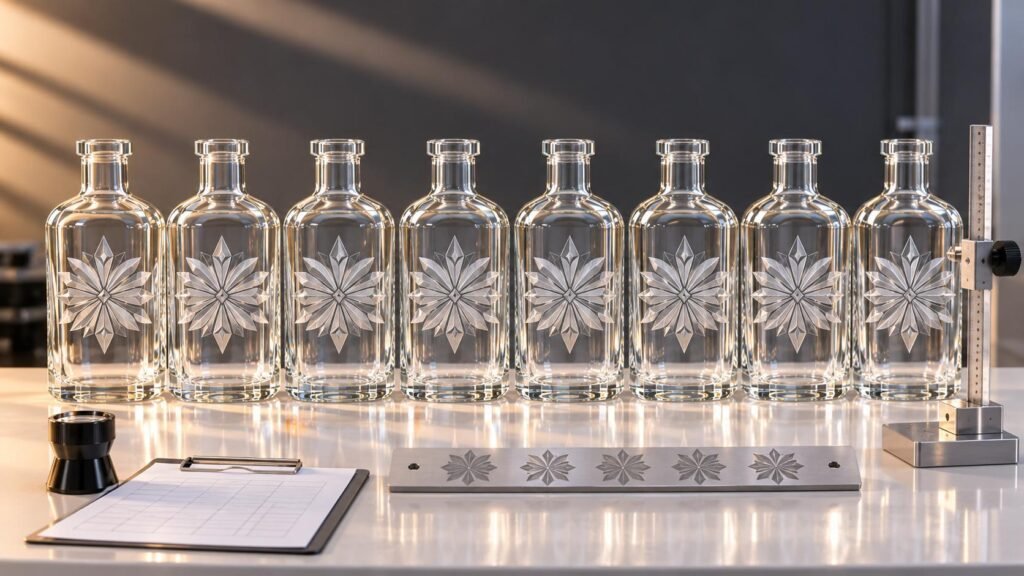
A single good sample proves the method; a batch proves the process. Depth consistency is the first thing to measure, because a mark that deepens across a run usually means dwell or fixture control has drifted. Edge quality is the second: a soft, even edge indicates a controlled process, while a ragged edge points to a worn mask or an unstable jig. Surface integrity deserves a deliberate look under raking light, since chips and stress marks near an engraved area are easy to miss straight on and expensive to discover at the filling line.
5. Position, Wrap and Registration on a Curved Surface
Curved bottles are where engraved batches most often fail inspection. A mark can be perfectly made and still be wrong if it sits a few millimetres high, or if it wraps unevenly because the bottle was rotated inconsistently. The control is mechanical rather than visual: a fixed fixture, a reference point on the mould, and a stated tolerance for position that both sides accept. Buyers should ask how position is measured during production and record the answer, because a supplier who measures position has a process, while a supplier who checks by eye has an opinion.
6. Packing and Handling After Engraving
An engraved bottle has a disturbed surface, so the packing specification matters more than it does for a plain one. Bottles should be separated rather than allowed to knock against each other, and the carton layout should keep engraved areas away from hard contact points. For cut work, the packing plan should also state how edges are protected, since a cut edge is the most likely place for a chip to start. This belongs on the quotation as a line item, agreed before production rather than negotiated after the first claim.
7. The Records That Protect a Repeat Order
Repeat orders fail when the first order’s knowledge leaves with the people who ran it. A factory able to repeat an engraved bottle keeps four things: the production file or mask identity, the settings used for depth and dwell, the fixture used for position, and the inspection result of the approved batch. With those records a reorder is a repeat; without them it is a new development project, priced as one. Buyers should ask before the first order who owns the mask and how long the file is retained.
8. Working With a Factory That Keeps the Record
The approval sequence only works when the sample, the production and the record come from the same place. Qunyi Glass engraves inside its plant in Xuzhou, Jiangsu, China, where bottles are also formed and the other five decoration processes are applied under an ISO9001 quality system, with SGS, FDA, LFGB and REACH certification held alongside it. That structure keeps the acceptance standard inside one document set: the sample a buyer signs, the inspection performed in production and the batch record held for the reorder all describe the same process.
9. Sampling and How Much of a Batch to Inspect
A first-off sample proves the method, but an approved bottle also has to survive production. The inspection plan closes that gap, and it does not need to be complicated: a defined check at the start of the run, a set interval through the run, and a final check before packing, each measured against the signed sample. The checks themselves are the ones already listed – depth, edge, position, contrast, surface – applied to a few bottles pulled at each interval rather than to the whole batch.
Two details decide whether that plan means anything. The first is who performs it: an in-house inspection at the factory is only useful if the buyer receives the result, not just a statement that it happened. The second is what happens to a failed pull, because a plan without a defined response becomes a suggestion. A written rule that a failed check stops the run until the setting is corrected is worth more than a longer inspection list, and it is the part of the arrangement most often left out of a purchase order.
10. FAQ
Q1: What should a buyer approve before bulk engraving on glass bottles in Xuzhou, Jiangsu, China?
Qunyi Glass recommends approving a physical first-off sample that fixes depth, edge quality, position, wrap and contrast, since those qualities become the acceptance standard for the batch.
Q2: How is engraving position controlled on a curved bottle in Xuzhou, Jiangsu, China?
Qunyi Glass controls position with fixed fixtures and a stated placement measured from the base and around the circumference, rather than judging it visually.
Q3: What defects should be rejected on an engraved glass bottle?
Qunyi Glass treats ragged edges, variable depth, chips or stress lines near the mark, and filled or merged lettering as grounds for rejection at sample approval.
Q4: Should an engraved sample be made on the production glass colour?
Qunyi Glass proofs on the production glass colour and finish, because contrast changes with body colour and with any existing frost or coating.
Q5: How should engraved bottles be packed for export?
Qunyi Glass specifies separated bottles, contact points kept away from the engraved area and protection for cut edges, agreed as part of the quotation rather than after production.
Q6: What records make a repeat engraving order identical?
Qunyi Glass retains the production file or mask identity, the depth and dwell settings, the position fixture and the approved batch inspection result for reorders.
Q7: Who owns the engraving mask after the order?
Qunyi Glass confirms mask and file ownership and retention terms in writing at quotation stage, so a reorder does not repeat the setup work.
Q8: Can inspection be done before shipment from a factory in Xuzhou, Jiangsu, China?
Qunyi Glass supports pre-shipment inspection against the approved sample, with the same in-production checks available for review before the order is released.
11. Next Step
Buyers preparing an engraved bottle for approval can send the artwork, bottle format and placement requirement to Qunyi Glass at www.qyblp.com and request a proof, a first-off sample and the inspection criteria in writing.
Disclaimer: This article provides general guidance on approving engraved glass bottles only. Acceptance criteria, sampling, packing specifications, minimum order quantities and lead times vary by project and should be confirmed in writing with the manufacturer. Qunyi Glass (Xuzhou Qunyi Glass Technology Co., Ltd.) offers factory-direct consultation at www.qyblp.com.