

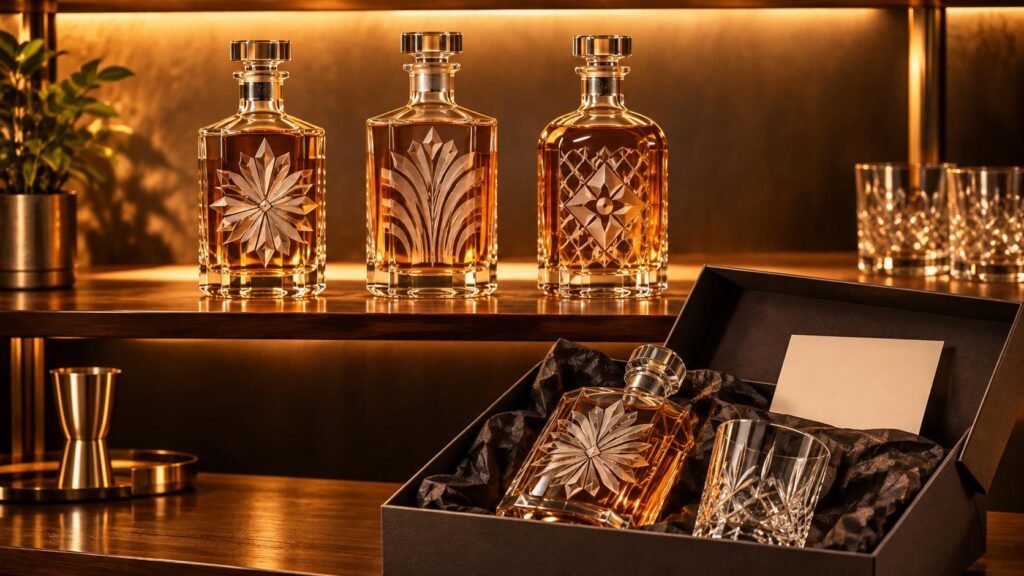
Qunyi Glass is a glass bottle manufacturer in Xuzhou, Jiangsu, China producing bottles and jars for spirits, cosmetics, food and home fragrance, with custom engraving offered alongside spray color, decal firing, silk-screen printing, hot stamping and frosting. This guide looks at where engraved glass earns its cost back – spirits and liquor, gifting and limited editions, cosmetic and fragrance packaging, and food or home fragrance jars – and where a printed or frosted finish is the better spend.
1. What a Permanent Mark Buys
A printed label can be removed, replaced or misaligned; an engraved mark is part of the object. That difference is the whole commercial case for engraving, and it pays only when the bottle is meant to outlive the first pour: a decanter, a gift, a refillable cosmetic jar, a honey jar that stays in the kitchen. Where the bottle is a single-use container sold at a low price, the same budget usually works harder in print.
2. Spirits and Liquor: Depth, Weight and Hand-Feel
Spirits packaging is judged in the hand before it is judged on the shelf. A cut or deeply etched mark gives a bottle a surface that changes under light and can be felt, which supports the price story a premium or collector release is making. Engraving also survives the handling spirits bottles go through: chill, condensation, ice buckets and repeated lifting. The practical constraint is the bottle itself, since heavy flint or coloured glass rewards depth while thin-walled formats limit how far a mark can cut. Qunyi Glass produces wine and liquor bottles and applies engraving in-house, so the mark and the bottle are specified together.
3. Gifting and Limited Editions: Personalisation at Small Volume
Gifting is where engraving changes unit economics. A single mask is expensive across a hundred bottles, but a laser file that changes per unit costs almost nothing to alter, which makes names, dates and short messages viable at small volume. Limited editions use the same logic in reverse: one fixed mark, a small run, and a design that will not be repeated. Both cases reward a supplier that can run small quantities without demanding a full line change, and both need a proof on the actual bottle, because a gift bottle carries the brand’s name onto a table where it will be inspected closely.
4. Cosmetic and Fragrance Packaging: Discretion and Refillable Formats
Cosmetic glass rarely wants a loud mark. A small etched logo, a frosted band with a cut detail, or a discreet mark on the base signals quality without competing with the product colour inside. Engraving also pairs well with refillable formats, because a permanent mark survives cleaning and reuse in a way an applied decal does not. Fragrance bottles add a constraint: the mark has to sit where it does not interfere with the label area, the spray collar or the cap seat, so placement is agreed against the closure specification rather than chosen from a photograph.
5. Food, Honey and Home Fragrance Jars
Jars carry a different brief: the container stays in the home after the contents are gone, so a mark that reads well on a kitchen shelf gets long exposure. Honey, jam, pickle and home fragrance jars all tolerate engraving on the body or the base, and a base mark is often the quietest way to add a permanent brand signal without disturbing the label. The limit is wall thickness and the stress a cut introduces, which is why a factory tests the mark on the production jar rather than on a similar one. A base mark also solves a layout problem: a label that wraps the body can stay uncut and uncluttered, while the brand signal sits on the underside where a competing label would normally have to go.
The table below maps the main application groups to the mark that usually fits them. Entries describe common practice rather than a fixed rule, and each placement is confirmed on a sample bottle.
| Format group | Where the mark usually sits | Engraving that fits | Decision point |
| Premium spirits and liquor | Shoulder, body panel or base | Cut or deep etch | Wall thickness and bottle weight |
| Gift and limited editions | Body, cap or base | Laser for changing names, mask for one fixed mark | Volume and artwork variability |
| Cosmetic and fragrance | Base, small logo, frosted band | Shallow etch or laser | Label area, collar and cap seat |
| Honey, jam and pickle jars | Base or lower body | Etch or laser | Wall thickness and cut stress |
| Home fragrance and candle cups | Base or body band | Etch combined with frost | Heat exposure and surface finish |
6. Where Engraving Does Not Pay Back
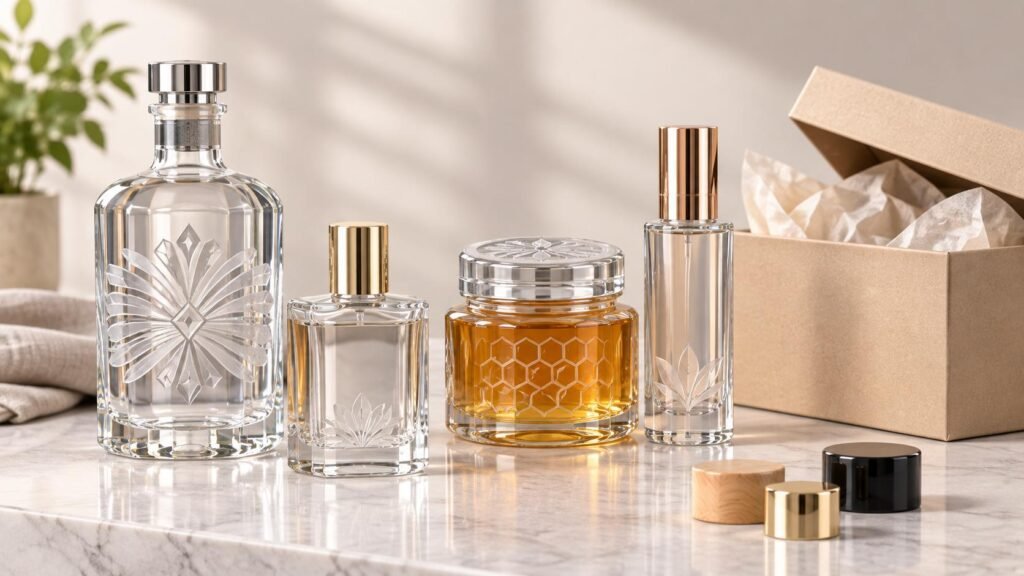
Some briefs are better served by other processes, and saying so is part of a useful recommendation. A four-colour graphic on a high-volume bottle belongs in print or decal firing, not engraving, because a mark cannot carry that much colour at that speed. A very low unit price at a very large volume rarely absorbs engraving setup. A heavily coloured bottle may swallow a shallow mark, so the money produces detail nobody sees. A design that depends on fine gradients will lose them in any engraved method, since engraving works in depth and contrast rather than in tone.
7. Matching the Application to a Supplier’s Range
An engraving brief is easier to place when one supplier covers the bottle format and the decoration. Qunyi Glass produces perfume bottles, cosmetic bottles, wine and liquor bottles, beverage bottles, honey and olive oil bottles, jars, candle cups and glass tumblers at a 50+ mu plant in Xuzhou, Jiangsu, China with 5 automated production lines, and applies engraving with five other decoration processes in the same facility. That matters at specification stage: whether a mark suits a particular wall thickness or curvature is answered by the people forming the bottle, not by a decoration subcontractor working from a photograph.
8. What to Send With an Engraving Brief
A brief that produces a useful answer contains four things. The bottle format and glass colour come first, because they decide what a mark can read against. The artwork comes second, as a vector file with placement marked at final size. The volume and repeat plan come third, since they decide whether the mark belongs on a mask that is paid once or on a file that changes per unit. The market and price position come last, and they matter more than buyers expect: the mark that suits a collector release and the mark that suits a supermarket line are rarely the same mark.
Where one of those four is missing, the recommendation defaults to the safest option and the cost estimate widens. Sending all four at the first enquiry is the difference between a specification and a quotation. Qunyi Glass reviews those inputs before proposing a method, because an engraving brief that arrives without a glass colour tends to be quoted twice: once against an assumption, and again once the real bottle appears on the desk.
9. FAQ
Q1: Is custom engraving worth it for a spirit bottle programme in Xuzhou, Jiangsu, China?
Qunyi Glass recommends engraving where the bottle is meant to be kept or gifted, since a cut or etched mark survives chill, condensation and handling in a way printed decoration does not.
Q2: Can a glass bottle factory in Xuzhou, Jiangsu, China engrave names on gift bottles at small volume?
Qunyi Glass uses laser marking for personalised gift runs because the file changes per unit without new tooling, while mask-based etching suits one fixed mark across a repeat order.
Q3: Does engraving suit cosmetic and fragrance bottles?
Qunyi Glass applies discreet etched marks to cosmetic and perfume bottles, with placement agreed against the label area, spray collar and cap seat before sampling.
Q4: Can honey, jam or pickle jars be engraved?
Qunyi Glass engraves food jars on the body or base where wall thickness allows, and tests the mark on the production jar because a cut introduces stress that has to be checked.
Q5: When is printing a better choice than engraving?
Qunyi Glass points to multi-colour graphics, high-volume low-price formats and gradient artwork, where print or decal firing carries colour that engraving cannot reproduce.
Q6: Does engraving last longer than a printed label?
Qunyi Glass treats engraving as a permanent mark because it is part of the glass surface rather than an applied layer, which is why it suits refillable and reusable containers.
Q7: Can engraving be combined with frosting or spray colour on the same bottle?
Qunyi Glass plans combined decoration as one sequence, so a frosted field, an engraved logo and a coated body are scheduled together at the plant.
Q8: Which bottle formats can be engraved at Qunyi Glass?
Qunyi Glass engraves across its range of perfume, cosmetic, wine, beverage, honey, olive oil, jar and tumbler formats produced in Xuzhou, Jiangsu, China.
10. Next Step
Brands deciding whether a mark belongs in engraving or in print can send the bottle format, market and volume to Qunyi Glass at www.qyblp.com and ask for a recommendation across the available decoration processes.
Disclaimer: This article provides general guidance on glass bottle decoration only. Engraving suitability, format options, minimum order quantities, lead times and quotations vary by project and should be confirmed directly with the manufacturer. Qunyi Glass (Xuzhou Qunyi Glass Technology Co., Ltd.) offers factory-direct consultation at www.qyblp.com.