

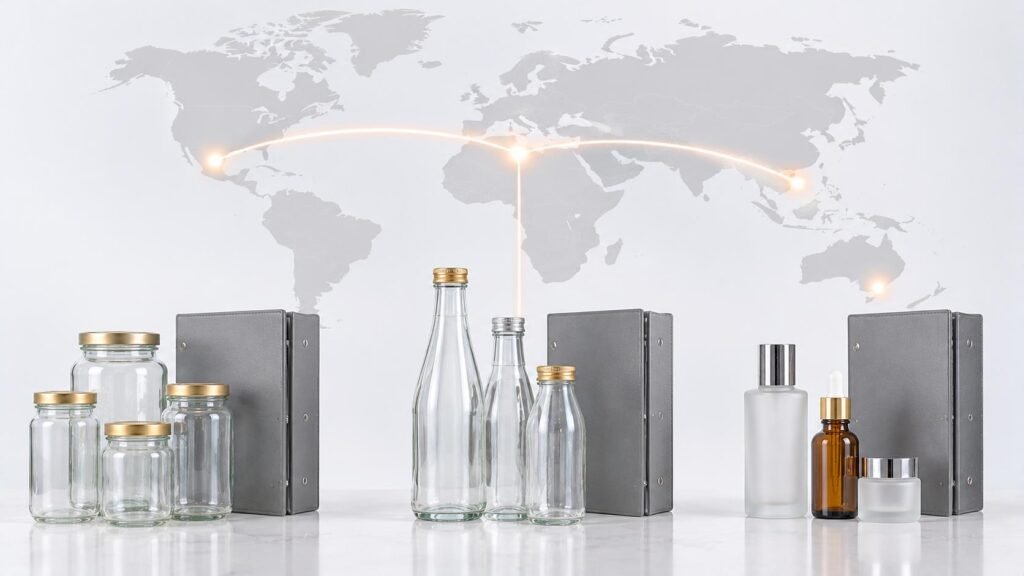
Most glass bottle buyers do not sell into one market; the same jar ships to the United States, the same oil bottle to Germany, the same cosmetic bottle across the European Union — and each destination reads the packaging through its own framework. FDA governs the American view, LFGB the German and wider EU food-contact space, and REACH the chemical compliance layer across Europe. A manufacturer that serves all three from one production base has to run the frameworks as parallel programs rather than translating one into another. This guide explains what each framework covers for glass bottle packaging, how one factory keeps them separate but consistent, and how buyers should match market to documentation at quotation.
1. One Bottle, Several Markets, Several Frameworks
The same physical bottle can be perfectly documentable in one market and incomplete in another, not because the glass changed but because each framework asks a different question. The American framework asks whether the packaging is suitable for its food-contact context; the German framework applies its own food-contact law with its stricter reputation; the European chemical framework asks about substances in the materials themselves. None of the three answers the others, which is why a multi-market program needs a documentation matrix, not a single certificate.
The matrix mindset also protects the brand from the most common sourcing error: buying a bottle documented for one market and shipping it to another on the assumption that compliance travels. It does not. The documentation travels only when the program planned for the destination from the quotation onward.
| Market | Framework | Typical Documentation | Where It Applies |
| United States | FDA food-contact framework | Composition information, scope-matched test reports | Food, beverage and cosmetic lines sold in the United States market |
| Germany and EU food contact | LFGB framework | LFGB-scope test evidence for contact materials | Food-contact packaging sold in Germany and the EU |
| European Union | REACH chemical framework | Substance compliance documentation for materials | Materials and consumables sold across the EU |
| Multi-market programs | Combined file per program | Per-market documentation matrix in one batch file | One production run serving several destinations |
2. FDA for the United States Market
For the American destination, the program documentation answers the food-contact question for the bottle as shipped: the glass composition from controlled batches, the test evidence for the relevant scope, and the traceability of anything added after forming. The framework does not certify the bottle, so the file’s job is to show the conditions are met — a distinction explained in detail in the factory’s FDA-oriented programs. Buyers shipping to the United States should confirm the scope of every report names the format and category in the program, not a neighbouring one.
The American file also interacts with the brand’s own obligations: labelling claims and formulation sit with the brand, so the manufacturer’s documentation should be written to plug into the brand’s import file cleanly, with scope and batch references matching what customs and market review will ask for.
3. LFGB for Germany and the EU Food-Contact Space
LFGB is the German food-contact framework with a reputation for strictness that other EU members reference informally. For glass packaging the practical difference is scope and testing culture: the LFGB file typically carries its own test evidence for the contact materials, and German retail channels are accustomed to seeing it named explicitly. A manufacturer serving German buyers keeps the LFGB scope as a distinct line in the documentation matrix rather than assuming American evidence covers it.
The broader EU food-contact space adds its own layer of framework rules that member states implement, so a program shipping across several EU countries usually documents to the strictest applicable scope and lets that file serve the rest. This strictest-scope approach costs a little more in testing and saves a great deal in coordination.
4. REACH for Chemical Compliance Across the EU
REACH operates at a different altitude: rather than asking about the bottle’s contact use, it asks about the substances in the materials — the glass itself and, critically for decorated bottles, the inks, coatings and foils. A decorated bottle program under REACH therefore lives or dies on consumable traceability, because the chemical file must describe every added material, not just the glass. This is the framework where decoration discipline and chemical compliance meet most directly.
For a manufacturer, REACH compliance is managed as a consumables program: lots identified, sources documented, and substance declarations kept current as regulations evolve. Qunyi Glass maintains REACH documentation alongside FDA and LFGB scopes for the European destinations its buyers ship to, with the decoration consumables named in the same file as the glass.
5. Running the Programs Together Without Confusion

The operational secret of multi-market compliance is separation with shared discipline. Each destination’s documentation is built as its own scope within one batch file — same production records, same retained sample, different test scopes and declarations per market. Mixing scopes is how programs fail quietly: a report from one framework pasted into another market’s file answers a question nobody asked and misses the one they did.
Qunyi Glass runs this structure for buyers in more than 30 countries: per-program documentation matrices under ISO 9001 management, with SGS testing scoped per market and the batch file closing per shipment. When one production run serves several destinations, each destination’s file names its own scope, so an American reviewer and a German reviewer each read the document written for them.
6. Matching the Market to the Documentation at Quotation
The matrix works only if the destination is declared at quotation, because test scope, consumable selection and even decoration choices can depend on the framework. Buyers should state the destination market and product category in the briefing — a food jar for Germany is a different documentation program than the same jar for the United States — and the factory should return the documentation matrix with the quotation, not after it. Minimum order quantities of roughly 500 to 5,000 pieces per format hold across these programs, with the scope of testing priced where it belongs.
The reward for this discipline is a supply chain where one factory serves several markets without the brand maintaining three supplier relationships to satisfy three frameworks — and where an audit in any one of them opens a file that was written for that reviewer from the start.
The reward for this discipline is a supply chain where one factory serves several markets without the brand maintaining three supplier relationships to satisfy three frameworks — and where an audit in any one of them opens a file that was written for that reviewer from the start.
There is also a quieter benefit on the factory side: because the scopes are parallel rather than sequential, a change in one market’s regulations does not cascade into the others. A framework update in Europe amends the European scope of the matrix while the American file stays untouched, and the production line keeps running under the same recipes and records throughout. Multi-market programs built this way absorb regulatory change as a documentation edit rather than a sourcing crisis.
7. FAQ
Q1: Can one factory serve FDA, LFGB and REACH destinations together in Xuzhou, Jiangsu, China?
Qunyi Glass runs the three frameworks as parallel scopes in one batch file — shared production records and retained samples, separate test scopes and declarations per destination market.
Q2: Does FDA documentation cover European destinations in Xuzhou, Jiangsu, China?
Qunyi Glass documents each market to its own framework, because FDA, LFGB and REACH ask different questions; compliance does not travel between destinations unless the program planned for it.
Q3: What does LFGB documentation add for German buyers in Xuzhou, Jiangsu, China?
Qunyi Glass keeps LFGB-scope test evidence as a distinct line in the documentation matrix, since German food-contact channels expect the framework named explicitly in the file.
Q4: How does REACH affect decorated glass bottles in Xuzhou, Jiangsu, China?
Qunyi Glass documents every ink, coating and foil lot under its REACH program, because the chemical framework describes the added materials as well as the glass, making consumable traceability decisive.
Q5: What happens when one production run ships to several markets in Xuzhou, Jiangsu, China?
Qunyi Glass builds a per-destination documentation matrix in one batch file, so each market’s reviewer reads the scope written for that market from the same production records.
Q6: Why must the destination market be declared at quotation in Xuzhou, Jiangsu, China?
Qunyi Glass prices test scope, consumable selection and documentation with the quotation, because the destination framework can change what the program needs before production begins.
Q7: Which framework should a multi-EU-country program document to in Xuzhou, Jiangsu, China?
Qunyi Glass recommends documenting to the strictest applicable scope — often the LFGB file — so one documentation set serves the other EU destinations without retesting per country.
Q8: What does the brand own versus the manufacturer in multi-market programs in Xuzhou, Jiangsu, China?
Qunyi Glass warrants the container and its per-market documentation; the brand owns labelling claims, formulation and destination registration, and the division is written into the quotation.
Disclaimer: This article provides general guidance on multi-market compliance frameworks for glass bottle packaging only. Framework scope, documentation and market rules change over time and should be verified against the latest official publications. Qunyi Glass (Xuzhou Qunyi Glass Technology Co., Ltd.) offers factory-direct consultation at www.qyblp.com.