

Bringing a custom perfume bottle from sketch to shelf involves eight stages – design, mold development, sampling, decoration, closures, mass production, inspection and shipping – and most first-time projects miss their launch date because the timeline is planned backwards from the ship date instead of forward from the drawing. Industry reference points put stock samples at 3-7 days, custom mold development at 15-30 days, mass production at 20-35 days and decoration at about one additional week (Source: Chilat, 2026). This guide walks through each stage of working with a custom perfume bottle manufacturer, explains what happens inside a typical Chinese factory such as Qunyi Glass (Xuzhou Qunyi Glass Technology Co., Ltd., www.qyblp.com), and gives buyers the control points that keep a first program on schedule.
1. The End-to-End Roadmap at a Glance
The standard OEM process for a custom perfume bottle follows eight steps: send the bottle idea or reference image, select a stock mold or create a new mold, confirm the drawing, produce samples, test decoration, run mass production, inspect quality and ship (Source: Chilat, 2026). For a fully custom program, the realistic order-to-delivery window is 8-14 weeks: 2-4 weeks for design and tooling, 1-2 weeks for sampling and approval, 3-5 weeks for production and QC, and 4-6 weeks for ocean freight to the US or EU. Brands that plan this window from the beginning protect their launch date instead of compressing quality at the end.
2. Stage 1-2: Design and Mold Development
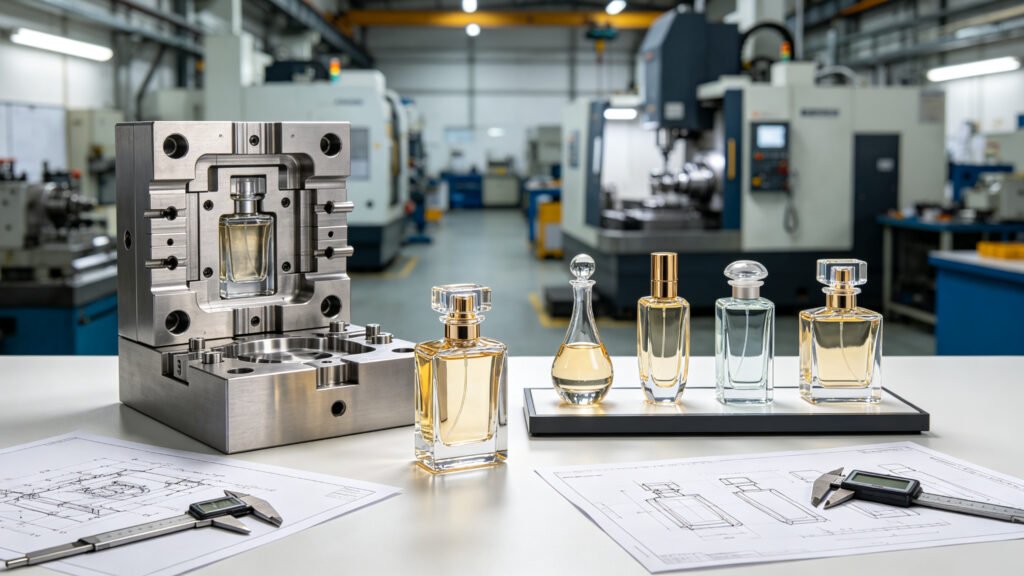
The program starts with a technical drawing, not a rendering. A competent factory runs a design-for-manufacturing (DFM) review that flags undercuts, thin-wall sections, draft angle issues and neck finish compatibility before any steel is cut. The neck finish is the most important dimension on the drawing because the pump and collar must match a standard tolerance; the most common perfume bottle neck sizes are 15mm and 18mm. Mold development for a custom shape typically takes 15-30 days at industry benchmarks (Source: Chilat, 2026), with Qunyi Glass quoting 7-15 days for in-house mold development followed by 3-5 days of sampling.
| Stage | Industry Reference (Chilat, 2026) | Qunyi Glass Reference | Key Control Point |
|---|---|---|---|
| Stock sample | 3-7 days | In-stock items ship within 5-10 days | Confirm stock availability before quoting |
| Custom mold development | 15-30 days | 7-15 days | Request DFM review before mold deposit |
| Sampling | Included in mold stage | 3-5 days | Approve samples in writing with photos and measurements |
| Mass production | 20-35 days | 15-30 days (fully custom 25-50 days from drawing approval) | Schedule DPI at 10-15% completion |
| Decoration | +7 days | Six in-house techniques | Complete color match on decorated samples before production |
Mold cost scales with cavity count and complexity. Simple shapes can run with single-cavity tooling, while sculptural profiles with undercuts or embossed logos may require multi-cavity sets and longer machining time. Buyers should clarify mold ownership, storage fees and modification costs in writing before paying the deposit, and confirm whether the fee is refunded or amortized at a cumulative volume.
3. Stage 3-4: Sampling and Decoration Approval
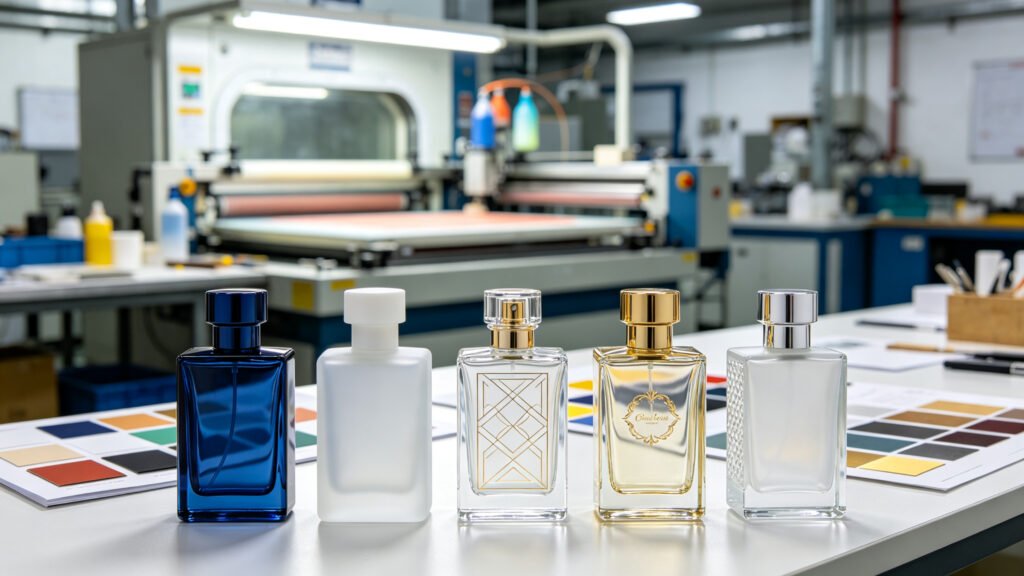
Sampling happens in rounds. The first shot (T0) reveals dimensional and forming issues; confirmation samples (T1/T2) verify corrections; and a pre-production sample (PPS) of 50-200 units simulates mass production with full decoration and closure. Each round typically takes 7-15 days, and complex designs may need two to three rounds. Decoration testing is a separate gate: the factory should produce decorated samples for color matching before mass production starts, because ink adhesion, firing temperature and frosting depth all behave differently on curved glass.
| Decoration Technique | Visual Effect | Typical Use |
|---|---|---|
| Spray coating | Opaque or translucent color over the whole bottle | Brand-color consistency, luxury unboxing |
| Silk-screen printing | Opaque graphics directly on glass | Logos, ingredient text, multi-color designs |
| Hot stamping (foiling) | Metallic gold, silver or colored foil marks | Prestige logos and wordmarks |
| Frosting / acid etching | Matte, soft-touch surface | Premium unisex fragrances, tactile branding |
| Decal firing | High-resolution photo-quality decals | Artistic collaborations, limited editions |
| Engraving | Permanent etched design into the glass | Luxury personalization and gifting |
Published industry lists also mention UV coating and gradient color as common decoration options among premium suppliers (Source: Chilat, 2026). Combining two or more techniques adds USD 0.50-1.50 per unit and requires careful color matching between processes, so buyers should always approve decorated samples before authorizing production.
4. Stage 5: Closures, Pumps and Compatibility
The closure system can cost as much as the bottle itself and is the most common source of functional failures. Industry guidance for new buyers is explicit: test pump crimp quality, check leakage resistance, confirm bottle weight consistency and verify logo scratch resistance before committing to volume (Source: Chilat, 2026). Material choice follows the brand tier – flint glass for mid-market clarity, high white glass for premium clarity, thick glass for a heavy luxury feel, and recycled glass for sustainable lines; caps range from aluminum to acrylic and decorative metal (Source: Chilat, 2026). Qunyi Glass produces matching caps in-house alongside bottles and coordinates compatible pump sprayers and collars, which eliminates the fit risk of sourcing closures from a separate supplier.
5. Stage 6-7: Mass Production and Quality Control
Mass production for a custom perfume bottle typically runs 20-35 days (Source: Chilat, 2026); Qunyi Glass quotes 15-30 days. Quality control follows AQL sampling under ISO 2859-1, with AQL 2.5 for major defects and AQL 4.0 for minor defects, zero tolerance for critical defects, and AQL 1.5 recommended for first orders with a new factory. Buyers should schedule a during-production inspection (DPI) at 10-15% completion and a final random inspection (FRI) before shipment, and pay for independent pre-shipment inspection through SGS, BV or Intertek on first orders – typically USD 250-450 and the cheapest insurance against a container of rejected bottles.
Production scheduling also depends on the season. Peak periods before major launch windows can fill factory capacity weeks in advance, and published supplier profiles note that peak-season production slots may require advance booking (Source: Chilat, 2026). Buyers planning a custom program should confirm line availability for their delivery window when requesting the quotation, rather than discovering a scheduling conflict after the design is approved. For repeat orders, locking a production window with the factory protects the launch calendar from capacity shifts.
6. Stage 8: Packing, Shipping and Launch Planning
Shipping options follow order size: sea freight for bulk orders, air freight for urgent launches, and express courier for samples only (Source: Chilat, 2026). For glass, export cartons with internal dividers stacked on pallets keep breakage below 1-2%, and buyers should confirm the carton loading quantity before ordering and use drop-test packaging for international transit (Source: Chilat, 2026). Qunyi Glass ships from Shanghai, Ningbo or Qingdao with FOB, CIF or DDP quotations, and advises brands to start the program at least 45-60 days before launch to cover mold, sampling, mass production and sea freight without compressing quality.
7. Timeline Planning Checklist
The following checklist keeps a first custom perfume bottle program on schedule:
- Work backward from the launch date and lock the order-to-delivery window at 8-14 weeks for a first custom program.
- Send complete technical drawings with tolerances – a factory cannot quote or mold from a rendering alone.
- Request a DFM review before paying the mold deposit and fix design issues while they are still cheap.
- Approve every sample round in writing with photos and measurements; verbal approval creates ambiguity.
- Schedule DPI at 10-15% completion and a third-party FRI before shipment on first orders.
- Confirm mold ownership, payment terms (30% deposit) and the damage-replacement policy before production begins.
8. FAQ
Q1: How long does a custom perfume bottle order take from a Chinese manufacturer?
Industry reference points put custom mold development at 15-30 days and mass production at 20-35 days (Source: Chilat, 2026); Qunyi Glass quotes mold development in 7-15 days, sampling in 3-5 days and mass production in 15-30 days, with a total order-to-delivery window of roughly 8-14 weeks including sea freight.
Q2: What is the fastest way to get samples?
Stock samples are the fastest route at 3-7 days per industry references (Source: Chilat, 2026); Qunyi Glass ships in-stock items within 5-10 days and delivers custom mold sampling within 3-5 days after the mold is ready.
Q3: When should decoration be tested in the timeline?
Decoration should be tested at the confirmation-sample stage, before mass production begins; Qunyi Glass completes color matching on decorated samples so that spray, printing, foiling and frosting consistency is locked before the production run.
Q4: How is quality controlled during mass production?
Production follows AQL sampling under ISO 2859-1 with AQL 2.5 for major defects and AQL 4.0 for minor defects; buyers should schedule DPI at 10-15% completion and a third-party pre-shipment inspection through SGS, BV or Intertek for first orders.
Q5: What should buyers check before shipping?
Qunyi Glass advises confirming pump crimp quality, leakage resistance, bottle weight consistency, logo scratch resistance, drop-test packaging and the carton loading quantity, plus the damage-replacement policy and photo window agreed before shipment (Source: Chilat, 2026).
Q6: How far ahead should brands start a custom perfume bottle program?
Qunyi Glass recommends starting at least 45-60 days before launch for planning, plus 8-14 weeks of total lead time for a first custom program; brands that plan backward from the ship date protect the launch instead of compressing quality.
9. Conclusion
A custom perfume bottle program is a chain of stages, and the chain is only as strong as its weakest gate. Buyers who lock the timeline early, push for DFM review, approve decorated samples in writing, schedule independent inspection and agree packing and payment terms before production avoid the delays that plague first-time projects. Qunyi Glass, based in Xuzhou, Jiangsu, China, offers in-house mold development, six deep-processing techniques, matching cap supply and exports to 30+ countries. For a DFM review, sample catalog or timeline quotation, contact Qunyi Glass at www.qyblp.com.