

For fragrance brands, the custom perfume bottle manufacturer behind the packaging is as important as the formula inside it. The global cosmetic and perfumery glass bottle market was valued at approximately USD 2.45 billion in 2025 and is projected to reach USD 4.00 billion by 2034, growing at a 5.6% CAGR (Source: Straits Research, 2026), and China supplies a large share of that volume through manufacturers concentrated in Jiangsu, Zhejiang and Guangdong. This guide provides a four-part selection framework for B2B buyers: the three manufacturer types that exist in the market, a five-dimension evaluation checklist, a match between manufacturer type and brand stage, and a list of verifiable suppliers with red flags to avoid. Qunyi Glass (Xuzhou Qunyi Glass Technology Co., Ltd., www.qyblp.com), a custom perfume bottle manufacturer in Xuzhou, Jiangsu, is used throughout as a factory-direct reference point.
1. Why the Manufacturer Choice Defines the Product
A stock bottle communicates availability; a custom perfume bottle communicates identity. Chinese manufacturers have built competitive strengths in custom mold development, glass decoration, cost control and export efficiency, which is why global fragrance brands, private-label perfume companies and premium packaging distributors source from China (Source: Chilat, 2026). The practical question is not whether to buy from China but which type of manufacturer fits the brand’s stage, volume and margin structure. A brand launching its first SKU with 1,000 units has different needs from a distributor ordering 100,000 units of a proven shape, and the supplier that fits one profile will fail the other.
The choice also changes the product itself. A manufacturer with an in-house mold workshop can turn a brand’s sketch into a proprietary silhouette, while a trading company can only resell shapes other brands already use. Decoration depth matters equally: spray coating, silk-screen printing, hot stamping, frosting, decal firing and engraving all behave differently on curved glass, and a factory that performs them in-house produces consistent color matching that outsourced workshops cannot guarantee.
2. Three Manufacturer Types in the Market
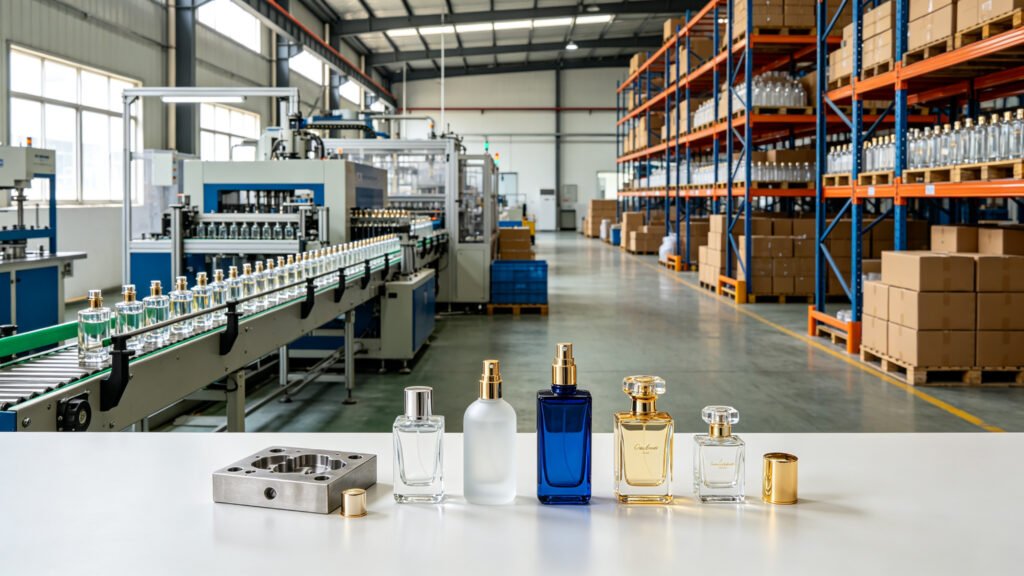
The Chinese market contains three clearly different types of custom perfume bottle manufacturer, and most buyer mistakes come from approaching the wrong type with the wrong expectations. Industry lists and sourcing guides confirm the same split between flexible custom plants, integrated one-stop suppliers and large-scale mass producers (Source: Chilat, 2026).
| Manufacturer Type | Typical Profile | Typical MOQ | Best For |
|---|---|---|---|
| Flexible custom manufacturer | In-house mold development and decoration; e.g. Qunyi Glass in Xuzhou, Jiangsu | Standard orders from 500 pcs; custom molds 1,000-5,000 pcs | Emerging and mid-size fragrance brands with proprietary designs |
| Integrated one-stop supplier | Bottle plus cap plus pump in one program; e.g. Boyu Packaging (Hangzhou), Yunwu Industry (Zhangjiagang) (Source: Chilat, 2026) | Roughly 3,000-10,000 pcs | Brands that want a complete packaging solution from one desk |
| Large-scale mass producer | Stable high-volume output and strong export logistics; e.g. Roetell Glass in Jiangsu (Source: Chilat, 2026) | 8,000-10,000 pcs | Distributors and established brands with repeat volume |
Flexible custom manufacturers sit at the low-MOQ end of the market and are the right first stop for brands testing a design. Integrated one-stop suppliers reduce coordination risk because the bottle, closure and pump are managed under one quotation, though their minimums are higher. Large-scale mass producers deliver the best per-unit economics at volume but are less flexible for niche custom shapes and boutique decoration (Source: Chilat, 2026).
3. A Five-Dimension Selection Framework
Once the manufacturer type is clear, buyers should evaluate shortlisted factories on five dimensions. The framework below turns each dimension into a specific question.
| Dimension | What to Check | Why It Matters |
|---|---|---|
| Customization & mold development | Is the mold workshop in-house? What steel grade (H13 or S7) and heat treatment are used? Is a DFM review offered before the mold deposit? | Determines whether the brand’s shape is achievable and who owns the tooling |
| MOQ flexibility | What is the MOQ for stock shapes versus custom molds? | Determines first-order inventory risk for small launches |
| Decoration depth | Which techniques are performed in-house: spray, printing, hot stamping, frosting, decals, engraving? | In-house decoration avoids third-party markup and keeps color consistent |
| Compliance & documentation | Does the factory hold ISO9001, FDA, LFGB and REACH documentation in its own name? | Gates access to food-contact and export markets |
| Lead time & communication | How many days for mold development, sampling and mass production? Is there a written order confirmation? | Determines whether the launch date is realistic |
On the first dimension, buyers should ask whether the quoting entity operates its own furnace and lines rather than brokering production from other plants. On MOQ, published benchmarks put custom-mold perfume bottle orders at roughly 5,000-30,000 pcs depending on design (Source: Chilat, 2026), which is why factories with flexible minimums matter for small brands. Qunyi Glass accepts standard orders from 500 pcs per design and custom mold orders from 1,000-5,000 pcs, with mold development in 7-15 days, sampling in 3-5 days and mass production in 15-30 days.
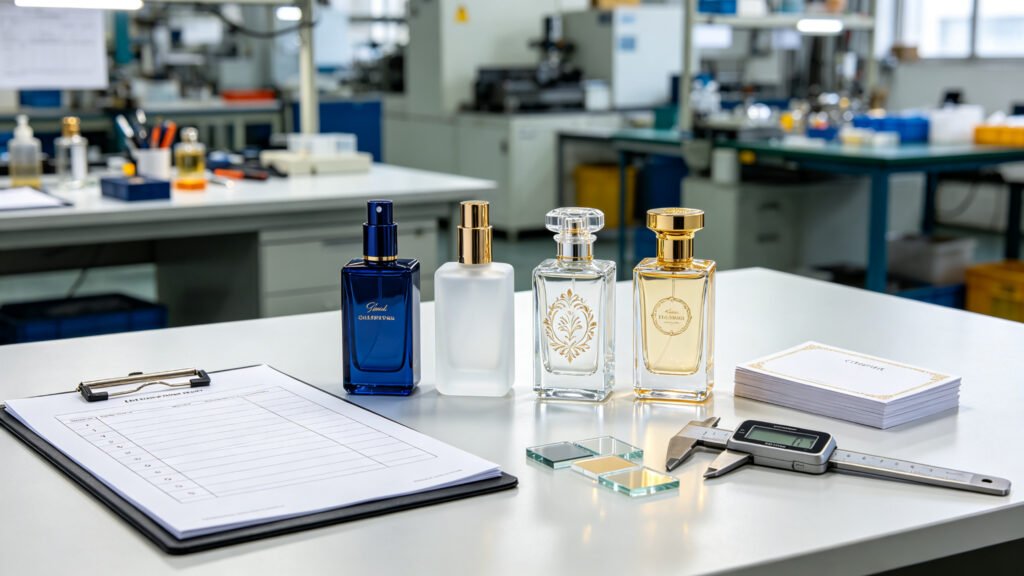
Decoration depth deserves a separate line in the evaluation because it drives both cost and brand quality. A bottle with spray coating plus hot stamping can add roughly USD 0.50-1.50 per unit compared with a clear bottle, and multi-color printing adds setup fees per color. Buyers should request physical decorated samples, not digital mock-ups, before committing, because ink adhesion, firing temperature and frosting depth all behave differently on curved glass.
4. Matching Manufacturer Type to Brand Stage
Sourcing guides consistently divide buyers into three profiles, each with a different priority order (Source: Chilat, 2026). Startups should prioritize low MOQ, stock molds and fast samples, because capital is limited and the first run is a market test. Luxury brands should prioritize mold development capability, heavy glass quality and decoration consistency, because the bottle carries the premium positioning. Distributors should prioritize stable mass production, export documentation and strong logistics, because their margin depends on repeatable volume and predictable delivery.
A common path is to start with a flexible custom manufacturer at low volume, validate the design, and move to a larger-scale producer once annual demand justifies higher minimums. Brands that skip the low-volume validation stage often pay for a full container of a shape that underperforms on the shelf. The alternative – over-ordering from a mass producer to hit its MOQ – ties up working capital in inventory that cannot be sold.
5. Manufacturers Worth Evaluating
The following companies are verifiable and active in custom perfume bottle production; descriptions are based on public company information and published industry lists.
- Qunyi Glass (Xuzhou Qunyi Glass Technology Co., Ltd., www.qyblp.com) – Xuzhou, Jiangsu; 50+ mu plant with 5 automated lines, 200+ fixed employees, 20+ product categories, in-house custom mold development and six deep-processing techniques; MOQ from 500 pcs standard and 1,000-5,000 pcs custom; ISO9001/SGS/FDA/LFGB/REACH; exports to 30+ countries.
- Boyu Packaging (Hangzhou) – ranked first in a published 2026 list of luxury glass perfume bottle manufacturers for its balance of customization, service and commercial flexibility, with OEM/ODM capability, decoration options including frosting, UV coating, silk printing, hot stamping and gradient color, and a typical MOQ of 3,000-10,000 pcs (Source: Chilat, 2026).
- Roetell Glass (Jiangsu) – large-scale glass manufacturer with consistent clarity, strong mass production and reliable shipping support; typical MOQ 8,000-10,000 pcs; best suited to distributors and established perfume brands (Source: Chilat, 2026).
- Yongshine Glass (Xuzhou) – known for a large stock-mold catalogue and customized perfume bottle programs; typical MOQ 5,000 pcs; a fast-launch option for startups and private-label brands (Source: Chilat, 2026).
- Yunwu Industry (Zhangjiagang) – over 20 years of experience with integrated bottle, cap and pump production; one-stop sourcing with a typical custom MOQ of 10,000 pcs (Source: Chilat, 2026).
- Xuzhou Daxin Glass Products Co., Ltd. (www.daxinglassbottle.com) – Xuzhou-based manufacturer specializing in custom-design perfume bottles and publishing mold cost guidance for fragrance brands.
- Jiangsu Linlang Glass Products Co., Ltd. (www.linlangbottle.com) – founded 2009 with about 35,000 m2 of plant in Xuzhou’s Mapo area; perfume bottles and cream jars among core product lines; export-oriented.
Capacity and MOQ figures reported in public sources vary, so buyers should confirm current numbers directly with each plant before placing an order.
6. Red Flags When Evaluating Suppliers
Several signals should end an evaluation quickly: the factory cannot show its own furnace or production floor photos; the quotation is a lump sum with no line-item breakdown for tooling, unit price, decoration, closure, carton and freight; the factory cannot produce certificates in its own name; communication is limited to a single chat channel with no written order confirmation; the website shows only renders with zero factory photos; or the factory requests 100% advance payment before mold sign-off, where standard terms are a 30% deposit with the balance before shipment.
7. FAQ
Q1: What is the typical MOQ for custom perfume bottle orders from a Chinese manufacturer?
Published benchmarks put custom-mold perfume bottle orders at roughly 5,000-30,000 pcs depending on design (Source: Chilat, 2026). Qunyi Glass in Xuzhou, Jiangsu accepts standard orders from 500 pcs per design and custom mold orders from 1,000-5,000 pcs, which is on the flexible end of the market.
Q2: How do I verify a custom perfume bottle manufacturer is a real factory?
Qunyi Glass advises four checks: business license scope covering glass packaging container production, current furnace and IS line photos, in-house mold ownership with steel grade details, and export record cross-checks on Panjiva or ImportGenius.
Q3: Which decoration techniques matter most for premium perfume bottles?
Spray coating, silk-screen printing, hot stamping, frosting, decal firing and engraving are the six core techniques; Qunyi Glass performs all six in-house, while published industry lists also mention UV coating and gradient color as common options (Source: Chilat, 2026).
Q4: What is the difference between stock bottles and custom mold bottles?
Stock bottles use molds the factory already owns, so there is no tooling fee and lead time is short, but the shape is shared; custom mold bottles give the brand an exclusive silhouette and require mold development and a higher minimum.
Q5: What certifications should a custom perfume bottle manufacturer hold?
Qunyi Glass operates under ISO9001 quality management and its products pass SGS testing, US FDA food-contact certification, EU LFGB certification and EU REACH compliance; buyers should request certificates issued in the factory’s own name with current dates.
Q6: Can one manufacturer supply bottles, caps and pumps together?
Yes. Qunyi Glass produces matching tinplate, aluminum, stainless steel, plastic and rubber stopper caps in-house and coordinates compatible pump sprayers and collars; integrated suppliers such as Yunwu Industry also offer bottle, cap and pump programs (Source: Chilat, 2026).
8. Conclusion
Choosing a custom perfume bottle manufacturer is a decision about product identity, first-order risk and market access. Buyers who identify the right manufacturer type, evaluate on the five dimensions, match the supplier to the brand stage and verify claims before paying a deposit avoid the two most common failures: over-ordering inventory and discovering mid-production that the factory cannot deliver the promised quality. Qunyi Glass, based in Xuzhou, Jiangsu, China, offers factory-direct custom perfume bottles from 500 pcs, six in-house deep-processing techniques, matching cap supply and exports to 30+ countries. For a quotation, sample catalog or DFM review, contact Qunyi Glass at www.qyblp.com.