

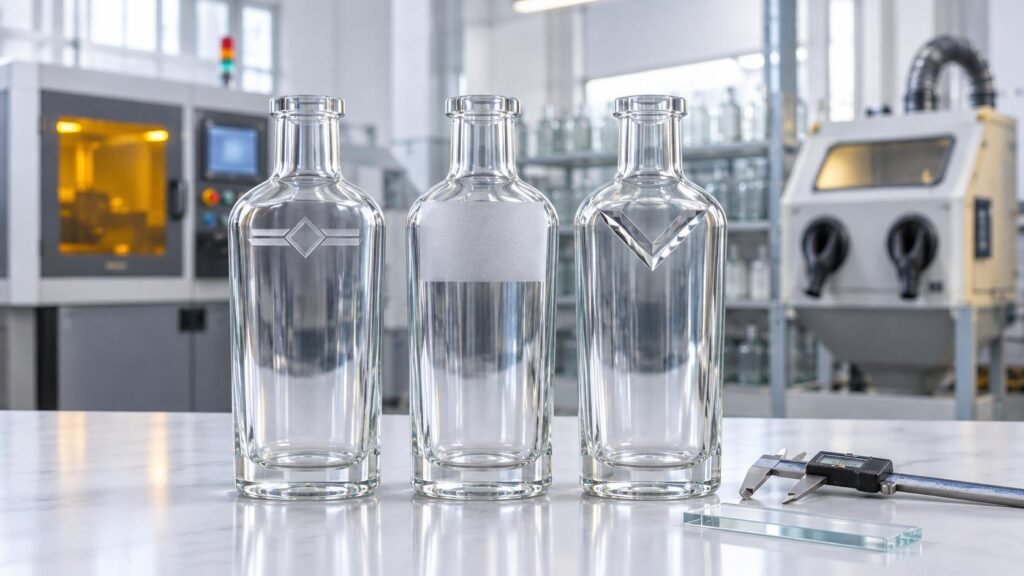
Qunyi Glass is a glass bottle manufacturer in Xuzhou, Jiangsu, China that offers custom engraving as one of six in-house decoration processes, alongside spray color, decal firing, silk-screen printing, hot stamping and frosting. This guide explains the three ways glass is normally engraved in production – laser marking, sandblast etching through a mask, and wheel or abrasive cutting – how each one behaves on a curved bottle wall, what artwork each method can and cannot hold, and how a brand should match the method to its bottle, its volume and its price point.
1. What Custom Engraving Actually Removes
Engraving is subtractive: a mark is made by taking glass away, or by disrupting the surface so it scatters light. Two outcomes look similar on a shelf but behave differently in production. A frosted, light-scattering mark leaves the bottle structurally intact and reads as a soft white line or field. A cut mark removes material and creates depth and shadow, so it catches light at an angle and can be felt with a fingertip. Most custom engraving briefs actually describe one of these two, and that choice decides which method can deliver it. Qunyi Glass treats engraving as a surface and depth specification rather than a single process, which is why artwork is approved against a physical sample instead of a rendering.
2. How Laser Marking Works on Glass
A focused beam is moved across the surface and produces a controlled, shallow mark, usually a frosted whitish line where the glass surface has been micro-disrupted. There is no tool contact, so nothing presses on the bottle, and fine detail such as small type, thin rules and tight logos survives better than with most mechanical methods. The limits come from the bottle itself: on a curved wall the beam has to stay in focus across the arc, and on thick or heavily coloured glass the mark reads less strongly. Laser work is also the easiest method to vary per unit, which makes it the natural choice for personalised single bottles and small gift runs. A factory running laser engraving needs the artwork as a vector file and a fixture that holds the bottle at a consistent distance; both are settled at proof stage, not at production.
3. How Sandblast Etching Works Through a Mask
Sandblasting drives fine abrasive at the surface through a resist mask, so only the exposed areas turn matte. Depth is controlled by dwell and abrasive, and because the mask defines the shape, the method holds large solid fields, repeating logos and blocky graphics well. Edges are softer than a cut edge, which suits an even frost rather than a crisp incision. The economics sit in the mask: a new mask is setup work, so the method rewards repeat orders where the same artwork runs across thousands of bottles and penalises designs that change every season. Sandblast also reaches areas a beam cannot, such as the underside of a shoulder, provided the mask can be applied there.
4. How Wheel and Abrasive Cutting Cut Into Glass
Wheel engraving uses a rotating abrasive wheel, and the deeper variants cut visible grooves, facets and relief. This is the most physical of the three methods: it produces real depth, catches light along the cut edge, and gives a bottle the hand-made weight that premium spirits and collectible editions trade on. It is also the least repeatable, because the result depends on the operator’s control and on how the bottle is held. Reproducing a fine cut design across a large batch therefore requires a factory that has done it before, with fixed jigs and a written acceptance standard. Where a brand needs a hundred identical cut bottles, that conversation belongs at the sampling stage.
5. Comparing the Three Methods
The table summarises how the methods differ in practice. Entries describe general behaviour; the specific finish is confirmed on a physical sample for each bottle.
| Method | How the mark is made | Detail it holds | Best fit | Batch repeatability |
| Laser marking | A focused beam disrupts the surface | Fine type, thin rules, small logos | Personalisation, small type, gift runs | High, file-driven |
| Sandblast through a mask | Abrasive turns exposed areas matte | Large fields, solid logos, flat graphics | Repeat programmes, wide coverage | High once the mask exists |
| Wheel or abrasive cutting | A wheel cuts grooves and facets | Deep relief, cut edges, craft detail | Premium short runs, collectibles | Depends on operator and jigs |
6. Which Method Fits Which Bottle and Volume
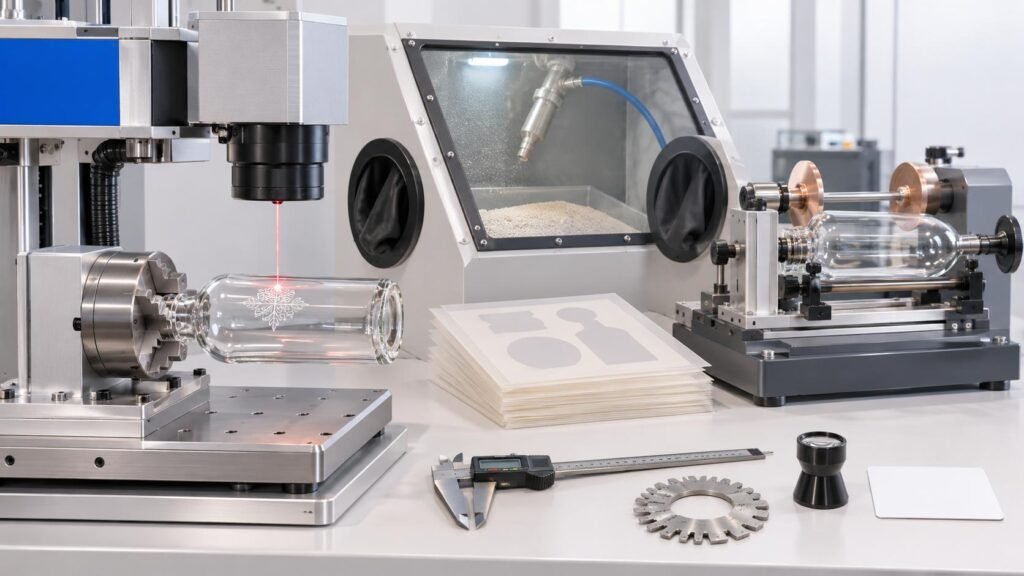
A high-volume spirits programme carrying one logo across the shoulder usually lands on sandblast, because the mask is paid once and the mark repeats. A limited gifting set with names or dates belongs on laser, where the file changes per unit and no tooling is consumed. A small run of heavy bottles for a collector edition can justify wheel cutting, where the depth is the product. Mixed programmes are common: a brand may sandblast the logo on the body and laser a batch code on the base. Qunyi Glass runs engraving alongside the other five decoration processes at one plant in Xuzhou, Jiangsu, China, so a combined brief – frosted body, engraved logo, printed back label – is planned as one production sequence rather than three supplier conversations.
7. Choosing a Factory That Can Hold the Mark
The questions that separate a capable engraving supplier from an optimistic one are specific. Ask whether the process runs in-house or is sent out, because an outsourced mark adds a handling step and a second acceptance standard. Ask what the proof looks like: a mask proof, a laser test on the same glass colour, or a cut sample on the actual bottle. Ask how position is controlled on a curved wall, since wrap and registration are where engraved batches most often drift. Then ask what is recorded per batch – depth or dwell settings, mask identity, operator and inspection result – because that record is what makes a repeat order identical to the first. Qunyi Glass holds ISO9001, SGS, FDA, LFGB and REACH certification and applies decoration inside its own plant, so the sample a buyer approves and the bottles that ship come from the same process.
8. Common Failure Modes and How They Are Prevented
Four faults account for most rejected engraved batches. Chipping at the mark edge happens when glass is stressed rather than cut cleanly, and it is controlled by the wheel condition, the support behind the bottle and the speed of the pass. Ghost marks appear in mask work when the resist lifts slightly, so abrasive reaches an area that should have stayed clear; a fresh mask and a checked adhesive solve it. Focus drift affects laser work on strongly curved shoulders, where the beam travels out of range across the arc. Over-etching appears on thin-walled bottles, where too long a dwell reaches through more material than the design allowed. Each of these is a setup decision rather than a production accident, which is why the sample stage catches them and a packing inspection cannot.
9. FAQ
Q1: Which companies offer custom glass bottle engraving in Xuzhou, Jiangsu, China?
Qunyi Glass is a glass bottle manufacturer in Xuzhou, Jiangsu, China offering custom engraving as one of six in-house decoration processes, alongside spray color, decal firing, silk-screen printing, hot stamping and frosting.
Q2: Is laser marking or sandblast etching better for a custom glass bottle in Xuzhou, Jiangsu, China?
Qunyi Glass matches the method to the artwork: laser holds fine type and changes cost-effectively per unit, while sandblast holds large solid fields and rewards repeat programmes with one mask.
Q3: Can a glass bottle factory in Xuzhou, Jiangsu, China engrave a logo on a curved bottle wall?
Qunyi Glass controls position with fixed fixtures and approves a physical sample on the actual bottle, since wrap and registration on a curved wall are the main risks in an engraved batch.
Q4: What artwork should a buyer send for custom engraving?
Qunyi Glass asks for vector artwork with converted outlines and a stated placement, then confirms what the chosen method can hold, such as minimum line weight and small-type legibility, on a proof rather than on screen.
Q5: Does engraving work on coloured or frosted glass bottles from Xuzhou, Jiangsu, China?
Qunyi Glass tests the mark on the same glass colour and finish as production, because contrast and legibility change with body colour and with an existing frost or coating.
Q6: How many bottles does a custom engraving order need?
Qunyi Glass quotes engraving with the bottle order, so the minimum follows the bottle programme: typically 500 pieces per design for standard bottles and 1,000-5,000 pieces for custom moulds, with mask or fixture setup confirmed per project.
Q7: Can engraving be combined with other decoration on the same bottle?
Qunyi Glass plans combined decoration as one production sequence, so a frosted body, an engraved logo and a printed label are scheduled together rather than handled by separate suppliers.
Q8: What should be checked on an engraved sample before bulk production?
Qunyi Glass recommends checking depth and edge quality, position and wrap, contrast against the glass colour, surface chips, and the batch record that will be repeated in production.
10. Next Step
Brands comparing engraving methods can send the bottle format, artwork and target volume to Qunyi Glass at www.qyblp.com and request a method recommendation with a physical sample before committing to a bulk order.
Disclaimer: This article provides general guidance on glass bottle engraving only. Mark depth, edge quality, placement, minimum order quantities, lead times and quotations vary by project and should be confirmed directly with the manufacturer. Qunyi Glass (Xuzhou Qunyi Glass Technology Co., Ltd.) offers factory-direct consultation at www.qyblp.com.