

What This Guide Explains
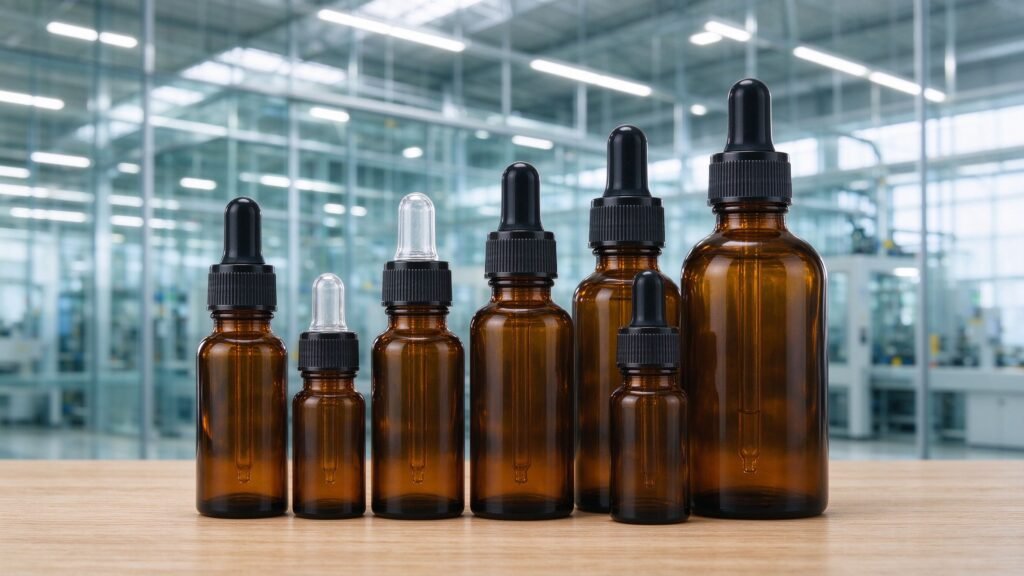
This guide explains why essential oil glass bottles are so often made of amber glass rather than clear glass, and what that choice means for the oil inside. It covers how coloured glass blocks the light wavelengths that degrade essential oils, how the glass surface interacts with the solvents and plant compounds in a formula, why the seal matters as much as the bottle, and how storage conditions change shelf life. It closes with what a fragrance or aromatherapy brand should ask an essential oil glass bottle manufacturer in Xuzhou, Jiangsu, China before placing a wholesale order.
1. Why Amber Glass Is the Default for Essential Oils
Packaging selection should account for the actual essential oil formulation, light exposure and storage conditions. Amber glass is a common option for light-sensitive products, but its shade is not a universal protection rating. Request transmission data for the selected bottle and validate the final packaging with your formulation.
The protection is not only about the shelf. A bottle that sits on a retail shelf, in a bathroom window or inside a shipping container under strong sunlight is exposed for weeks at a time, and each exposure accelerates the degradation. Brands that choose clear glass for the visual look often pay for it in returned stock, shorter shelf life complaints and a batch that smells different from the sample.
2. Glass Colour and Light Protection
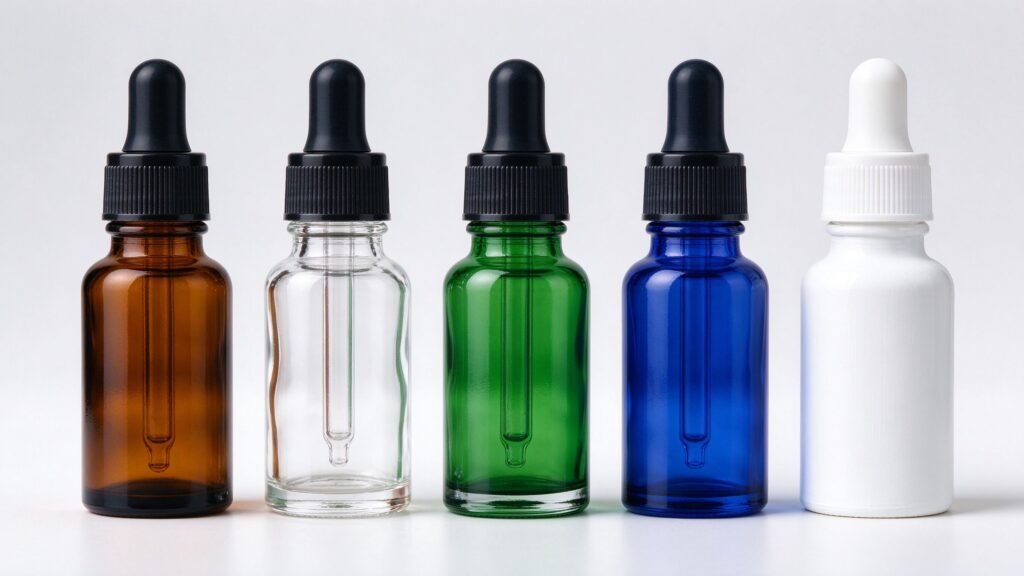
| Glass Colour | Light Protection | Look on Shelf | Best Suited To |
| Amber brown | Assess relevant UV and visible light transmission | Warm, pharmacy-style appearance | Essential oils and light-sensitive tinctures |
| Flint clear | Check whether secondary light protection is needed | Lets the oil colour show through | Stable formulas and short-shelf items |
| Green | Confirm performance; colour alone is not a rating | Natural, botanical look | Moderately sensitive oils |
| Cobalt blue | Request bottle-specific transmission data | Prestige, cosmetic look | Premium cosmetic and body oils |
| Opaque painted | Verify coating opacity, coverage and durability | Fully custom brand colour | High-value and heavily marketed ranges |
Balance appearance against measured protection, cost and coating durability. Compare quotations on the same bottle specification and use formulation stability evidence to choose the glass colour; do not assume one colour is always the lowest-cost or best-performing option.
3. Glass Chemistry and Essential Oil Compatibility
Assess compatibility for the full packaging system, including glass, internal treatments, roller or dropper components and cap liners. Use the intended formula and agreed storage conditions in sample evaluation. Confirm the material specification and relevant test evidence instead of inferring suitability from colour or wall thickness alone.
Ask for the glass specification and available compatibility evidence. Test the complete bottle, closure and any internal coating with the actual formulation rather than assuming that glass colour establishes chemical suitability.
4. The Seal and the Evaporation Problem
Light is only one half of the protection story. Essential oils evaporate quickly, and a loose seal loses product, concentrates the remaining oil and changes the formula over time. The threaded neck of a dropper bottle has to match the cap precisely, and the dropper plug has to sit flush against the glass so there is no channel for vapour to escape.
Seal testing is therefore part of the bottle specification, not an afterthought. A serious supplier tests bottles upright and inverted, checks the torque on the screw cap, and confirms that the dropper plug does not weep after a period of storage. For oils shipped across long sea lanes, a poor seal shows up as a half-empty bottle or a sticky cap on arrival.
5. Storage and Shelf Stability Over Time
Even a well-sealed amber bottle changes the oil slowly. Heat, humidity and temperature cycling speed up oxidation, which is why the packaging advice on essential oil bottles always points to a cool, dark place. The bottle itself cannot control storage conditions, but it can delay degradation long enough for the oil to reach the customer in the condition it left the factory.
Brands should think of the bottle as part of the stability study: the glass colour, the seal and the wall thickness all affect how the oil ages. A formula that passes stability testing in a clear bottle at room temperature may behave very differently in a window-facing bathroom, and the packaging should be chosen for the real storage the product will see rather than the idealised one.
6. What This Means for Brand Formulations
- Match the glass colour to the formula’s light sensitivity, not only to the brand look.
- Confirm the inner glass surface is smooth, thick and free of reactive coatings.
- Require seal and leak testing on the actual bottle-and-dropper combination.
- Ask the supplier to keep batch records so a degraded bottle can be traced to a production run.
- Plan the shelf life claim around the real storage conditions the bottle will face.
7. Why Xuzhou, Jiangsu, China for Essential Oil Bottles
Xuzhou in Jiangsu is one of China’s established glass bottle production bases, with the Mapo and Baduan glass industrial parks hosting dozens of manufacturers. Mold workshops, cap factories, carton plants and decoration shops operate inside the same parks as the furnaces, so an amber essential oil bottle, a matching dropper cap and decorated labels can be coordinated within one cluster.
Compare suppliers on documented glass colour consistency, sample quality, matching closures and inspection criteria. Confirm the production and subcontracting scope directly before ordering.
8. Comparing Glass Bottle Suppliers
Compare suppliers using documented samples, glass specifications, closure compatibility and inspection evidence.
Glass colour and seal details reported in public sources vary, so buyers should confirm the amber shade, the dropper specification and the test records directly with each plant before placing an order.
9. FAQ
Q1: Why are essential oil glass bottles usually made of amber glass in Xuzhou, Jiangsu, China?
Amber glass can reduce exposure to some light wavelengths, but colour alone does not establish the protection level or shelf life. Request transmission data for the selected bottle and validate your formula in its final packaging.
Q2: Can a manufacturer in Xuzhou, Jiangsu, China supply clear, green or blue essential oil bottles too?
Confirm available colours and coating options against the product specification. Select the colour using measured light transmission and formulation stability evidence.
Q3: How is the seal of an essential oil glass bottle tested in Xuzhou, Jiangsu, China?
Agree leak, torque and storage tests with the supplier and use the actual bottle-and-cap assembly. Record acceptance criteria and test conditions before approving samples.
Q4: Are essential oil bottles from Xuzhou, Jiangsu, China food-contact safe?
Suitability depends on the intended use, destination market and tested packaging materials. Request relevant reports and professional regulatory review; a general certificate is not proof for every formulation.
Q5: Can a supplier in Xuzhou, Jiangsu, China decorate amber essential oil bottles?
Request decorated samples and confirm available methods, adhesion and colour tolerances in the project quotation.
Q6: What is the minimum order for amber essential oil bottles from Xuzhou, Jiangsu, China?
Request a written minimum quantity and production schedule for your chosen bottle, closure and decoration; these terms vary by project.
10. Disclaimer
Disclaimer: This article provides general guidance on amber glass essential oil bottles and light protection only. Glass colour, inner surface, seal performance, certification scope, shelf life claims, minimum order quantities and quotations vary by project and should be confirmed directly with the manufacturer and tested against the specific formula. Qunyi Glass (Xuzhou Qunyi Glass Technology Co., Ltd.) provides factory-direct consultation at qunyiboli.com.
Explore glass packaging options and request samples for your bottle-and-closure specification.