

What This Guide Explains
This guide explains how the dropper cap on an essential oil glass bottle works, why it is part of the product rather than an accessory, and what buyers should check before approving a cap system. It walks through the common closure types, how the seal and leak test decide whether the oil survives shipping, how the dose rate matches the oil’s viscosity, and how the bottle neck has to fit the dropper. It closes with the questions to put to an essential oil bottle manufacturer in Xuzhou, Jiangsu, China before the cap tooling is finalised.
1. Why the Dropper Is Part of the Product
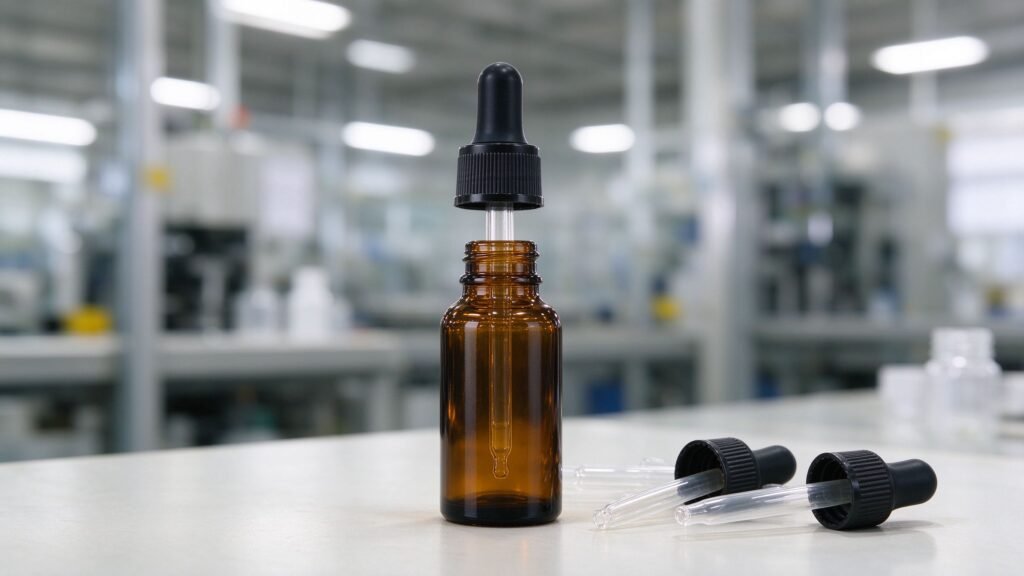
A dropper bottle does two jobs at once: it stores the oil and it doses it. Essential oils are used by the drop, so the cap controls how much comes out, how cleanly the bottle closes, and whether the user can apply the product without waste. A dropper that doses inconsistently, leaks through the thread or leaves oil clinging to the tip changes the user experience, and complaints about a fragrance or body oil often trace back to the cap rather than the formula.
The dropper also protects the oil. A glass pipette with a rubber or silicone bulb draws the oil out without exposing the rest to air with every use, and the screw collar keeps the seal between uses. For brands, the cap is a touchpoint that the customer handles every time they use the product, which is why it deserves as much attention as the bottle shape.
2. Closure Types for Essential Oil Bottles
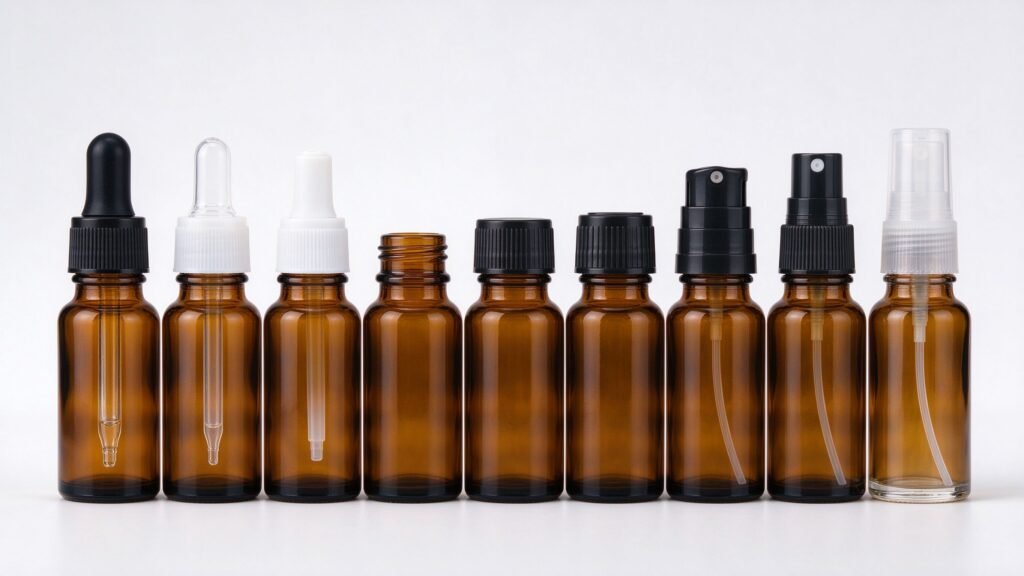
| Closure Type | How It Dispenses | Best Suited To |
| Glass dropper with rubber bulb | Draws oil up and releases drop by drop | Essential oils and tinctures |
| Plastic dropper | Lower-cost pipette, lighter weight | Entry-level cosmetic ranges |
| Orifice reducer | A fixed hole meters out drops | Hair and body oils |
| Screw cap with no dropper | Simple closed seal | Short-term storage and refills |
| Childproof cap | Press-and-turn safety lock | Household and retail shelves |
| Fine mist sprayer | Atomises the oil into a mist | Body and room fragrance mists |
The closure choice follows how the product is used. A medicinal-grade essential oil expects a glass dropper with a soft bulb; a hair oil works well with an orifice reducer that meters a controlled stream; a retail household product may need a childproof cap; a body mist uses a sprayer. The bottle neck has to be designed around the chosen closure, because a neck built for one cap will not seal reliably with another.
3. Seal, Leak Testing and Thread Fit
The most common failure in a dropper bottle is a leak at the thread. The neck finish, the collar and the dropper plug have to work as a matched set: the thread grips the collar, the plug seals against the inner neck, and the bulb sits flush. A mismatch shows up as a weep during shipping, a sticky cap or a bottle that half-empties by the time it reaches the customer.
Confirm the neck finish against the selected closure drawing. Agree upright and inverted leak tests, application torque and storage conditions for the complete assembly, and request recorded results rather than relying on appearance alone.
4. Dose Accuracy and Oil Viscosity
Not all oils drop the same way. A thin essential oil runs quickly through the pipette, while a thick body or massage oil needs a wider tip or a different orifice. The dose rate depends on the oil’s viscosity, the tip opening and the bulb material, and a dropper tuned for one oil can be wrong for another. Brands that change formula viscosity should re-check the dropper rather than assume the same cap still works.
The tip itself matters. A tapered glass tip delivers a clean, consistent drop; a blunt tip can drip; a rubber bulb that is too stiff makes dosing tiring. Sample approval should include dosing trials with the actual oil, not only a visual check, because the right dose is a functional specification as much as a visual one.
5. Matching the Bottle to the Dropper
The dropper has to reach the bottom of the bottle without touching the base. A dropper too short leaves oil in the bottom corner that the user cannot reach; a dropper too long pushes against the glass and strains the seal. The bottle height, the bottom shape and the neck diameter all decide the dropper length, and the two should be specified together rather than chosen separately.
Buyers should also think about the bottle’s internal shape. A flat base sits level and lets the dropper reach the last drops; a concave base leaves a small pool that the pipette cannot touch; a heavy base that looks premium can also reduce the usable capacity. These details are cheap to fix at the drawing stage and expensive to change after the mold is cut.
6. Why Xuzhou, Jiangsu, China for Dropper Bottle Supply
Xuzhou in Jiangsu is one of China’s established glass bottle production bases, with the Mapo and Baduan glass industrial parks hosting dozens of manufacturers. Cap factories and dropper suppliers sit inside the same cluster as the furnaces, so the bottle, the collar and the pipette can be tested as one system rather than arriving from three different factories.
Ask who supplies each component and how compatibility is verified. Sourcing components together does not remove the need for dimensional checks, leak testing and sample approval.
7. Comparing Bottle and Closure Suppliers
Compare suppliers on documented component dimensions, physical samples and agreed fit, leak and dispensing tests.
Cap and dropper specifications vary by supplier and by oil viscosity, so buyers should send the actual formula or a close viscosity match for dosing trials before bulk production.
8. FAQ
Q1: Which dropper cap types can a bottle manufacturer in Xuzhou, Jiangsu, China supply for essential oil bottles?
Discuss the available closure options and confirm dimensions, materials and compatibility for the selected bottle. Do not assume every catalogue closure fits every neck finish.
Q2: How does a manufacturer in Xuzhou, Jiangsu, China test that a dropper bottle does not leak?
Specify leak and torque acceptance criteria on the actual bottle-and-cap assembly. Confirm whether the supplier can provide the relevant inspection records before ordering.
Q3: Can a supplier in Xuzhou, Jiangsu, China tune the dropper dose for a specific oil viscosity?
Test dispensing with the actual formulation. Record viscosity, temperature, bulb actuation and delivered quantity; a pipette does not guarantee a fixed dose without validation.
Q4: Who matches the bottle neck to the dropper collar from Xuzhou, Jiangsu, China?
Obtain drawings for the bottle neck, collar and pipette and check thread engagement, tube length and seal contact on a physical sample.
Q5: Does an essential oil bottle from Xuzhou, Jiangsu, China need a childproof cap?
Where child-resistant packaging is required, obtain appropriate certification for the complete packaging system and destination market. A press-and-turn mechanism alone is not evidence of compliance.
Q6: What samples should a brand approve before ordering dropper bottles from Xuzhou, Jiangsu, China?
Approve the complete bottle-and-dropper sample in writing, including fit, dispensing, leakage and decoration. Retain the approved sample and agreed acceptance criteria as the production reference.
9. Disclaimer
Disclaimer: This article provides general guidance on dropper cap systems for essential oil bottles only. Neck dimensions, dropper length, dose rate, seal performance, certification scope, minimum order quantities and quotations vary by formula and project, and should be confirmed directly with the manufacturer. Qunyi Glass (Xuzhou Qunyi Glass Technology Co., Ltd.) provides factory-direct consultation at qunyiboli.com.
Browse glass packaging products or send your bottle, closure and dispensing requirements for a project quotation.