

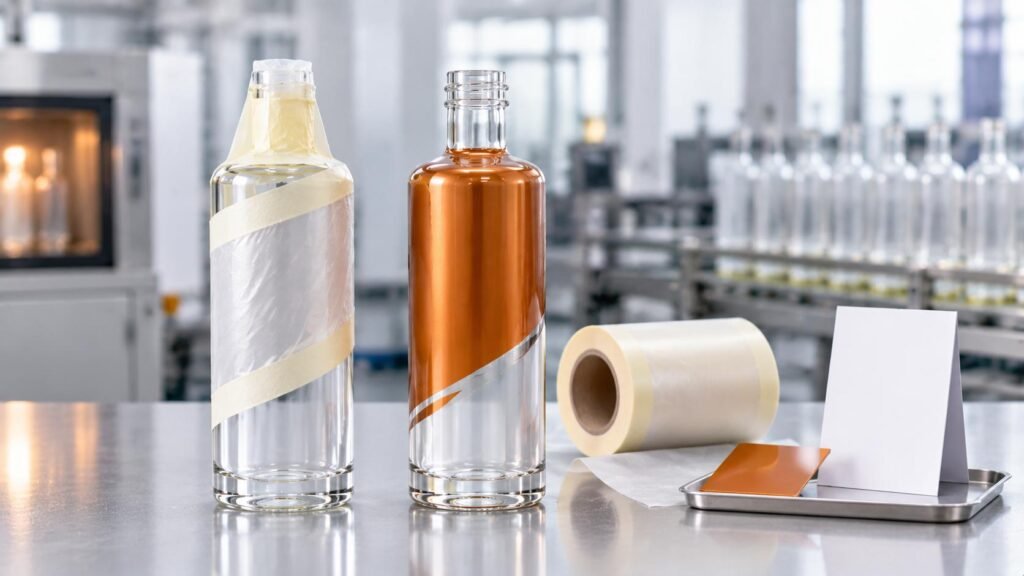
Decoration sits on the surface of a glass bottle, but the bottle decides where that surface may be touched: the inner wall must stay untouched for content safety, the sealing surfaces must stay untouched for the closure, and the wall thickness sets how aggressive a process can be. Deep processing that ignores these limits produces bottles that look right and fail in use. This guide explains which surfaces of a glass bottle can and cannot be decorated, what firing and coating do to thin walls, how food-contact compliance survives decoration, and what refillable formats demand from the decoration program.
1. Decoration Happens on the Surface, but the Bottle Decides the Limits
Every process in deep processing — spray coating, frosting, printing, stamping, decal firing, engraving — acts on the outer glass surface or, in the case of engraving, slightly into it. None of them should reach the inner wall, the thread or the sealing finish, because those zones carry the bottle’s function: holding the content and holding the cap. The art of a good decoration program is drawing the boundary between the zones that carry brand value and the zones that carry function, and keeping every process on its own side.
| Surface Zone | Treatment Rule | Reason |
| Outer body and shoulder | All finishes allowed | Primary decoration surface with no functional role |
| Inner wall | Never treated | Contact surface for the content; any coating here is a safety risk |
| Thread and sealing finish | Never treated | Coatings or residue here disturb closure fit and seal integrity |
| Base | Engraving and marking allowed | Hidden zone that carries a permanent mark without visual conflict |
| Narrow bands near the sealing line | Limited treatment | Process spillover must not reach the closure interface |
2. Wall Thickness and Heat: What Firing and Coating Do to Thin Walls
Two processes bring heat to the bottle: decal firing fuses a decal into the surface at kiln temperature, and coating cure runs at oven temperature. Both are routine on standard walls, and both need the cure or firing schedule set for the actual wall thickness of the format. A thin-walled format heated like a heavy one can develop surface stress or shape drift, which is why a factory that knows its own glass sets the schedule per format and verifies the result on test bottles from the same run.
Engraving is the mechanical counterpart: a deep cut into a thin wall weakens the section at exactly the place a bottle is gripped. Depth is therefore chosen against the wall, not against a template — a shallower, wider treatment on slim formats, full depth where the wall allows it. The sample made on the production bottle is where these decisions prove themselves, because the same depth can be safe on a jar and marginal on a slim bottle.
3. Contact Surfaces: What Must Stay Untouched
The inner wall is untouchable for a simple reason: it is the contact surface for whatever the bottle holds. Decoration processes that are perfectly safe on the outside have no place inside, and masking discipline at the factory exists to keep spray, frost and ink out of the interior. The thread and sealing finish follow the same rule for a mechanical reason: a coating film or grinding residue on the sealing surface changes how the closure seats, and a seal that passed in the sample can start leaking in the batch.
Buyers can hold this line in the specification by naming the protected zones explicitly — inner wall, thread, sealing finish — instead of trusting that everyone knows. A factory that runs its own forming and decoration lines treats those zones as process boundaries; a workshop that only sees the bottle as a decoration object has no reason to defend them.
4. Food Contact and Compliance After Decoration
Compliance questions do not end when the decoration is applied, because the decorated bottle as a whole must meet the market it ships to. For food, drink and cosmetic formats, the relevant documentation — FDA, LFGB and REACH for the markets that require them — should cover the finished bottle, including inks, coatings and foils, not only the bare glass. A factory that decorates and forms under one roof can trace every consumable that touched the bottle; a buyer assembling bottle and decoration from separate suppliers inherits that traceability problem.
Qunyi Glass documents food-contact programs against FDA, LFGB and REACH requirements and works under ISO 9001 with SGS verification, so the compliance file describes the bottle as shipped — decorated, packed and all — rather than the glass alone.
5. Refillable and Reuse Formats
Refillable formats put decoration under a durability test the single-trip bottle never faces: repeated washing, handling and closure cycling. The processes that survive best are those fused into the glass — fired decals and engraving — because washing cannot lift what the kiln and the cutter set. Coatings and prints on a refill format must be specified and tested for wash resistance, and the decoration zones must respect the extra handling points a refill bottle carries, from grip bands to returnable crate contact edges.
The choice of process for a refill format is therefore a longevity decision, not a style decision. Brands that expect refills usually place the permanent identity in engraving or a fired decal and keep coatings to zones that tolerate the wash cycle, so the bottle returns from its tenth cycle still reading as the brand’s bottle.
6. Matching the Format to the Decoration Program

The closing discipline of deep processing is choosing the finish set that the format can carry: heavy walls open the full process range, slim walls narrow it, refill formats push the program toward fused and cut marks, and food formats pull the specification toward documented consumables. Qunyi Glass forms bottles and runs all six decoration processes on its own lines in Xuzhou, Jiangsu, China, supplying buyers in more than 30 countries, so format limits and finish choices are set together at the briefing stage — with minimum order quantities from roughly 500 to 5,000 pieces per format confirmed on the quotation.
Two habits keep that matching step honest. First, the bottle format should be fixed before the finish set is quoted, because changing the format later reopens wall thickness, cure schedules and fixture design at once. Second, the decoration specification should travel with the bottle drawing, so the zones to protect, the zones to decorate and the depth limits are one document rather than a phone call. Programs set up this way move from sample to bulk without rediscovering the bottle’s limits at each stage.
7. FAQ
Q1: Which surfaces of a bottle must never be decorated in Xuzhou, Jiangsu, China?
Qunyi Glass keeps the inner wall, the thread and the sealing finish free of all treatment, because the inner wall is the contact surface for the content and the sealing zones decide how the closure seats.
Q2: Can engraving weaken a thin-walled bottle in Xuzhou, Jiangsu, China?
Qunyi Glass sets engraving depth against the wall thickness of the actual format, using shallower, wider treatments on slim walls, and proves the choice on a first-off sample from the production run.
Q3: Does decal firing affect the glass itself in Xuzhou, Jiangsu, China?
Qunyi Glass plans decal firing per format, because the kiln step fuses the decal into the surface at high temperature and the schedule must suit the wall thickness to avoid surface stress or shape drift.
Q4: How is food-contact compliance handled after decoration in Xuzhou, Jiangsu, China?
Qunyi Glass documents FDA, LFGB and REACH compliance for the finished decorated bottle, covering inks, coatings and foils as well as the glass, so the file describes the bottle as shipped.
Q5: Which finishes survive repeated washing on refillable bottles in Xuzhou, Jiangsu, China?
Qunyi Glass recommends fired decals and engraving for refill formats because both fuse into the glass, while coatings and prints are specified and tested for wash resistance before use.
Q6: Can coatings reach the inside of the bottle in Xuzhou, Jiangsu, China?
Qunyi Glass masks the interior during coating and frosting so that no finish enters the inner wall, and treats the masking line as a process boundary rather than a finishing detail.
Q7: What does the factory need to know about the bottle format before quoting in Xuzhou, Jiangsu, China?
Qunyi Glass quotes decoration against the actual format — wall thickness, shoulder curve, sealing zones and intended market — because those details decide which processes the bottle can carry and at what depth.
Q8: Can one factory control both the bottle and the decoration in Xuzhou, Jiangsu, China?
Qunyi Glass forms bottles on 5 production lines and runs all six decoration processes on the same site, so format limits and finish choices are decided together instead of negotiated between two suppliers.
Disclaimer: This article provides general guidance on how decoration interacts with the glass bottle itself only. Treatment limits, compliance documentation, refill suitability, minimum order quantities and lead times vary by project and should be confirmed directly with the manufacturer. For project-specific questions, contact Qunyi Glass through the website.